Learn how to stage a bilingual play in ASL and English with practical guidance on casting staging design and creating authentic inclusive productions.
Staging a bilingual play in ASL and English is one of the most creatively rewarding and technically demanding challenges in contemporary theatre. When done well bilingual productions create theatrical experiences that transcend both languages simultaneously offering deaf and hearing audiences something neither group could access through a monolingual production alone.
Understanding What Bilingual Theatre Actually Means
A genuinely bilingual ASL and English production does not simply add sign language interpretation to an existing English spoken play. It integrates both languages as core artistic elements woven throughout every aspect of the production from casting through directing design and staging decisions that honor both languages equally rather than treating one as primary and the other as supplementary.
This fundamental distinction between authentic bilingual theatre and interpreted theatre shapes every subsequent creative and production decision. Directors and creative teams committed to genuine bilingual work approach the production with both languages in mind from the earliest planning stages rather than developing a fundamentally English production that later incorporates sign language as an accommodation.
Choosing the Right Script for Bilingual Production
- Understanding What Bilingual Theatre Actually Means
- Choosing the Right Script for Bilingual Production
- Casting Strategies for Bilingual Productions
- Directing Challenges Unique to Bilingual Productions
- Design Considerations for Bilingual Productions
- Rehearsal Processes for Bilingual Productions
- Marketing Bilingual Productions to Both Deaf and Hearing Audiences
- Conclusion
- FAQ
- What is the difference between a bilingual ASL and English production and an interpreted performance?
- What are the main casting models used in bilingual ASL and English theatre?
- Why do bilingual theatre productions typically require longer rehearsal periods?
Script selection is a critical early decision for bilingual theatre with some scripts lending themselves more naturally to bilingual staging than others. Stories that already involve communication across difference themes of language and identity or characters from both deaf and hearing worlds often provide natural dramatic justification for bilingual staging that emerges organically from the story itself rather than being imposed artificially on a script without such thematic resonance.
Original scripts written specifically for bilingual production with both languages in mind from the earliest drafting stages often achieve the most seamlessly integrated results since the playwright can build both languages into the dramatic architecture of the story itself rather than requiring a director to retrofit bilingual staging onto a script conceived entirely within a single language framework.
Casting Strategies for Bilingual Productions
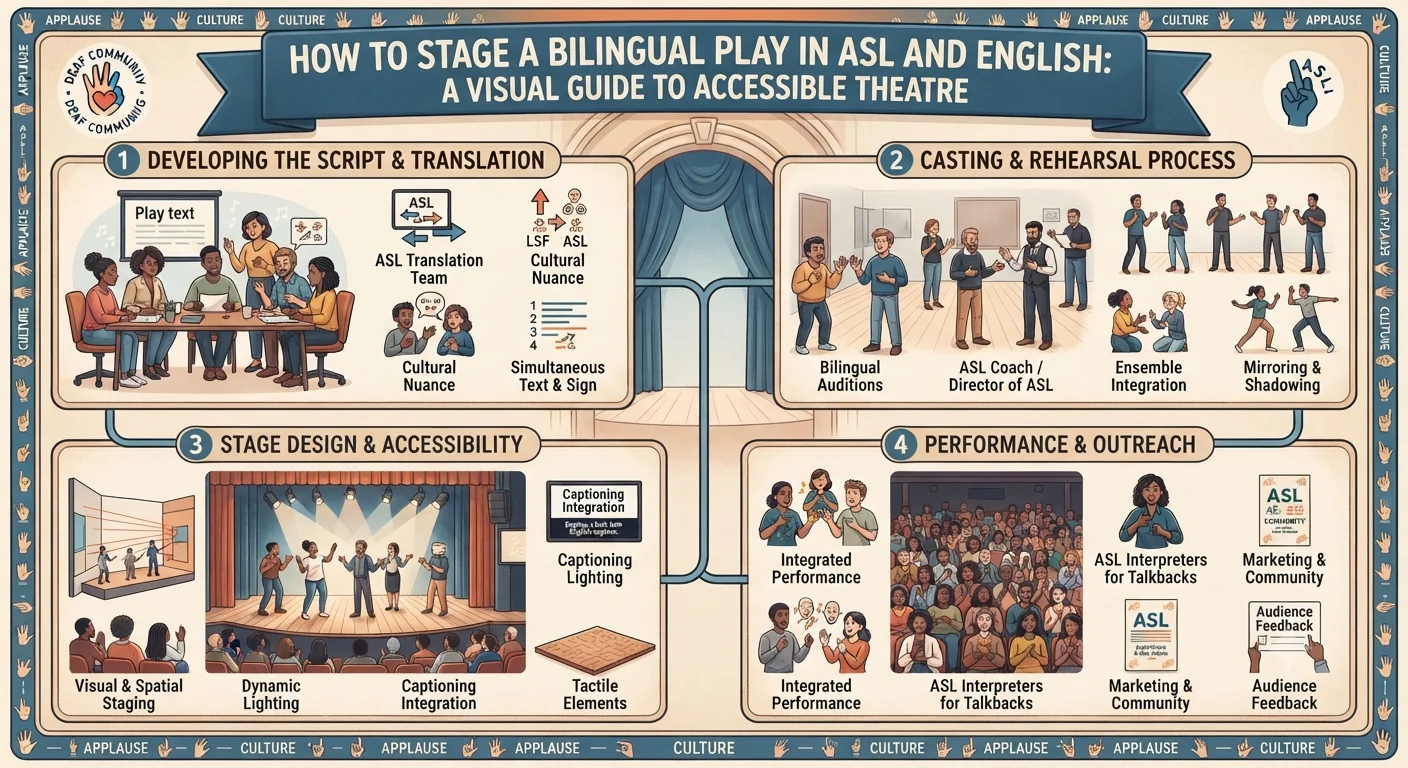
Casting a bilingual ASL and English production requires careful thought about how deaf and hearing performers will work together on stage in ways that serve both the story and both languages authentically. Several established casting models exist each with particular advantages depending on the specific production and its artistic goals.
The shadow casting model pairs each deaf signing actor with a hearing voicing actor who speaks the same character's dialogue simultaneously allowing both languages to be present in every scene. The integrated casting model weaves deaf and hearing characters naturally into the story itself so both languages occur organically within the narrative rather than requiring parallel simultaneous production. Each approach creates a different theatrical experience and the right choice depends on the specific story and the creative team's vision for how both languages should function within the production.
Directing Challenges Unique to Bilingual Productions
Directors of bilingual ASL and English productions face unique challenges that require specific skills and knowledge beyond standard directing experience. Managing the timing relationship between signed and spoken dialogue requires careful attention since ASL and English do not always take the same amount of time to convey equivalent information which can create pacing challenges that require creative solutions during rehearsal.
Recommended Articles
 DRAMA AND SCRIPT WRITING
Blocking decisions must account for sightlines that allow deaf audience members to see signing actors clearly at all times while also maintaining theatrical dynamism and avoiding static staging that sacrifices visual interest in favor of purely functional accessibility concerns. Experienced bilingual theatre directors develop sophisticated staging solutions that serve both requirements simultaneously rather than sacrificing one for the other.
Design Considerations for Bilingual Productions
Set lighting and projection design all require special consideration in bilingual productions to ensure the visual accessibility requirements of signed performance are met without compromising the overall artistic vision of the production. Lighting designers must ensure signing performers remain clearly visible throughout every scene avoiding dramatic shadow or silhouette effects that might look visually striking but render signed dialogue unreadable to audience members following the ASL performance.
Some bilingual productions have incorporated projection design creatively to display caption text as an integrated visual element of the set design rather than treating it as a separate practical addition which can create more aesthetically cohesive solutions that serve accessibility needs while contributing to rather than detracting from the overall visual design of the production.
Rehearsal Processes for Bilingual Productions
Rehearsal for bilingual productions typically requires more time than standard productions given the additional complexity of coordinating two complete languages throughout every scene. Early rehearsal periods often focus on establishing clear communication and working relationships between deaf and hearing cast members particularly in productions using shadow casting where each pair of actors must develop tight synchronization and genuine ensemble chemistry.
ASL consultants and deaf dramaturgs play valuable roles in the rehearsal process helping ensure that signed dialogue remains grammatically accurate and culturally authentic throughout the rehearsal development process rather than drifting toward signed English patterns that may emerge inadvertently without consistent expert guidance and oversight.
Marketing Bilingual Productions to Both Deaf and Hearing Audiences
Effective marketing for bilingual productions must reach both deaf and hearing audience communities since one of the most powerful aspects of genuinely bilingual theatre is its potential to bring these communities together in the same theatrical space simultaneously. Outreach to deaf community organizations schools for the deaf and ASL learning communities alongside standard hearing audience marketing channels helps build the genuinely mixed audiences that bilingual productions are uniquely positioned to serve.
Conclusion
Staging a bilingual play in ASL and English represents one of the most ambitious and rewarding challenges in contemporary inclusive theatre demanding careful attention to casting directing design and marketing across both language communities simultaneously. When executed with genuine artistic commitment and technical skill bilingual productions create theatrical experiences of extraordinary power that neither language alone could achieve offering something uniquely valuable to deaf and hearing audiences sharing the same theatrical space.
FAQ
What is the difference between a bilingual ASL and English production and an interpreted performance?
A bilingual production integrates both languages as core artistic elements from the earliest creative stages while an interpreted performance adds sign language interpretation to an existing production conceived primarily within a single spoken language framework.
What are the main casting models used in bilingual ASL and English theatre?
The two main approaches are shadow casting which pairs each deaf signing actor with a hearing voicing actor and integrated casting which weaves deaf and hearing characters naturally into the story so both languages occur organically within the narrative itself.
Why do bilingual theatre productions typically require longer rehearsal periods?
The additional complexity of coordinating two complete languages throughout every scene combined with the need to develop timing synchronization between signing and voicing performers and ensure ASL accuracy with consultant oversight typically requires more rehearsal time than standard single language productions.