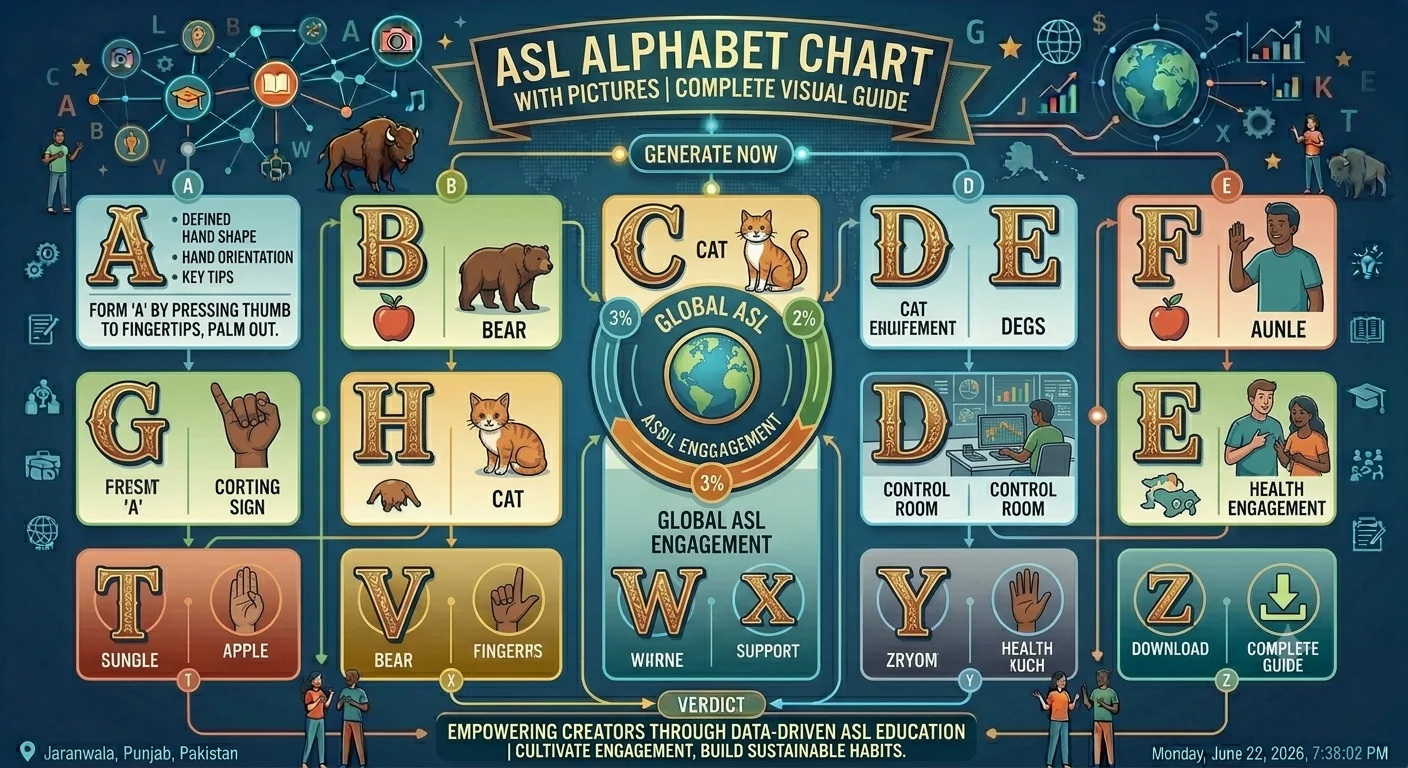
The ASL alphabet also called the manual alphabet is the very first thing every American Sign Language learner should master. It allows you to spell out words names and unfamiliar terms using only your hand. This complete guide walks through every letter handshape along with tips to help you fingerspell clearly and read fingerspelling accurately.
What is the ASL manual alphabet
The ASL manual alphabet consists of 26 distinct handshapes one for each letter of the English alphabet. These handshapes are used to fingerspell words letter by letter rather than using a single sign for an entire word. Fingerspelling is most commonly used for proper nouns names of places brand names and English words that do not yet have an established sign.
Unlike full ASL vocabulary signs which often have movement and use space meaningfully most manual alphabet letters are static handshapes held in a neutral position in front of the body at roughly chest height. A few letters such as J and Z do involve movement to complete the shape correctly.
Letters formed with a closed fist
Several letters in the ASL alphabet begin from a closed fist position. The letter A is formed with a closed fist with the thumb resting alongside the fingers. The letter S is a closed fist with the thumb wrapped across the front of the fingers. The letter E curls all fingers down with the thumb tucked underneath touching the fingertips. The letter M tucks the thumb under three fingers while N tucks the thumb under two fingers.
These closed fist letters can be visually similar to each other for beginners which makes careful practice with a mirror or video feedback especially valuable when first learning them.
Letters formed by extending specific fingers
Many ASL letters are formed by extending one or more specific fingers from a closed hand. The letter D extends only the index finger while the thumb and middle finger touch to form a circle. The letter I extends only the pinky finger from a closed fist. The letter L extends the thumb and index finger to form a clear L shape. The letter Y extends the thumb and pinky finger while the middle fingers stay folded down.
- Sign Language vs Spoken Language Key Differences Explained
- How to Learn ASL at Home for Beginners Step by Step Guide
- What is ASL and How Many People Use It Worldwide
The letter U extends the index and middle fingers together pointing upward while V extends the same two fingers but spread apart in a clear V shape. The letter W extends the index middle and ring fingers spread apart while K is similar to V but with the thumb placed between the index and middle fingers.
Letters that involve movement
Two letters in the manual alphabet require movement rather than a static handshape. The letter J starts in the position for the letter I and then traces a small J shape in the air. The letter Z traces the shape of the letter Z in the air using the index finger.
These two letters often take beginners slightly longer to master smoothly since they require coordinated movement rather than simply holding a shape.
Letters that can be confused by beginners
Certain letter pairs commonly confuse new ASL learners because the handshapes look similar at first glance. M and N are often confused since both involve the thumb tucked beneath folded fingers with only the number of fingers covering the thumb differing. U and V can also be confused since both extend the index and middle fingers with the only difference being how far apart the fingers are spread.
Recommended Articles
 SIGN LANGUAGE EDUCATION
 SIGN LANGUAGE EDUCATION
 SIGN LANGUAGE EDUCATION
 SIGN LANGUAGE EDUCATION
P and Q are also frequently mixed up since both use a similar handshape to K and D respectively but oriented downward rather than upward. Practicing these specific letter pairs side by side can help beginners build the muscle memory needed to distinguish them quickly.
Tips for fingerspelling clearly
Keep your hand at a consistent height roughly at chest level and avoid letting your hand drift downward as you spell through a longer word. Maintain a steady rhythm rather than rushing through letters since consistent pacing makes fingerspelling significantly easier for others to read.
Avoid bouncing your hand between each letter. Many beginners add unnecessary movement between letters which can make fingerspelling harder to follow. The transition between letters should be smooth and minimal rather than exaggerated.
Tips for reading other people's fingerspelling
Reading fingerspelling is often more challenging for beginners than producing it themselves. Rather than trying to identify each letter individually as it appears focus on recognizing the overall shape and rhythm of common words as a whole pattern. This skill develops naturally with exposure and practice over time.
Watching native signers fingerspell at full conversational speed even if you cannot follow every letter at first will help train your eye to recognize patterns faster than only practicing with slowed down beginner content.
When to use fingerspelling versus signs
Fingerspelling should generally be reserved for proper nouns words without an established sign or occasionally for emphasis or clarification. Relying on fingerspelling too heavily instead of learning proper ASL vocabulary signs is a common mistake among beginners and can result in a communication style that feels more like signed English than natural ASL.
Conclusion
Mastering the ASL alphabet is the essential first step for any sign language learner. With consistent practice of each handshape attention to commonly confused letter pairs and exposure to native fingerspelling at natural speed beginners can build a strong foundation that supports every other aspect of ASL learning that follows.
FAQ
How long does it take to learn the ASL alphabet? Most beginners can learn to form all 26 letters within a few days to a week of focused practice though reading fast fingerspelling fluently takes longer with continued exposure.
Which ASL letters require movement rather than a static handshape? The letters J and Z both require tracing their shape in the air rather than holding a single static position.
Why is fingerspelling sometimes hard to read even after learning the alphabet? Reading fingerspelling at conversational speed requires recognizing whole word patterns rather than individual letters which is a skill that develops with practice and exposure over time.