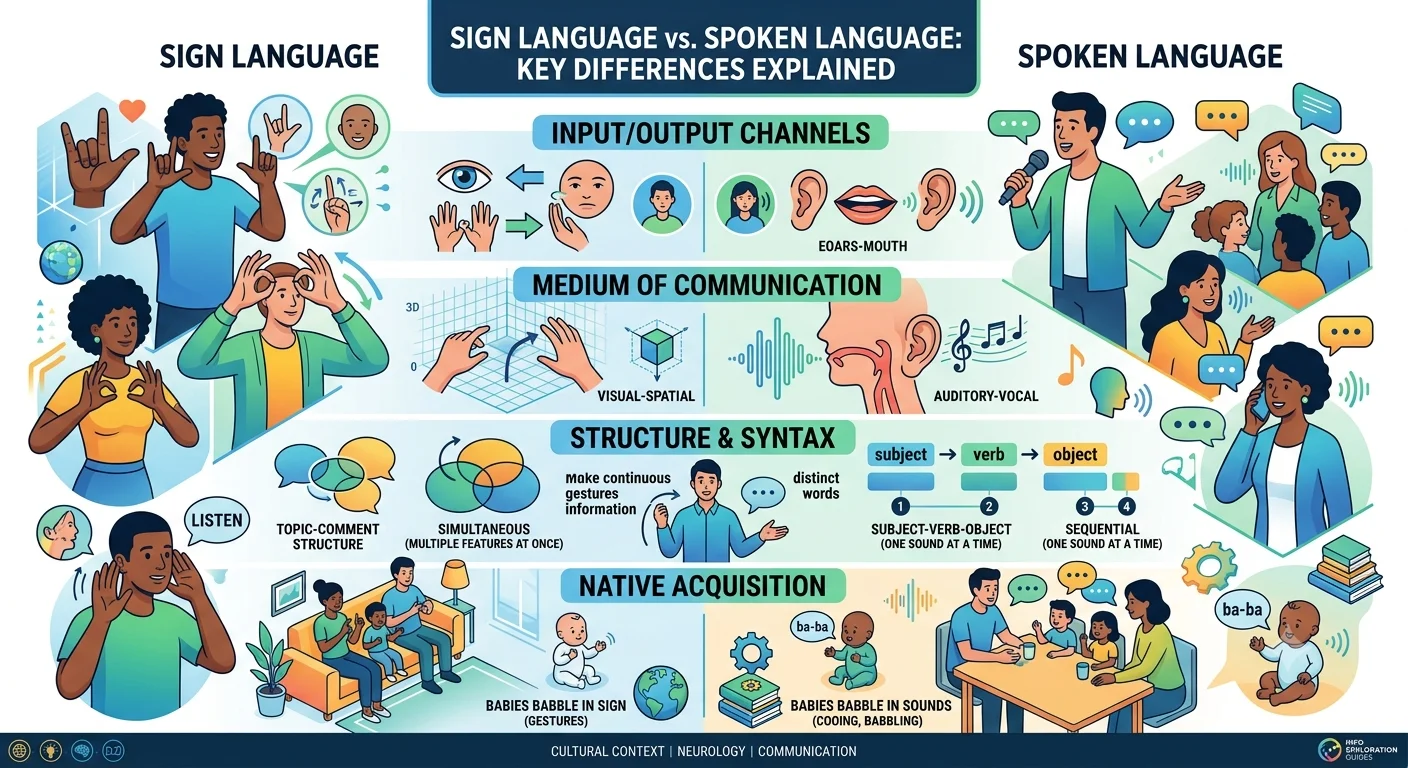
Sign language and spoken language are both complete natural human languages but they differ significantly in how they are produced perceived and structured grammatically. Understanding these differences helps explain why sign languages like ASL deserve the same linguistic respect as spoken languages and why they are not simply visual versions of spoken speech.
How sign language and spoken language are produced
Spoken language is produced through the vocal tract and perceived through hearing. Sound travels through the air in a linear sequence with one sound following another over time. Sign language is produced through the hands face and body and perceived visually. This fundamental difference in modality shapes nearly everything else about how the two types of language work.
Because sign language is visual it can convey certain types of information simultaneously rather than sequentially. A signer can show handshape movement location and facial expression all at the same time in a single sign whereas spoken language must produce sounds one after another in sequence. This gives sign languages a unique capacity for layered simultaneous meaning that spoken languages structure differently.
Grammar differences between ASL and English
American Sign Language has its own grammar that differs substantially from English grammar despite being used primarily in English speaking countries. ASL frequently uses a topic comment sentence structure where the topic of a sentence is established first followed by a comment about that topic. English typically relies more heavily on a fixed subject verb object order.
ASL also uses space grammatically in ways spoken languages cannot. A signer can establish a location in the signing space to represent a person or object and then refer back to that location later in the conversation without repeating the full noun. This spatial grammar has no direct equivalent in spoken language structure.
The role of facial expression and body movement
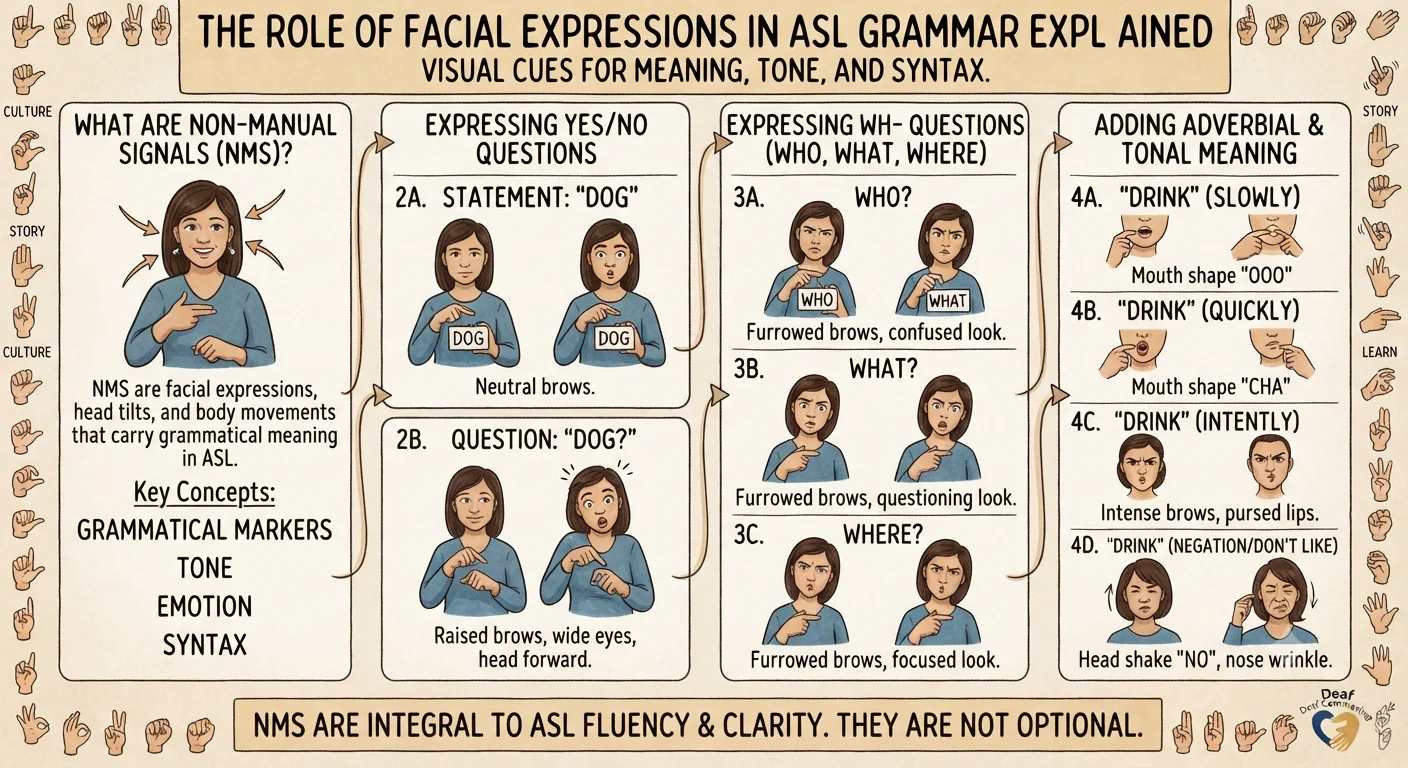
In spoken language tone of voice pitch and inflection carry significant grammatical and emotional information. In sign language facial expression eyebrow position and body posture serve many of these same grammatical functions. A raised eyebrow can mark a yes or no question. A particular mouth shape can intensify or modify the meaning of a sign.
- How to Learn ASL at Home for Beginners Step by Step Guide
- What is ASL and How Many People Use It Worldwide
This means that what might look to an untrained observer like simple emotional expression during signing is often actually essential grammatical information that changes the meaning of what is being communicated.
Are sign languages less complex than spoken languages
This is a common misconception that linguists have thoroughly debunked. Sign languages are just as grammatically complex as spoken languages. They have their own rules for word formation sentence structure and meaning that linguists can analyze with the same rigor applied to any spoken language.
Recommended Articles
 SIGN LANGUAGE EDUCATION
 SIGN LANGUAGE EDUCATION
 SIGN LANGUAGE EDUCATION
 SIGN LANGUAGE EDUCATION
Linguist William Stokoe's research in the 1960s was groundbreaking precisely because it demonstrated through rigorous linguistic analysis that ASL met every formal criterion of a complete language. Before his work many people including some educators assumed sign languages were simple gesture systems rather than true languages with their own grammar.
Can sign language convey everything spoken language can
Yes sign languages are fully capable of expressing any concept that spoken languages can express including abstract ideas humor poetry and complex technical information. Skilled ASL interpreters successfully interpret everything from legal proceedings to medical consultations to academic lectures which demonstrates the full expressive range of the language.
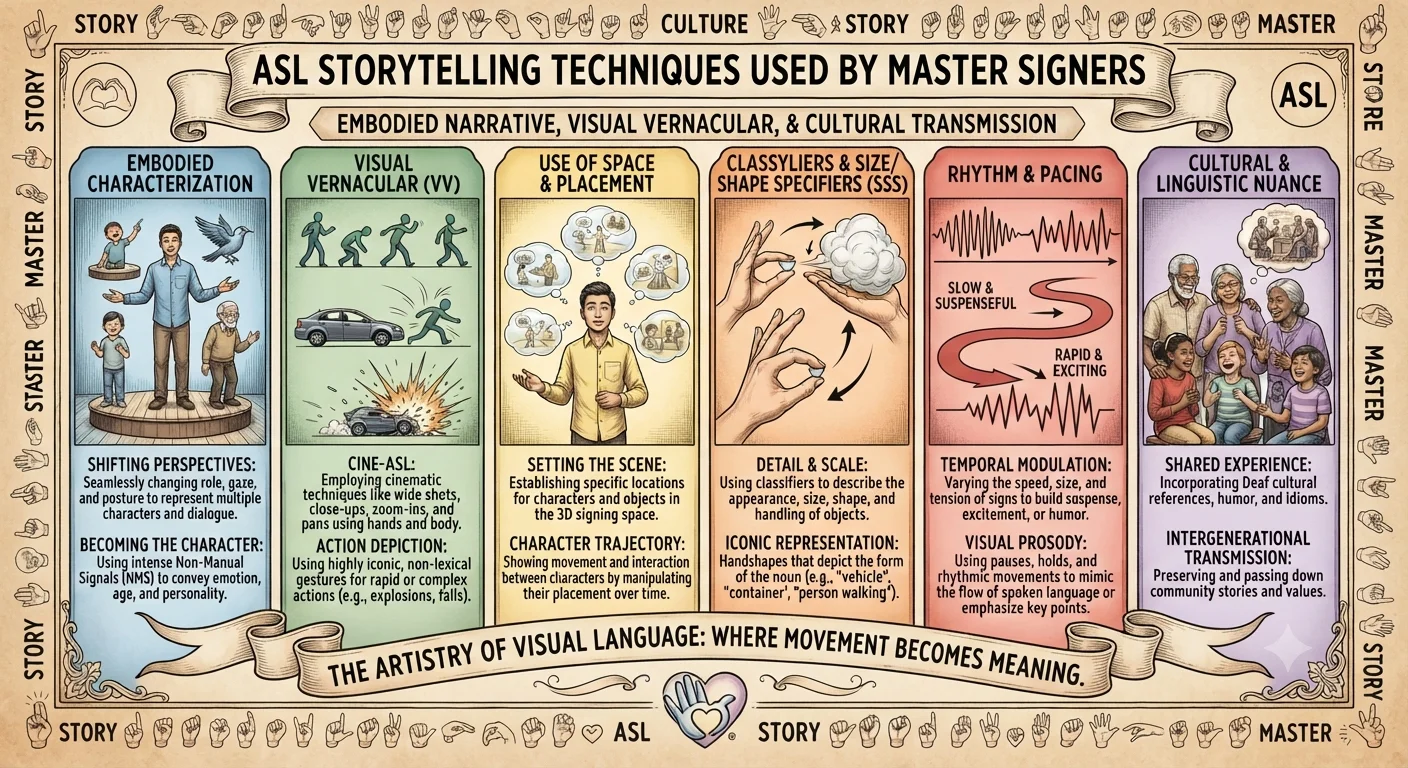
Sign language poetry and storytelling have also developed as distinct art forms that use the visual and spatial properties of sign language to create artistic effects that would not be possible in spoken language at all.
Why this comparison matters
Understanding the differences between sign language and spoken language matters because it helps dismantle the misconception that sign language is somehow a lesser or simplified communication system. Recognizing ASL and other sign languages as complete languages with their own grammar has had real world consequences for deaf education policy and the legal recognition of sign languages in various countries.
When sign languages are properly understood as complete languages rather than gesture systems it strengthens the case for bilingual deaf education that values ASL equally alongside English rather than treating ASL as something to move beyond.
Conclusion
Sign language and spoken language are different in their physical production and certain grammatical structures but both are complete sophisticated human languages capable of expressing the full range of human thought and emotion. Understanding these differences with accuracy helps build greater respect for sign languages and the deaf communities who use them as their primary means of communication.
FAQ
Is ASL just English translated into hand movements? No ASL has its own grammar vocabulary and sentence structure that differs significantly from English. It is not a visual version of English.
Why does facial expression matter so much in sign language? Facial expression in sign languages often carries grammatical meaning such as marking questions or modifying the intensity of a sign rather than only conveying emotion.
Did linguists always consider sign language a real language? No for much of history sign languages were dismissed as simple gestures. Linguistic research beginning in the 1960s proved that sign languages meet every formal criterion of complete natural languages.