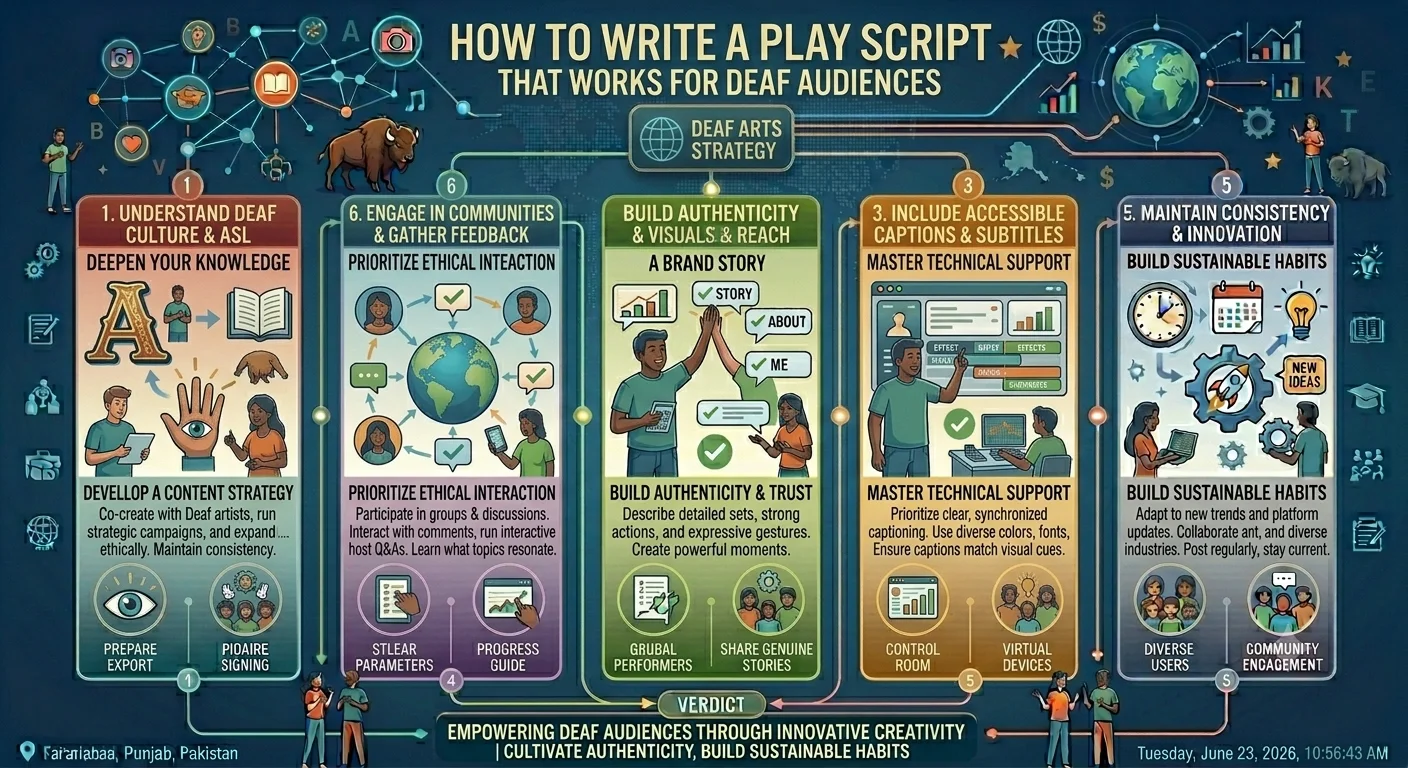
Writing a play script that genuinely works for deaf audiences requires thinking beyond simply adding an interpreter to an existing hearing focused production. It requires understanding how visual storytelling staging and language choices can make a production accessible and meaningful rather than treating accessibility as an afterthought. Here is a complete guide to writing plays that truly work for deaf audiences.
Start by involving deaf collaborators early
The single most important step any playwright can take when writing for deaf audiences is involving deaf collaborators from the earliest stages of development rather than bringing them in only after a script is finished. Deaf dramaturgs directors and actors can identify opportunities and pitfalls that a hearing writer working alone is likely to miss entirely.
Authentic deaf perspective in the writing process leads to scripts that resonate genuinely with deaf audiences rather than scripts that simply translate a hearing centered story into a format with sign language added on top.
Think visually from the very first draft
ASL and visual storytelling more broadly rely on space movement and image in ways that spoken dialogue heavy scripts often do not account for. When writing for deaf audiences consider how a scene could be staged to convey meaning visually rather than relying primarily on extended dialogue exchanges that work well for hearing audiences but translate less effectively into a visual medium.
Strong scripts for deaf audiences often include more physical staging directions and visual cues than a typical hearing focused script. Writers should think about what the audience will see at every moment not only what characters will say.
Consider how ASL grammar shapes dialogue and pacing
If your script will be performed in ASL either through direct ASL dialogue or through interpretation it helps enormously to understand how ASL grammar and pacing differ from spoken English. ASL often conveys complex spatial and relational information more efficiently than spoken English which means dialogue heavy English scripts can feel slow or redundant once translated.
Writers working closely with deaf collaborators can identify places where dialogue should be trimmed or restructured to flow naturally once the script moves into ASL performance rather than simply translating English dialogue word for word.
Decide on your approach to integrating ASL and English
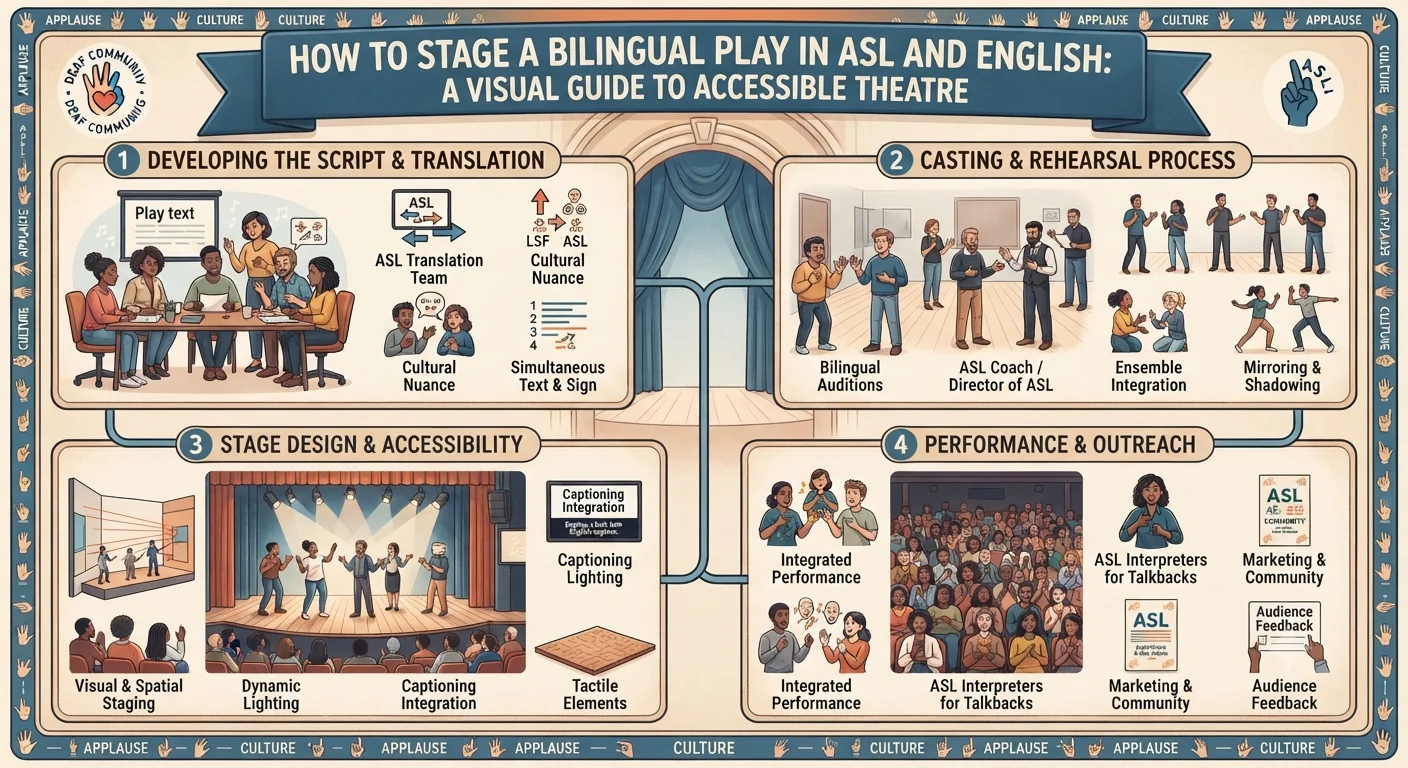
There are several established approaches to combining ASL and spoken English within a single production and the right choice depends on your specific story and audience goals. Some productions use simultaneous voicing where hearing actors voice dialogue while deaf actors sign it at the same time similar to the approach pioneered by the National Theatre of the Deaf.
Other productions like Deaf West Theatre's acclaimed revivals integrate deaf and hearing characters within the story itself so that ASL and spoken English are both organic parts of the narrative rather than two parallel tracks layered on top of each other. Choosing your approach early in the writing process will shape many subsequent creative decisions.
Write deaf characters with full complexity
Avoid writing deaf characters whose only defining trait is their deafness. The strongest scripts for deaf audiences and about deaf characters give those characters full personalities ambitions flaws and relationships just as any well written character deserves. Deafness can be an important part of a character's identity and experience without being the entirety of who they are as a person.
Recommended Articles
 DRAMA AND SCRIPT WRITING
Many successful deaf theatre productions explore deaf identity specifically and meaningfully but they do so by giving characters rich inner lives rather than using deafness as a simple plot device or source of conflict alone.
Plan for staging that serves sightlines for sign language
Sign language requires clear sightlines since audience members need to see the signer's hands face and body clearly to follow the performance. When writing staging directions consider how blocking will affect whether audience members can see signing actors clearly especially during group scenes with multiple characters signing at once.
Overlapping dialogue which works perfectly well in spoken theatre can become very difficult to follow in signed performance since audience members cannot easily watch two signers at once the way they might process two overlapping voices. Writers should consider staggering signed exchanges rather than overlapping them when writing for ASL performance.
Research existing deaf theatre work thoroughly
Before writing a script intended for deaf audiences study existing successful deaf theatre productions closely. Watching recordings or attending live performances of works like Children of a Lesser God Spring Awakening and other acclaimed deaf theatre productions will give you a concrete sense of how skilled writers and directors have solved the staging and structural challenges unique to this kind of work.
Test early drafts with deaf audiences and performers
Whenever possible arrange readings or workshop performances of your script with deaf actors and in front of deaf audience members before finalizing the work. Feedback at this stage can reveal pacing issues unclear staging or moments where the script does not translate as effectively into visual performance as intended on the page.
Conclusion
Writing a play script that truly works for deaf audiences requires far more than adding sign language to an existing hearing centered story. It requires visual thinking, close collaboration with deaf artists from the earliest stages, careful attention to staging and sightlines, and a genuine commitment to creating complex authentic deaf characters. Writers who approach this work with humility and collaboration can create theatre that resonates powerfully with deaf and hearing audiences alike.
FAQ
Do I need to know ASL to write a play for deaf audiences? While ASL fluency is valuable it is not strictly required as long as you collaborate closely with deaf dramaturgs and consultants throughout the writing process who can guide language and staging decisions.
What is the difference between simultaneous voicing and integrated casting approaches? Simultaneous voicing has hearing actors voice dialogue while deaf actors sign it at the same time. Integrated casting weaves deaf and hearing characters into the story itself so both languages occur naturally within the narrative.
Why does overlapping dialogue cause problems in signed theatre? Audience members following sign language need clear sightlines to one signer at a time since visual attention cannot easily split between two simultaneous signed exchanges the way hearing attention can process overlapping speech.