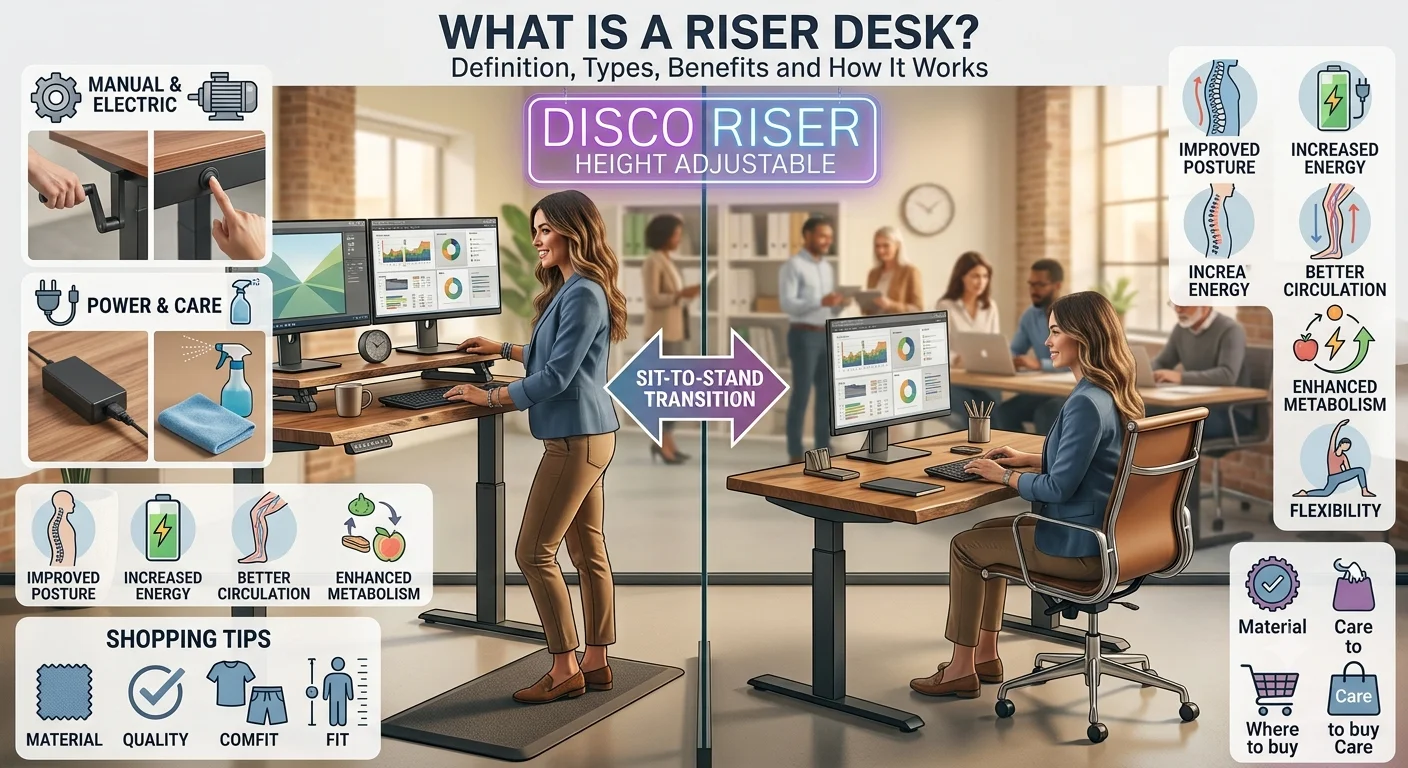
What Is a Riser Desk? Definition, Types, Benefits and How It Works, A riser desk is a height-adjustable platform placed on top of your existing desk that raises your monitor, keyboard and mouse to standing height. It lets you switch between sitting and standing throughout your workday without replacing your current furniture. It is also called a desk riser, standing desk converter or desk converter.
Think of it as a desk on top of a desk. You raise it when you want to stand and lower it when you want to sit. Your workspace upgrades in minutes without any tools or permanent changes.
Quick Answer: What Is a Riser Desk?
A riser desk is a portable height-adjustable platform that converts any regular desk into a sit-stand workstation. It holds your monitor on the top level and your keyboard and mouse on a lower tray. When you adjust the height, both surfaces move together so your ergonomic position stays correct whether you are sitting or standing.
How Does a Riser Desk Work?
- Quick Answer: What Is a Riser Desk?
- How Does a Riser Desk Work?
- Types of Riser Desks
- Key Benefits of a Riser Desk
- 1. Reduces Back and Neck Pain
- 2. Improves Posture
- 3. Boosts Energy and Focus
- 4. Encourages More Movement
- 5. Affordable Entry Point
- 6. No Need to Replace Your Current Desk
- 7. Quick Setup
- 8. Space Efficient
- Riser Desk vs Standing Desk: What Is the Difference?
- Who Should Use a Riser Desk?
- How to Set Up a Riser Desk Correctly
- What to Check Before Buying a Riser Desk
- Riser Desk Pros and Cons at a Glance
- Frequently Asked Questions About Riser Desks
- Final Thoughts
A riser desk works by using a lifting mechanism to raise or lower the platform to your preferred height. The mechanism type depends on the model you choose.
Gas Spring (Most Popular): You squeeze a lever and the platform lifts smoothly on its own. No electricity is needed. Fast to adjust and easy to use every day.
Manual Lever: Pull or push a lever to lock the height in place. Simple and budget-friendly. Best if you adjust once or twice a day.
Crank Handle: Turn a handle to raise or lower the surface. Slower but gives precise height control.
Electric / Motorized: Press a button and the platform moves automatically. Best for frequent position changers or heavier equipment setups.
Most riser desks have a small base that spreads weight evenly so the unit stays stable when holding your keyboard, monitor and other accessories. The design leaves enough space beneath so it can move smoothly up and down while you keep using your desk drawers and storage without any issue.
Types of Riser Desks
Riser desks come in several styles to match different needs and budgets.
Fixed Height Riser This type stays at one set height once installed. It does not move up or down. Best for people who want a dedicated standing position without needing to adjust throughout the day. Good for a single user who already knows their ideal standing height.
Manual Gas Spring Riser This is the most popular type on the market. You squeeze a handle and the platform lifts smoothly. No electricity needed. Fast to adjust and easy to use for daily office routines. Ideal if you switch between sitting and standing several times a day.
Manual Lever or Crank Riser These are the most affordable options. They work fine but take a little more physical effort to lift. Good choice on a tight budget.
Electric Riser Uses a motor to raise and lower the platform at the press of a button. Often includes memory presets for your sitting and standing heights. Heavier than manual options and needs a nearby power outlet. Best for professional setups with multiple monitors or heavier equipment.
Compact or Portable Riser A smaller footprint version designed for tight spaces like cubicles, small apartments or shared desks. Gives you the sit-stand benefit without taking over your workspace.
X-Lift vs Z-Lift Design X-lift risers move straight up and down. Z-lift risers tilt slightly toward you when raised. X-lift is generally more stable and takes less desk space.
Key Benefits of a Riser Desk
1. Reduces Back and Neck Pain
Sitting puts around 90 percent more pressure on your spinal discs compared to standing. When your monitor sits at eye level and your keyboard is positioned correctly, you naturally sit and stand straighter. Less slouching means less neck, shoulder and back strain, which is something almost every desk worker can relate to.
2. Improves Posture
When your screen is at the right height, your shoulders and neck stay more relaxed. Over time, better posture leads to fewer aches and less fatigue at the end of the day.
3. Boosts Energy and Focus
Standing increases blood flow and oxygen to your brain. That mid-afternoon slump that hits around 3 PM becomes far less severe when you have been alternating positions throughout the day. Many users report feeling more alert when they are not sitting all day.
4. Encourages More Movement
Health experts recommend following the 20-8-2 rule. Sit for 20 minutes, stand for 8 minutes and do 2 minutes of movement such as stretching or walking. A riser desk makes position changes part of your workflow so micro-breaks actually happen without disrupting your work.
5. Affordable Entry Point
A quality desk riser typically costs between $80 and $400. A full electric standing desk costs anywhere from $400 to over $1,000. For someone who wants to test the sit-stand lifestyle before committing to a larger investment, a riser desk is a low-risk way to get started.
6. No Need to Replace Your Current Desk
If you love your desk, whether it is a solid wood piece, a desk with built-in storage or simply something you are not ready to part with, a riser lets you keep it and still enjoy the benefits of standing at work.
7. Quick Setup
Most models require no tools and are ready to use within 5 to 10 minutes of unboxing. This makes them ideal for renters, shared desk environments or anyone who cannot make permanent changes to their workspace.
8. Space Efficient
Riser desks sit on top of your existing desk so they do not take up extra floor space. This makes them a good choice for small rooms, shared desks or home offices with limited square footage.
Riser Desk vs Standing Desk: What Is the Difference?
This is one of the most searched questions around this topic and the distinction matters before you buy.
A riser desk sits on top of your current desk and raises only the portion where your monitor and keyboard sit. The rest of your desktop stays at its original fixed height.
A full standing desk replaces your entire workstation. The whole desk surface moves up and down, usually electric or crank-based. It gives you more usable surface area at both sitting and standing height but costs significantly more and requires replacing furniture you may already like.
Recommended Articles
 GENERAL POSTS
 GENERAL POSTS
 GENERAL POSTS
 GENERAL POSTS
A sit-stand desk and a height-adjustable desk are the same category as a full standing desk. They refer to a complete desk whose entire surface adjusts.
- Cowgirl Party Hat Styles: The Ultimate Guide to Shop Disco Cowboy Hats for Every Celebration
- Snow Day Calculator: Will School Be Cancelled Tomorrow?
- Stylish Name Generator Tool: The Ultimate Guide to Creating Cool and Fancy Names Online
If you already have a desk you like and are just starting out with sit-stand working, a riser desk is typically the smarter and more budget-friendly first step.
Who Should Use a Riser Desk?
A riser desk works well for many types of users.
Home office workers often choose it because it fits on an existing desk and needs little space.
Office workers like it because setup is quick and does not require moving furniture or getting approval for office renovations.
Shared desk setups benefit the most since different users can adjust the height throughout the day to match their individual needs.
Writers and coders who spend entire days typing benefit significantly. The combination of neck strain from screens and wrist strain from keyboards gets better with proper riser positioning.
People on a budget who want the health benefits of standing without committing to a full furniture replacement.
Renters or anyone who cannot make permanent changes to their workspace find the riser ideal since it involves zero modifications to the desk or room.
How to Set Up a Riser Desk Correctly
Buying the right riser is only half the job. Setting it up incorrectly creates new problems while solving old ones.
Monitor Position: Your monitor top should sit at or just slightly below your eye level when standing. If it is too low you will hunch. If it is too high you will strain your neck looking up.
Keyboard and Mouse Position: Your keyboard should allow your elbows to rest at about a 90-degree angle with your wrists relaxed and straight. Keep your wrists in a neutral position, neither bent up nor down.
Standing Posture: When standing, keep your feet about shoulder-width apart and avoid locking your knees. Shift your weight occasionally to reduce fatigue.
Anti-Fatigue Mat: If you plan to stand for longer periods, using an anti-fatigue mat can make a noticeable difference in comfort. It reduces pressure on your feet, knees and lower back.
Ease into It: Instead of standing all day, start with short intervals and gradually increase your standing time. Many experts suggest alternating between sitting and standing every hour or following the 20-8-2 rule.
What to Check Before Buying a Riser Desk
Weight Capacity: Most standard risers hold around 25 to 35 pounds. If you have two large monitors or heavy equipment, check this number carefully before ordering.
Surface Width: A single monitor needs at least 28 inches of surface width. For dual monitors you need 35 inches or more. Measure your monitors before you pick a size.
Desk Depth: If your desk is 24 inches deep or less, you need a compact riser. A full size riser will hang over the edge or feel unstable.
Height Range: Electric models usually offer a wide adjustment range of 70 to 120 centimeters, making them adaptable to people of different heights.
Stability: Cheaper models wobble at full height and under load, especially during typing or video calls. Look for X-lift designs and solid construction if stability is a priority.
Power Requirements: Electric models need a nearby power outlet. Manual and gas spring models work anywhere.
Riser Desk Pros and Cons at a Glance
Pros Sets up in minutes with no tools required. Costs far less than a full standing desk. Keeps your existing furniture. Works in small spaces without changing your room layout. Easy to move or take to a different location.
Cons Only raises part of your desk surface. The rest stays at its original fixed height. Takes up desktop space so you need at least 35 inches of width for dual-level models. Weight limits matter for heavy dual-monitor setups. Cheaper models can wobble at full height under load.
Frequently Asked Questions About Riser Desks
What is a riser desk used for? A riser desk is used to convert a regular fixed-height desk into a sit-stand workstation. It lets you alternate between sitting and standing during your workday to reduce back pain, improve posture and boost energy without replacing your existing desk.
Is a riser desk the same as a standing desk? No. A riser desk sits on top of your current desk and raises only a portion of the surface. A standing desk replaces your entire workstation and lets the whole desk surface move up and down.
How much does a riser desk cost? Most quality riser desks cost between $80 and $400. Electric models with memory presets cost more. Full electric standing desks start at around $400 and can exceed $1,000.
Does a riser desk really help with back pain? Yes. Sitting for long periods puts significantly more pressure on your spinal discs than standing. Alternating between sitting and standing with a riser desk helps distribute spinal load more evenly and reduces back, neck and shoulder strain over time.
How long should you stand at a riser desk? Experts suggest starting with short standing intervals and building up gradually. The 20-8-2 rule is a commonly recommended approach. Sit for 20 minutes, stand for 8 minutes and do 2 minutes of light movement. You should never stand all day as this creates its own set of problems.
Can I use a riser desk with a laptop? Yes. Most riser desks are compatible with laptops, single monitors and dual-monitor setups. When using a laptop, you may want a separate keyboard and mouse so your wrists and neck can both be in a neutral position at the same time.
Final Thoughts
A riser desk is one of the simplest and most affordable ways to bring more movement into your workday. It does not require replacing your furniture, redesigning your office or spending a fortune. You place it on your desk, raise it when you want to stand and lower it when you want to sit. Over time those small position changes can lead to real improvements in posture, energy and comfort.
If you are new to sit-stand working or working with a limited budget, a riser desk is the smart place to start. Writers, coders, home office workers and shared workspace users all benefit from the flexibility it brings. Choose the right type for your desk size and work style, set it up correctly and use it consistently. Small changes in how you work can lead to meaningful long-term benefits for your health and productivity.