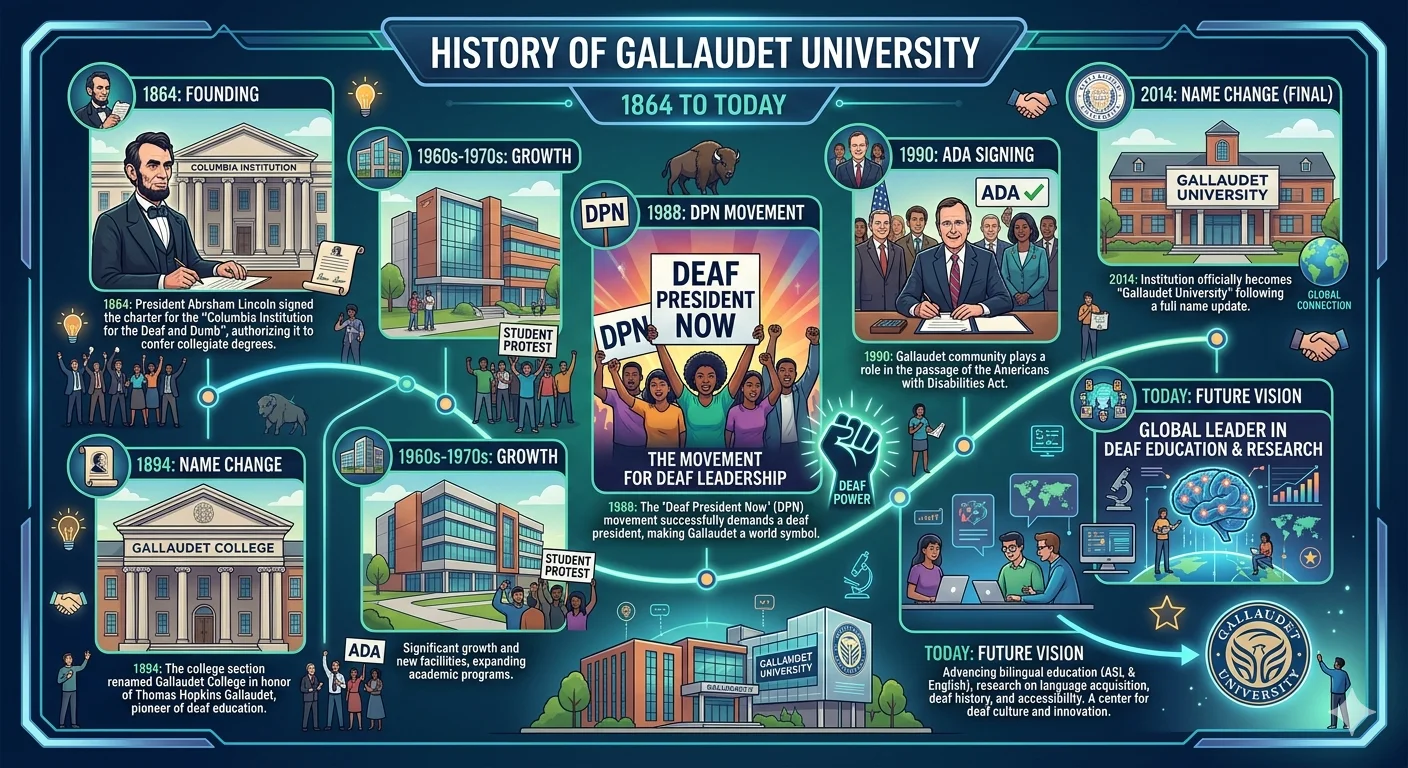
Gallaudet University in Washington, DC, is one of the most unique educational institutions in the world. It is the only university where all programs and services are specifically designed to accommodate deaf and hard of hearing students. From its founding in 1864 to its role as a global center of deaf culture and learning today, Gallaudet University has shaped generations of deaf leaders, artists, educators, and advocates.
How Gallaudet University was founded
The story of Gallaudet University In 1856 a gentleman called Amos Kendall gave both money and property to start a school for the deaf and blind in Washington, DC. Edward Miner Gallaudet was asked to run this new school. He was the son of Thomas Hopkins Gallaudet, who was involved in setting up the first school for the deaf in America.
Edward Miner Gallaudet had grander aspirations than just a school. He aimed to set up a whole university so deaf people would be able to obtain a bachelor's degree and further their education to an equal standard to that of a non-deaf university. In 1864 he successfully persuaded Abraham Lincoln, the president of the time, to sign a bill that allowed the university to confer college degrees. Gallaudet thus became, and remains to this day, the world's first and only university to have been set up exclusively for the deaf.
Initially the college was known as the Columbia Institution for the Instruction of the Deaf and Dumb and the Blind. It was renamed Gallaudet College in 1954 in recognition of Thomas Hopkins Gallaudet. In 1986 it became Gallaudet University.
Gallaudet’s development in the 20th century
- How Gallaudet University was founded
- Gallaudet’s development in the 20th century
- The Deaf President Now the movement of 1988
- Gallaudet University today
- The cultural significance of Gallaudet
- Conclusion
- FAQ
- Who started Gallaudet University?
- Is Gallaudet University solely for the deaf?
- What was the Deaf President Now movement?
Throughout the late 1800s and early 1900s the college continued to develop. Being based in Washington, DC, allowed it to be in close contact with those in government. This was key in the numerous fights that the deaf community would become involved in in order to further their recognition and rights.
Gallaudet specialized in a wide range of subjects, including education, liberal arts, science, and the arts. It acted as a base for the majority of deaf teachers who would later manage deaf schools throughout America. Without doubt the impact of Gallaudet alumni has been significant on deaf education in America.
Alongside this, Gallaudet became an important hub for both the conservation and furthering of American Sign Language. Whilst many teachers were attempting to eradicate sign language and encourage deaf people to communicate orally, Gallaudet continued to utilize, respect, and analyze ASL.
The Deaf President Now the movement of 1988
The most significant event in Gallaudet University’s recent past was in March 1988. In spite of two extremely suitable deaf candidates for the position of university president, the board of trustees appointed a hearing person. Students, staff, and alumni protested in order to highlight that Gallaudet should have a deaf president. This protest received much media coverage and was labeled ‘Deaf President Now.' Eventually, the board of trustees changed its mind and appointed Dr. I. King Jordan as Gallaudet’s first deaf university president.
Recommended Articles
 DEAF CULTURE AND HISTORY
 DEAF CULTURE AND HISTORY
 DEAF CULTURE AND HISTORY
 DEAF CULTURE AND HISTORY
As well as being highly significant for Gallaudet, the Deaf President Now protest was also a major turning point for the whole disability rights movement in America. It played a key role in the development of the Americans with Disabilities Act in 1990. It proved to the rest of the world that deaf people are highly effective at fighting for their rights and can be successful in doing so.
Gallaudet University today
Gallaudet University has around 1500 undergraduate and postgraduate students. Students can study for a wide range of degrees, with over 40 undergraduate and 30 postgraduate options. Teaching is given in both ASL and English, and there are interpreters for all classes and situations.
Gallaudet has one of the world's most renowned drama schools for deaf students. Many deaf people have graduated from the theater program and have then successfully pursued professional careers in theater, film, and television as actors, directors, set designers, and playwrights.
Gallaudet's Laurent Clerc National Deaf Education Center is also a national center for research and development in deaf education. Much of its work influences the teaching of deaf students throughout the USA.
The cultural significance of Gallaudet
Gallaudet University also acts as the center of deaf culture. It is where deaf people meet, ASL is studied, deaf arts are produced and displayed, and where deaf leaders are taught and developed.
Many of deaf culture and deaf arts’ key historical figures have been both staff and students at Gallaudet. Throughout over 150 years, the Washington, D.C., campus has been the site for talks, demonstrations, art displays, and festivities, which have all played a key role in the development of deaf life in America.
Conclusion
Gallaudet University is much more than a college. It is a symbol of deaf people’s achievements and the recognition that they are fully entitled to be in educational and international positions of power. Whether it be Abraham Lincoln’s 1864 signature, the Deaf President Now campaign, or indeed its current status as an international hub for deaf culture, Gallaudet University demonstrates that deaf people have always been entitled to these positions.
FAQ
Who started Gallaudet University?
Gallaudet University was created with the assistance of Amos Kendall and was headed by Edward Miner Gallaudet. It was officially established by President Abraham Lincoln in 1864.
Is Gallaudet University solely for the deaf?
Whilst predominantly for deaf and hard of hearing people, hearing students can also study at Gallaudet. All students are required to both study and communicate using ASL.
What was the Deaf President Now movement?
Students demonstrated against the hearing person that had been made president. The campus was closed for a week, and eventually the board appointed Dr. I. King Jordan as Gallaudet’s first deaf president.