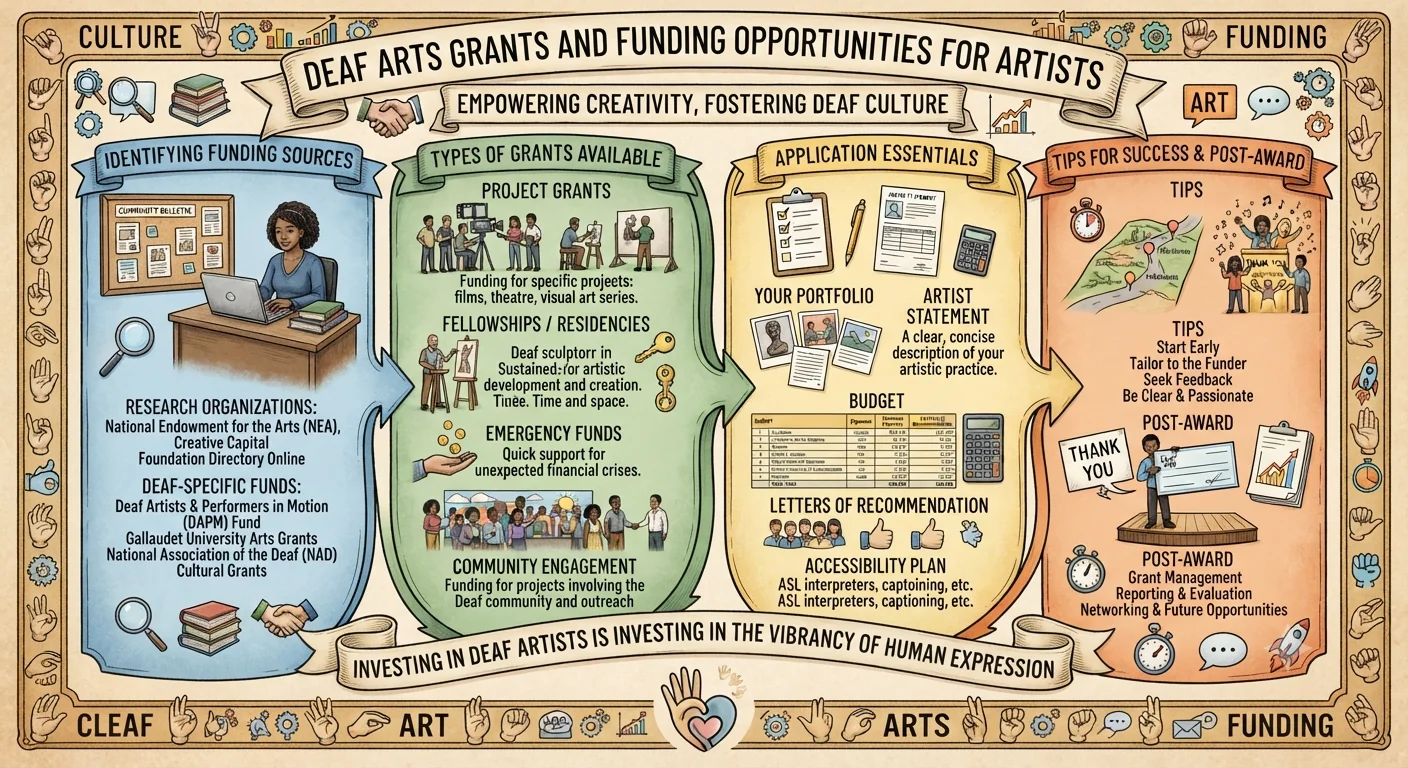
Discover deaf arts grants and funding opportunities available for deaf artists and arts organizations covering national foundations state programs and application strategies.
Finding funding for deaf arts projects and careers requires knowledge of both general arts funding landscapes and the specific grant programs and foundations that explicitly support deaf cultural expression and accessibility in the arts. This comprehensive guide covers the major categories of funding available to deaf artists and arts organizations along with practical strategies for building a sustainable funding approach that supports creative work over the long term rather than relying on a single uncertain source.
Why Dedicated Deaf Arts Funding Matters
Dedicated deaf arts funding matters because deaf artists and deaf arts organizations face specific financial challenges that general arts funding does not always adequately address. The additional costs of communication access including sign language interpretation for rehearsals and performances captioning services for productions and the need for deaf specific outreach and marketing to reach deaf audiences all represent real production costs that hearing theatre and arts organizations typically do not need to budget for in the same way.
Beyond these additional production costs deaf arts organizations often serve communities with specific cultural and linguistic needs that require specialized expertise community relationships and programming approaches that general arts organizations lack the knowledge or community standing to provide effectively. Funding that recognizes these specific organizational needs and the distinct cultural value of deaf arts programming is essential for enabling the kind of sustained and excellent work that deaf communities deserve and that broader cultural diversity in the arts requires.
National Endowment for the Arts Funding
- Why Dedicated Deaf Arts Funding Matters
- National Endowment for the Arts Funding
- Foundation Funding for Deaf Arts
- State Arts Council Funding
- Disability Arts Specific Funding Programs
- Individual Artist Fellowship Programs
- Community Foundation and Local Funding
- Building a Diversified Funding Strategy
- Conclusion
- FAQ
- What is the most accessible starting point for deaf artists seeking arts funding?
- Should deaf artists apply for general arts funding or only disability and deaf specific programs?
- How important are relationships with foundation program officers for successful grant applications?
The National Endowment for the Arts provides funding across multiple program categories that deaf artists and organizations can access including both general arts funding programs and specific accessibility focused grants that support organizations working to make arts programming more accessible to disabled audiences including deaf and hard of hearing community members. NEA grant programs change periodically so visiting the NEA website directly to review current funding opportunities and eligibility requirements is essential before beginning any application process.
NEA grants are competitive and typically require demonstrated organizational capacity previous artistic achievement and clear project plans that articulate both artistic vision and community impact. Deaf arts organizations and individual deaf artists seeking NEA funding benefit from framing their work both in terms of artistic excellence and in terms of the specific community and accessibility value that deaf arts programming provides since both dimensions are relevant to NEA funding priorities.
Foundation Funding for Deaf Arts
Private foundations represent an important funding source for deaf arts with some foundations specifically focused on disability arts or deaf cultural programming and others providing general arts support that deaf artists and organizations can access through competitive application processes. Researching which foundations have historically funded deaf arts or disability arts programming is an important early step in building a foundation funding strategy since targeting foundations with demonstrated interest in this work is significantly more efficient than applying broadly to foundations without relevant program focus.
Foundations specifically focused on deaf community support and advocacy sometimes include arts and cultural programming within their grantmaking alongside more traditional community service and advocacy work. Building relationships with program officers at foundations with relevant interests through informational conversations before submitting formal applications significantly improves the chances of successful funding relationships compared to cold application submissions without prior relationship development.
State Arts Council Funding
Every state has an arts council that distributes public funding for arts programming within the state and most state arts councils have some funding available for accessibility programming and for organizations serving specific cultural communities including deaf and hard of hearing populations. State arts council funding is often more accessible to smaller and emerging deaf arts organizations than highly competitive national foundation funding since state programs typically include funding tiers appropriate for organizations at various stages of development and capacity.
State arts council programs vary significantly across different states in terms of available funding amounts eligibility requirements and priority areas so researching the specific programs available in your state through your state arts council website is essential for identifying the most relevant funding opportunities for your specific organizational profile and project needs.
Disability Arts Specific Funding Programs
Several funding programs specifically support disability arts including deaf arts as a recognized category of culturally specific artistic practice deserving dedicated support. These disability arts focused programs often understand the specific additional costs and community context of deaf arts programming more readily than general arts funders who may need more education about what makes deaf arts programming distinct and why it deserves specific support rather than being expected to compete for funding on the same terms as hearing arts organizations without the additional costs and community specific context that deaf arts work entails.
Recommended Articles
 EVENTS AND FESTIVALS
 EVENTS AND FESTIVALS
 EVENTS AND FESTIVALS
 EVENTS AND FESTIVALS
International examples of disability arts funding from countries including the United Kingdom where disability arts has received more substantial dedicated policy and funding support than in the United States can provide useful advocacy models and inspiration for deaf arts advocates working to build stronger dedicated funding infrastructure within American arts funding systems.
Individual Artist Fellowship Programs
Individual deaf artists rather than organizations can access funding through artist fellowship programs at both national and state levels that support creative development and project creation across various art forms. Many state arts councils offer individual artist fellowships or project grants that deaf artists are eligible to apply for on equal terms with hearing applicants since these programs typically fund artistic merit and project quality rather than specifically disability or cultural community focus.
Deaf artists applying for general individual artist fellowships benefit from articulating clearly both the artistic quality and the specific cultural value of their work rather than assuming reviewers unfamiliar with deaf cultural context will independently recognize the significance of the cultural community their work serves and represents.
Community Foundation and Local Funding
Community foundations and local funding sources including corporate sponsorships from businesses with meaningful connections to deaf community and philanthropy from individuals within the deaf community and their extended networks represent important local funding sources that national and state level programs cannot fully substitute for. Local funding relationships often provide not just financial support but community visibility and credibility that strengthen organizations' ability to pursue larger competitive grants from regional and national funders.
Deaf arts organizations with strong local community relationships and demonstrated local support often present more compelling cases to outside funders than organizations without this local foundation since demonstrated community investment signals organizational credibility and relevance that purely external funding support cannot convey as convincingly.
Building a Diversified Funding Strategy
The most financially sustainable deaf arts organizations build diversified funding portfolios that draw on multiple funding sources rather than depending on any single grant program or funder for the majority of their operating support. This diversification protects organizations from the potentially devastating impact of losing a single major funding source and demonstrates to potential funders the broad support that makes an organization a sound investment of grant dollars.
Building this diversified portfolio takes time and sustained relationship development with multiple funders across different program areas and geographic scopes. Organizations and artists early in their funding development journey benefit from starting with the most accessible local and state level opportunities before systematically expanding toward more competitive regional and national funding sources as they build the track record and organizational capacity that stronger competitive applications require.
Conclusion
Funding for deaf arts is available through multiple channels from national government arts programs through private foundations state arts councils and local community sources though accessing this funding requires strategic research relationship development and competitive application work that demands sustained attention alongside the creative work itself. Deaf artists and organizations that invest in building strong diversified funding relationships create the financial foundation that allows sustained creative work and community service rather than perpetual uncertainty about whether the next project can proceed.
FAQ
What is the most accessible starting point for deaf artists seeking arts funding?
State arts council funding programs typically represent the most accessible entry point for deaf artists and smaller organizations since these programs often include funding tiers appropriate for various organizational sizes and developmental stages with less competitive pressure than major national foundation grants.
Should deaf artists apply for general arts funding or only disability and deaf specific programs?
Deaf artists benefit from pursuing both general arts funding programs where their work competes on artistic merit and deaf or disability specific programs that recognize the particular cultural value and additional costs of deaf arts programming since a diversified approach across multiple funding categories creates stronger overall funding sustainability.
How important are relationships with foundation program officers for successful grant applications?
Relationships with program officers at foundations with relevant funding interests are extremely valuable since informed conversations before submitting formal applications help applicants understand whether their work genuinely fits a funder's priorities and allow funders to learn about the applicant's work in context significantly improving the chances of successful funding relationships compared to cold application submissions.