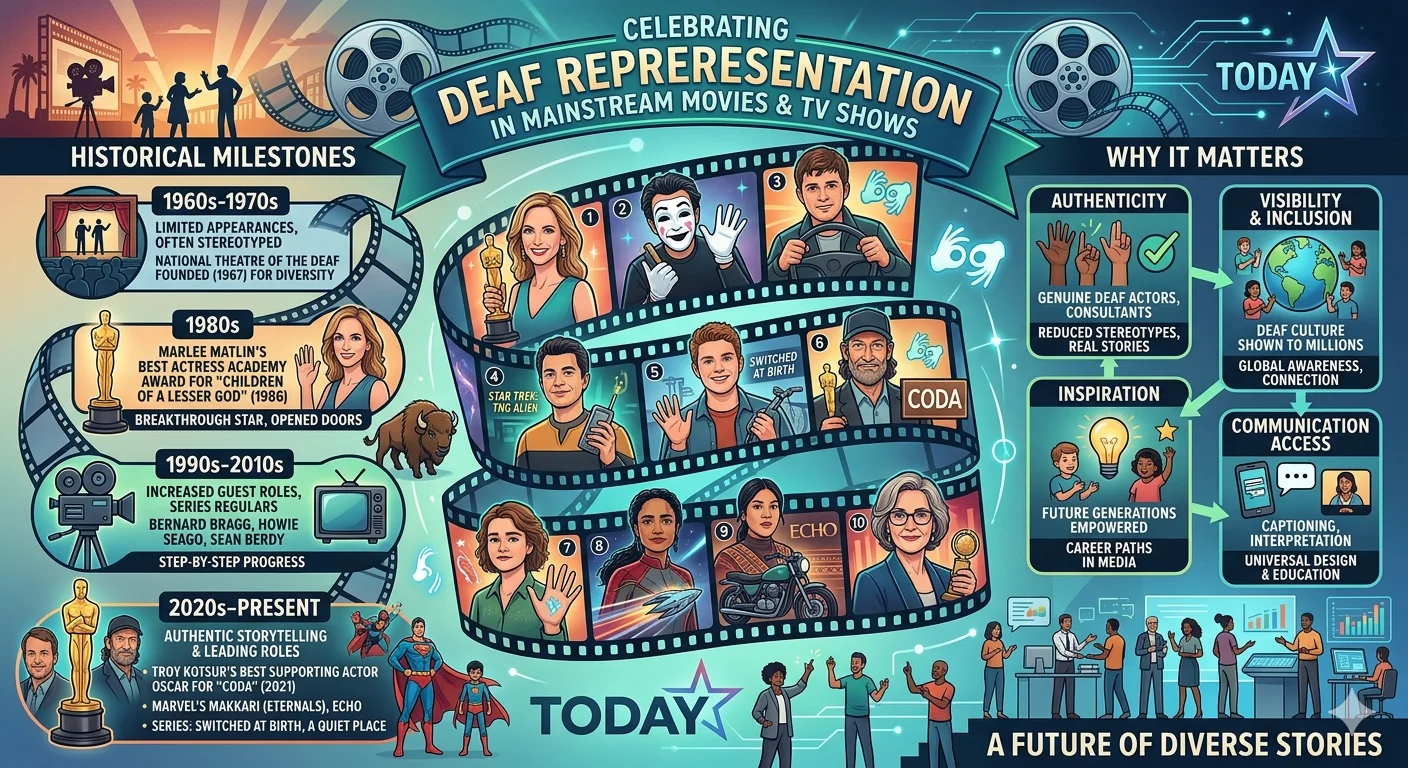
Deaf representation in mainstream movies and television has gone through a significant transformation over the past several decades. What once consisted of hearing actors playing deaf characters with little authenticity has slowly shifted toward more genuine casting and storytelling. Understanding this evolution helps explain both the progress made and the work still ahead.
Early portrayals of deaf characters in film
For much of film history deaf characters were rare and when they did appear they were frequently played by hearing actors with minimal research into deaf culture or sign language. These portrayals often reduced deaf characters to objects of pity or used deafness purely as a plot device rather than presenting deaf people as complete characters with their own agency and interior life.
Sign language in these early portrayals was often inaccurate or invented entirely for the screen rather than drawn from real ASL. This sent a message that authenticity in deaf representation did not matter as much as the convenience of casting decisions.
Children of a Lesser God as a turning point
The 1986 film Children of a Lesser God marked an important turning point. Marlee Matlin a real deaf actor was cast in the lead role of Sarah Norman and her performance was authentic precise and emotionally powerful. Her Academy Award win for Best Actress proved that audiences and the film industry could embrace a deaf lead performance at the highest level.
The success of this film demonstrated that authentic casting was not only possible but could produce work that critics and audiences responded to passionately. It set a precedent that advocates would point to for decades afterward when pushing for similar opportunities.
Sesame Street and early television representation
On television Linda Bove's long running role on Sesame Street beginning in 1971 introduced generations of children to a deaf character in a warm everyday setting. Her character was not defined by tragedy or struggle. She was simply a librarian who happened to be deaf and who used ASL naturally as part of the show's diverse cast of characters.
This kind of normalized representation mattered enormously for shaping how an entire generation of hearing children understood deafness from an early age without stigma attached.
The CODA breakthrough
In 2021 the film CODA brought deaf representation to a new level of mainstream recognition. The film featured three deaf actors Troy Kotsur Marlee Matlin and Daniel Durant in central roles as a deaf family with a hearing daughter. The film won the Academy Award for Best Picture in 2022 making it the first film with a majority deaf cast to win the industry's top honor.
- How to Learn ASL at Home for Beginners Step by Step Guide
- National Theatre of the Deaf Complete History and Legacy
Troy Kotsur's Best Supporting Actor win for the same film made him the first deaf man to win an Academy Award for acting. The film was praised specifically for depicting deaf family life with warmth humor and authenticity rather than treating deafness as a tragedy to be overcome.
Television's growing deaf representation
Recommended Articles
 INCLUSIVE STORYTELLING
 INCLUSIVE STORYTELLING
 INCLUSIVE STORYTELLING
 INCLUSIVE STORYTELLING
Television has also made meaningful strides. The series Switched at Birth which ran from 2011 to 2017 featured numerous deaf actors and storylines centered on deaf identity and deaf culture. The show was notable for filming entire episodes in ASL without subtitles at times forcing hearing audiences to experience communication the way deaf characters did.
More recent television productions have continued to include deaf characters played by deaf actors and have consulted with deaf writers and producers to ensure storylines reflect authentic deaf experiences rather than assumptions made by hearing writers.
Why authentic casting matters
When deaf actors play deaf roles the performance carries a level of lived authenticity that cannot be replicated through research alone. Sign language fluency timing cultural references and the subtle physical rhythms of deaf communication are extremely difficult for hearing actors to fully master no matter how skilled they are.
Authentic casting also creates real career opportunities for deaf performers in an industry where roles for deaf actors have historically been scarce. Every deaf role given to a hearing actor is an opportunity denied to a deaf performer in a field where opportunities are already limited.
What still needs to improve
Despite real progress deaf representation in mainstream media still has significant room to grow. Deaf characters remain a small fraction of overall on screen representation. Deaf writers and directors are still underrepresented in decision making roles even on projects that feature deaf characters prominently.
Many deaf advocates argue that true progress means deaf talent should not be limited to deaf themed stories alone. Deaf actors playing roles where deafness is incidental rather than central to the plot would represent another meaningful step forward in normalizing deaf presence across all genres of storytelling.
Conclusion
Deaf representation in mainstream movies and television has moved from inauthentic and often harmful portrayals toward a model that increasingly values genuine deaf talent and perspective. Films like Children of a Lesser God and CODA along with television shows like Switched at Birth have shown that authentic deaf storytelling can achieve both critical acclaim and mainstream success. The progress is real but the work toward full and equal representation continues.
FAQ
What was the first major film to feature a deaf actor in a lead role? Children of a Lesser God in 1986 starring Marlee Matlin is widely considered a landmark film for authentic deaf representation in a lead role.
Did CODA feature real deaf actors? Yes CODA featured deaf actors Troy Kotsur Marlee Matlin and Daniel Durant in central family roles which contributed significantly to the film's praised authenticity.
Why does authentic casting matter for deaf roles? Authentic casting brings genuine lived experience and sign language fluency to performances and creates career opportunities for deaf actors in an industry where such roles have historically been limited.