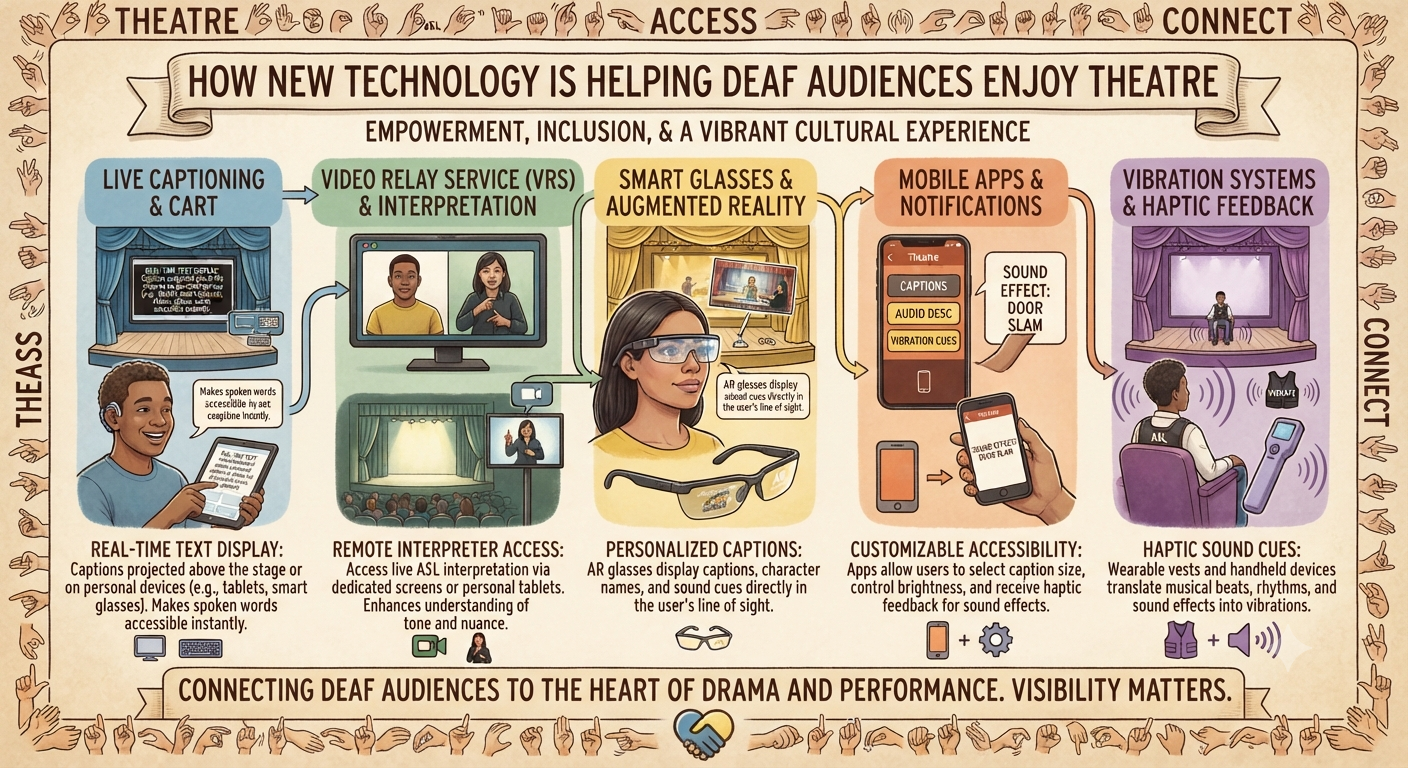
Discover how new technology is helping deaf audiences enjoy theatre more fully through smart captioning augmented reality and innovative accessibility solutions.
Technology is transforming theatre accessibility for deaf and hard of hearing audiences at an unprecedented pace creating new possibilities for accessing live performance that were simply not available even a decade ago. From sophisticated captioning systems to augmented reality applications these technological innovations are expanding what inclusive theatre can mean and raising the bar for what deaf audiences can reasonably expect from their theatre going experience.
Advanced Captioning Technology in Modern Theatres
Captioning technology for live theatre has advanced significantly in recent years moving well beyond the early systems that required fully manual operation toward more sophisticated solutions that combine pre-prepared caption scripts with increasingly refined synchronization tools. Modern captioning software allows operators to trigger individual caption lines with greater precision while also providing backup automatic advancement features that help maintain synchronization even when live performance timing varies from rehearsed patterns.
Networked captioning systems now allow caption displays to be distributed across multiple screens positioned throughout theatre auditoriums rather than limited to a single screen in a fixed location ensuring that deaf audience members seated anywhere in the house can access caption text without needing to request specific seating areas near the only available caption screen. This distributed display approach significantly improves the captioned theatre going experience by making caption access compatible with a much wider range of preferred seating locations.
Seatback Caption Displays
- Advanced Captioning Technology in Modern Theatres
- Seatback Caption Displays
- Augmented Reality Caption Glasses
- Smart Phone Caption Applications
- Remote Interpreting Technology
- Artificial Intelligence and Automatic Captioning
- Technology and Human Expertise Working Together
- Conclusion
- FAQ
- What are augmented reality caption glasses and how do they work in theatre?
- What is seatback captioning and how does it improve the theatre going experience?
- Can artificial intelligence replace human caption operators in live theatre?
Seatback captioning systems represent one of the most significant recent improvements in theatre accessibility technology providing individual small screens mounted on the back of seats in front of caption users that display text at close comfortable reading distance rather than requiring viewers to look away from the stage toward a distant shared screen. Several major theatres in both the United States and United Kingdom have installed seatback captioning systems that dramatically improve the captioned experience by allowing deaf and hard of hearing audience members to maintain much closer visual connection with the live performance while reading caption text.
The intimate scale of seatback displays also reduces the social visibility of caption use which some deaf and hard of hearing audience members find preferable to using larger shared screens that make their accessibility need visible to surrounding audience members. This privacy dimension of seatback captioning has been noted by accessibility advocates as an important feature that respects deaf audience members' dignity and personal comfort preferences in ways that more visible shared screen systems cannot provide.
Augmented Reality Caption Glasses
Augmented reality glasses that display caption text directly within the wearer's field of vision represent perhaps the most exciting emerging technology for theatre accessibility allowing deaf and hard of hearing audience members to watch the live performance and read captions simultaneously without looking away from the stage at all. Several major theatre organizations have piloted AR caption glasses programs with promising results suggesting that this technology may become an increasingly common theatre accessibility option as the technology matures and costs decrease.
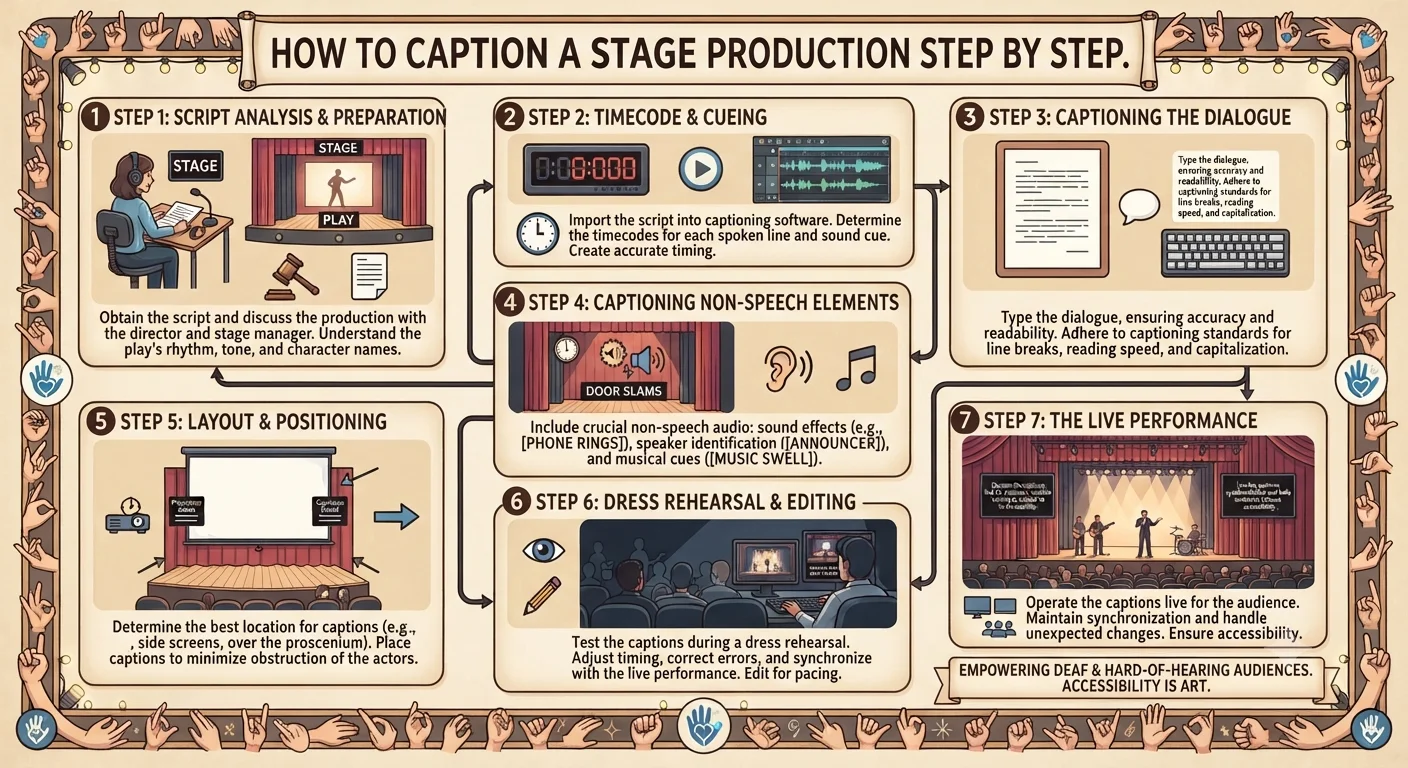
- How to Caption a Stage Production Step by Step
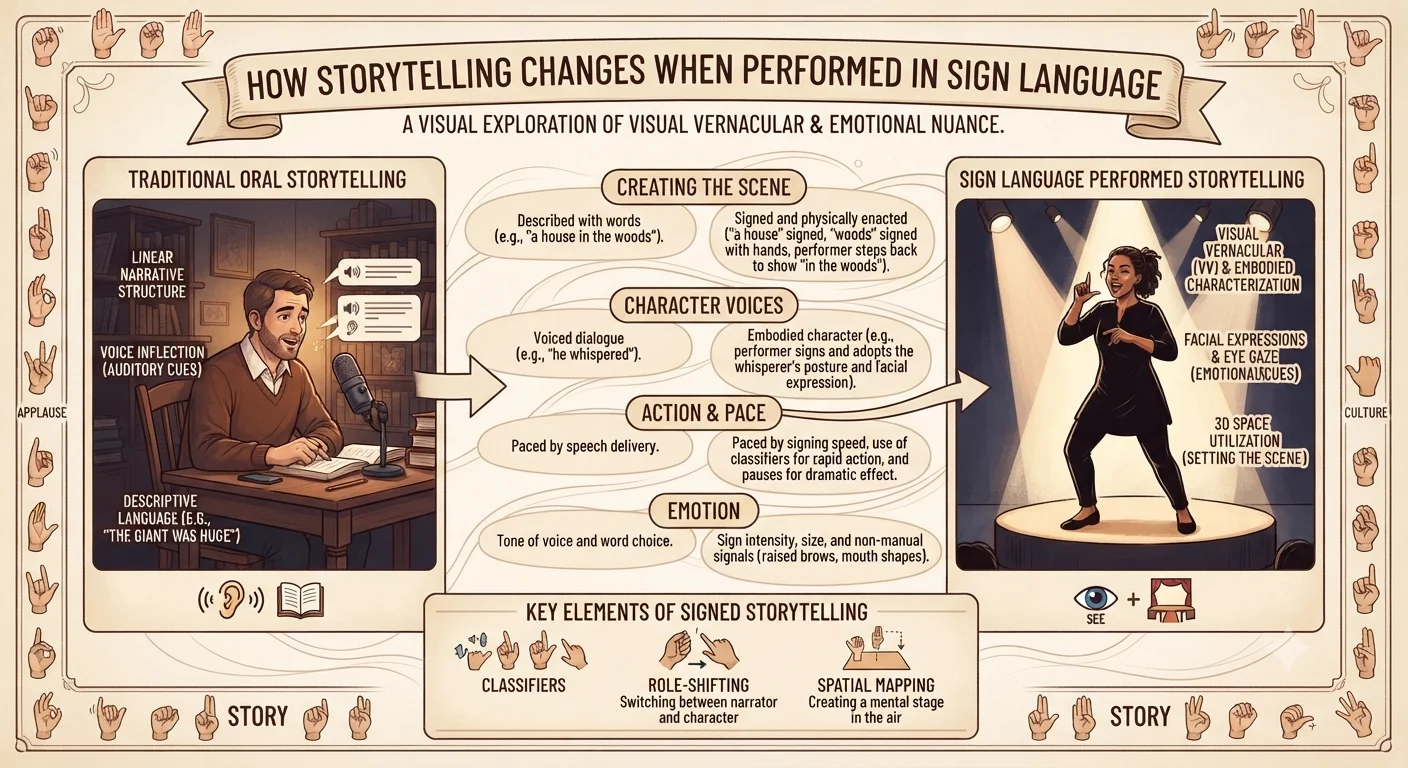
- How Storytelling Changes When Performed in Sign Language
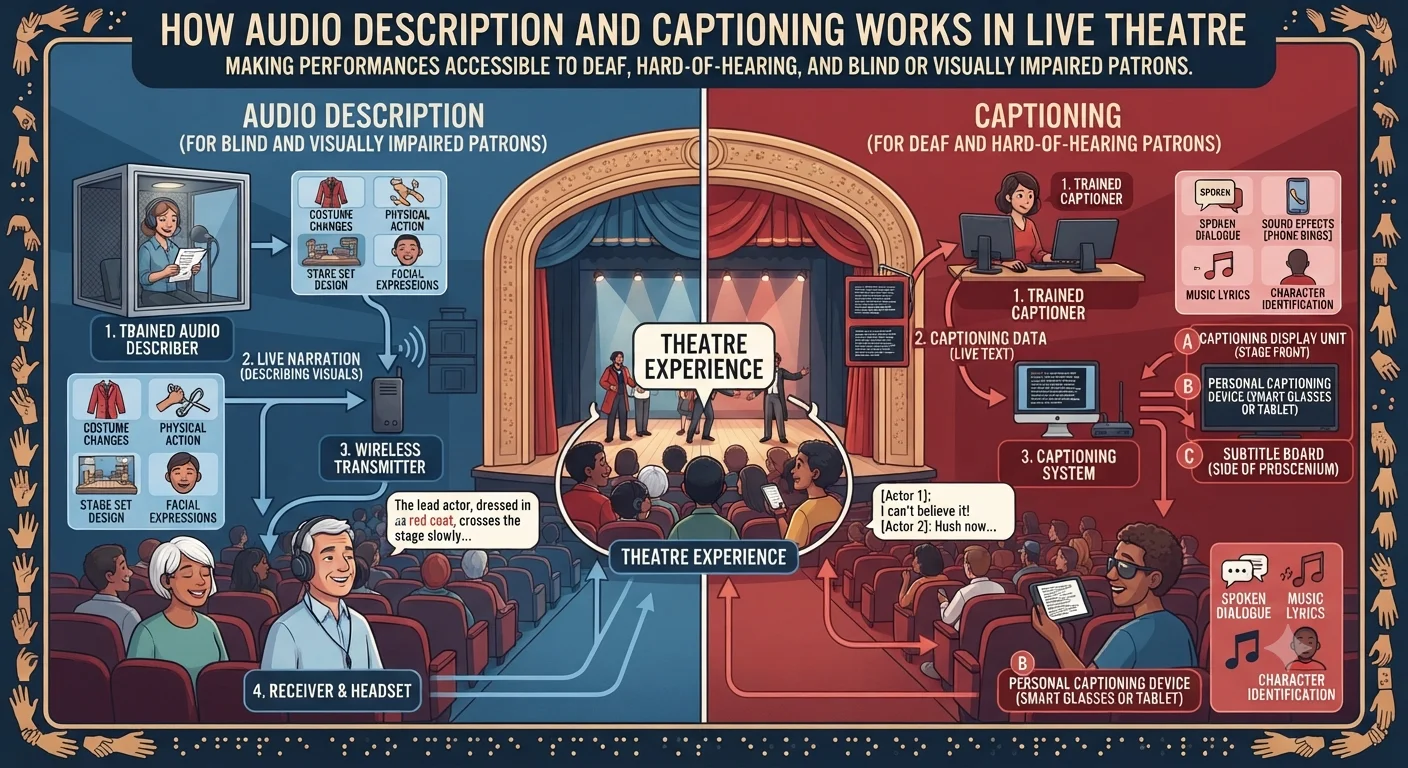
- How Audio Description and Captioning Works in Live Theatre
Current AR glasses for theatre accessibility typically work by receiving wirelessly transmitted caption text from the theatre's captioning system and displaying it as transparent text overlaid on the wearer's view of the stage. While early implementations have encountered challenges including battery life limitations display clarity issues and the need to calibrate the text position for different seating locations the fundamental technology has shown sufficient promise to attract continued investment and development from theatre organizations committed to leading edge accessibility solutions.
Smart Phone Caption Applications
Several theatres have developed or adopted smartphone applications that allow audience members to receive caption text directly on their own smartphones or tablets during captioned performances. These app based systems leverage the personal devices that many audience members already carry eliminating the need for theatres to maintain hardware inventories of dedicated caption devices while providing familiar and comfortable display interfaces that audience members already know how to use.
Recommended Articles
 INCLUSIVE STORYTELLING
 INCLUSIVE STORYTELLING
 INCLUSIVE STORYTELLING
 INCLUSIVE STORYTELLING
Smartphone caption applications also offer additional flexibility features including the ability to adjust text size and display preferences to match individual reading needs that one size fits all dedicated caption devices cannot provide. Some applications allow users to scroll back to review earlier caption text that may have been missed providing a reviewing capability that real time display systems without this feature cannot offer.
Remote Interpreting Technology
Video remote interpreting technology is enabling some theatres to offer ASL interpretation for deaf audience members without requiring a physical interpreter to be present in the theatre venue. By transmitting high quality video of a remote ASL interpreter to a screen visible to deaf audience members theatres that might lack access to local qualified theatre interpreters or that want to offer interpreted performances more frequently can expand their interpreted performance programming using remote interpreting technology.
While remote interpreting for live theatre presents specific challenges related to synchronization video quality and the importance of seeing both the interpreter and the stage simultaneously current technology is increasingly capable of delivering remote interpretation quality that provides meaningful access even if it does not yet fully replicate the experience of an in person interpreter positioned optimally within the theatre space.
Artificial Intelligence and Automatic Captioning
Artificial intelligence based automatic speech recognition technology is being explored as a potential tool for improving live theatre captioning by reducing dependence on fully manual operator triggered captioning systems. AI speech recognition that could automatically generate caption text from live dialogue in real time would potentially allow captioning at more performances including non-designated performances without the specialized human operator currently required for reliable live captioning.
Current AI speech recognition technology still faces meaningful challenges in live theatre environments including microphone quality variations theatrical projection styles that differ from everyday speech patterns and the need to handle overlapping dialogue in ways that remain problematic for current systems. However the rapid pace of AI development in this area suggests that automatic theatre captioning technology may become significantly more reliable and widely deployable within a reasonably near timeframe even if it is not yet ready for primary deployment in most live theatre contexts.
Technology and Human Expertise Working Together
The most important perspective on new theatre accessibility technology is that it works best when supporting rather than replacing the human expertise of skilled caption operators ASL interpreters and accessibility specialists who understand both the technical and human dimensions of providing genuine access rather than merely nominal compliance. Technology can expand what is possible and make existing accessibility solutions more reliable and comfortable but the commitment knowledge and judgment of skilled human accessibility professionals remain essential for translating technological capability into genuinely excellent deaf audience experience.
Conclusion
New technology is genuinely transforming what theatre accessibility for deaf and hard of hearing audiences can look like offering innovations from seatback caption displays to augmented reality glasses that represent meaningful improvements over previous accessibility solutions. As these technologies continue maturing and as more theatres invest in implementing them thoughtfully the gap between the theatre experience available to hearing and deaf audiences will continue narrowing in ways that benefit everyone who values live performance as a shared human experience deserving of genuine universal access.
FAQ
What are augmented reality caption glasses and how do they work in theatre?
AR caption glasses display caption text directly within the wearer's field of vision as transparent text overlaid on their view of the stage receiving wirelessly transmitted caption text from the theatre's captioning system allowing deaf audience members to watch the performance and read captions simultaneously without looking away from the stage.
What is seatback captioning and how does it improve the theatre going experience?
Seatback captioning provides individual small screens mounted on seats in front of caption users displaying text at close comfortable reading distance that allows much closer visual connection with the live performance compared to shared distant screens while also providing greater privacy for caption users who prefer discreet accessibility solutions.
Can artificial intelligence replace human caption operators in live theatre?
Current AI speech recognition technology still faces meaningful challenges in live theatre environments making human operators essential for reliable captioning at present though the rapid pace of AI development suggests automatic theatre captioning may become significantly more viable within a reasonably near timeframe even if it is not yet ready for primary deployment in most contexts.