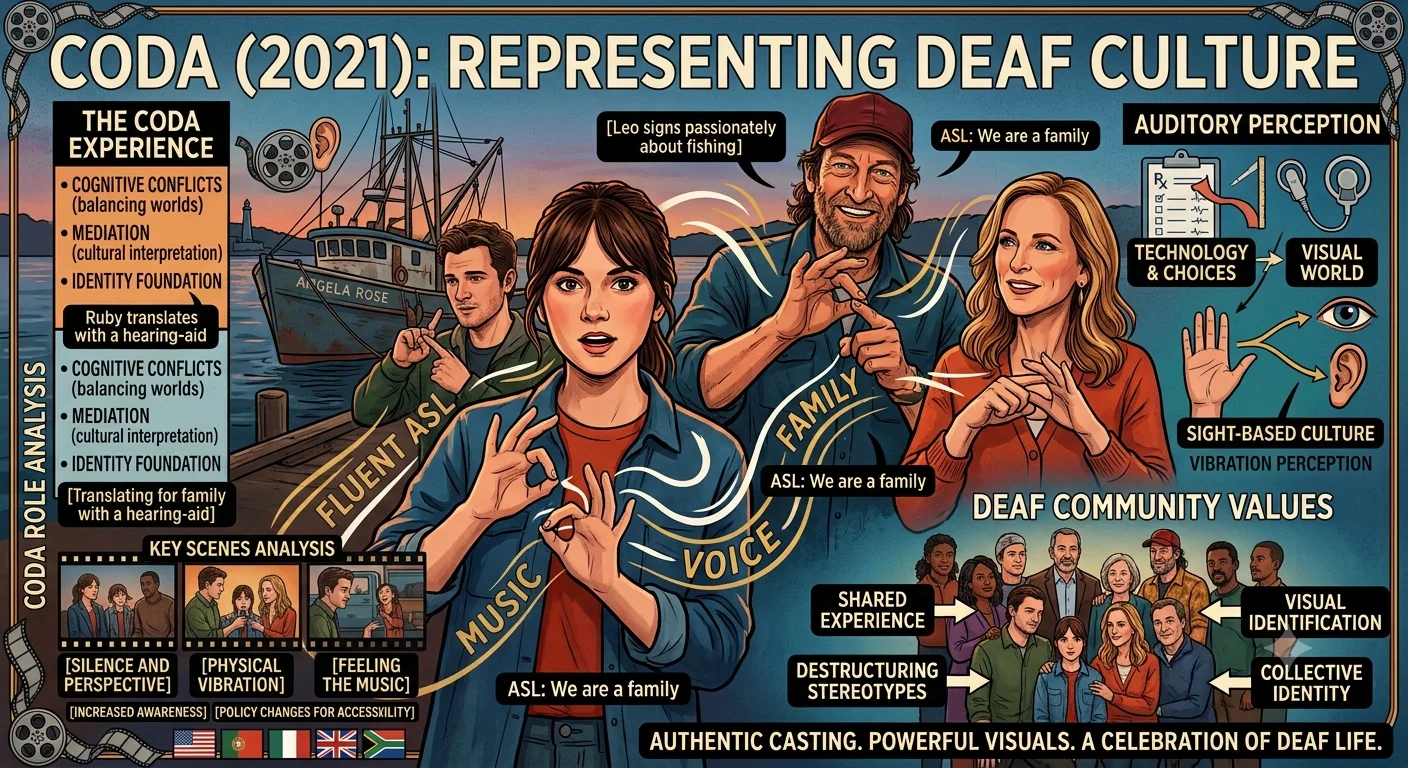
CODA released in 2021 became one of the most celebrated examples of authentic deaf representation in mainstream cinema in recent memory. The film's portrayal of a deaf family and its eventual historic Academy Award win marked a significant milestone for deaf representation that continues to influence conversations about authentic storytelling in Hollywood.
What CODA is about
CODA tells the story of Ruby a hearing teenager who is the only hearing member of her deaf family. The title itself stands for child of deaf adults a term used within deaf and hearing communities to describe hearing children raised by deaf parents. The film follows Ruby as she navigates her unique position translating and interpreting for her family while pursuing her own personal passion for singing which her deaf family members cannot directly experience.
The story explores themes of family obligation identity and the particular tensions that can arise for hearing children of deaf parents who often take on interpreting responsibilities from a young age while also developing their own individual interests and paths that may diverge from their family's deaf cultural context.
Authentic casting as the foundation of the film's success
A central reason CODA achieved such widespread acclaim for authentic representation was its commitment to casting real deaf actors in the central deaf family roles. Marlee Matlin played Ruby's mother Jackie Troy Kotsur played her father Frank and Daniel Durant played her brother Leo. This casting decision meant the film's deaf family scenes carried genuine ASL fluency and authentic deaf cultural rhythm that would have been extremely difficult for hearing actors to replicate convincingly.
This commitment to authentic casting extended beyond simply hiring deaf actors. The production reportedly worked to ensure ASL dialogue felt natural and unforced rather than appearing as a translation of English dialogue which is a common pitfall in productions with less genuine commitment to deaf cultural authenticity.
How the film portrayed deaf family dynamics
CODA was widely praised for depicting deaf family life with warmth humor and complexity rather than treating deafness as a source of tragedy or constant struggle. The film shows Frank and Jackie as parents with a full range of personality including humor sexuality and frustration that felt refreshingly human compared to more limited or pitying portrayals of deaf characters in earlier mainstream films.
The film also thoughtfully explored the specific challenges of being a CODA including Ruby's complicated feelings about her interpreting responsibilities and the guilt she experiences when considering pursuing her own dreams that would take her away from her family's daily communication needs. This nuanced exploration resonated strongly with many real CODAs who saw their own experiences reflected authentically on screen for perhaps the first time.
Troy Kotsur's historic Academy Award win
Troy Kotsur's performance as Frank earned him the Academy Award for Best Supporting Actor at the 2022 ceremony making him the first deaf man to win an acting Oscar. His win followed Marlee Matlin's earlier historic Best Actress win for Children of a Lesser God decades before, building on her trailblazing legacy in a powerful and symbolic way.
- How Closed Captions Changed Theatre Accessibility Forever
- Deaf Representation in Mainstream Movies and TV Shows
Kotsur's acceptance speech delivered in ASL and met with a standing ovation became one of the most memorable moments of the ceremony and brought significant mainstream attention to deaf representation and ASL as a language deserving of recognition on one of entertainment's biggest stages.
Recommended Articles
 INCLUSIVE STORYTELLING
 INCLUSIVE STORYTELLING
 INCLUSIVE STORYTELLING
 INCLUSIVE STORYTELLING
CODA winning Best Picture
CODA also won the Academy Award for Best Picture making it the first film with a majority deaf cast to win the industry's highest honor. This historic recognition signaled a significant shift in how the film industry's most prestigious institution was willing to recognize and celebrate authentic deaf led storytelling at the highest level of mainstream achievement.
The Best Picture win carried particular significance because it represented industry recognition not just for individual deaf performances but for the film as a complete artistic achievement demonstrating that authentic deaf representation could be central to award worthy storytelling rather than a notable but secondary element of a larger story.
Critical and community reception
CODA received broadly positive reviews from critics who praised its warmth humor and authentic performances. Within the deaf community reception was largely though not universally positive with many praising the film's authentic casting and nuanced family portrayal while some critics noted the story still centers significantly on Ruby's hearing perspective and journey rather than fully centering the deaf family members themselves.
This nuanced reception reflects ongoing community conversations about what truly complete and centered deaf representation looks like even within celebrated and largely positive examples like CODA which still found its central narrative anchor in a hearing character's coming of age story.
The film's broader cultural impact
CODA's success has had ripple effects across the entertainment industry by demonstrating decisively that authentic deaf casting and storytelling can achieve both critical acclaim and major awards recognition. This track record provides ammunition for advocates pushing for continued authentic casting opportunities for deaf actors in future productions.
The film also introduced many mainstream audiences to ASL and deaf family dynamics in an accessible and emotionally engaging format potentially building greater general public understanding and appreciation for deaf culture beyond audiences who might have sought out explicitly deaf focused content previously.
Conclusion
CODA represents a landmark achievement in authentic deaf representation combining genuine deaf casting nuanced family storytelling and historic award recognition that has significantly advanced industry conversations about deaf talent and representation. While community conversations about whose perspective truly centers the story continue the film's impact on visibility and opportunity for deaf actors and authentic storytelling remains substantial and significant.
FAQ
What does CODA stand for in the film's title? CODA stands for child of deaf adults a term describing hearing children raised by deaf parents which describes the film's main character Ruby.
Did CODA feature real deaf actors in the family roles? Yes Marlee Matlin Troy Kotsur and Daniel Durant who are all deaf played Ruby's mother father and brother respectively bringing authentic ASL fluency to these central roles.
What historic achievement did CODA accomplish at the Academy Awards? CODA won Best Picture making it the first film with a majority deaf cast to win this award while Troy Kotsur became the first deaf man to win an acting Oscar for his supporting role.