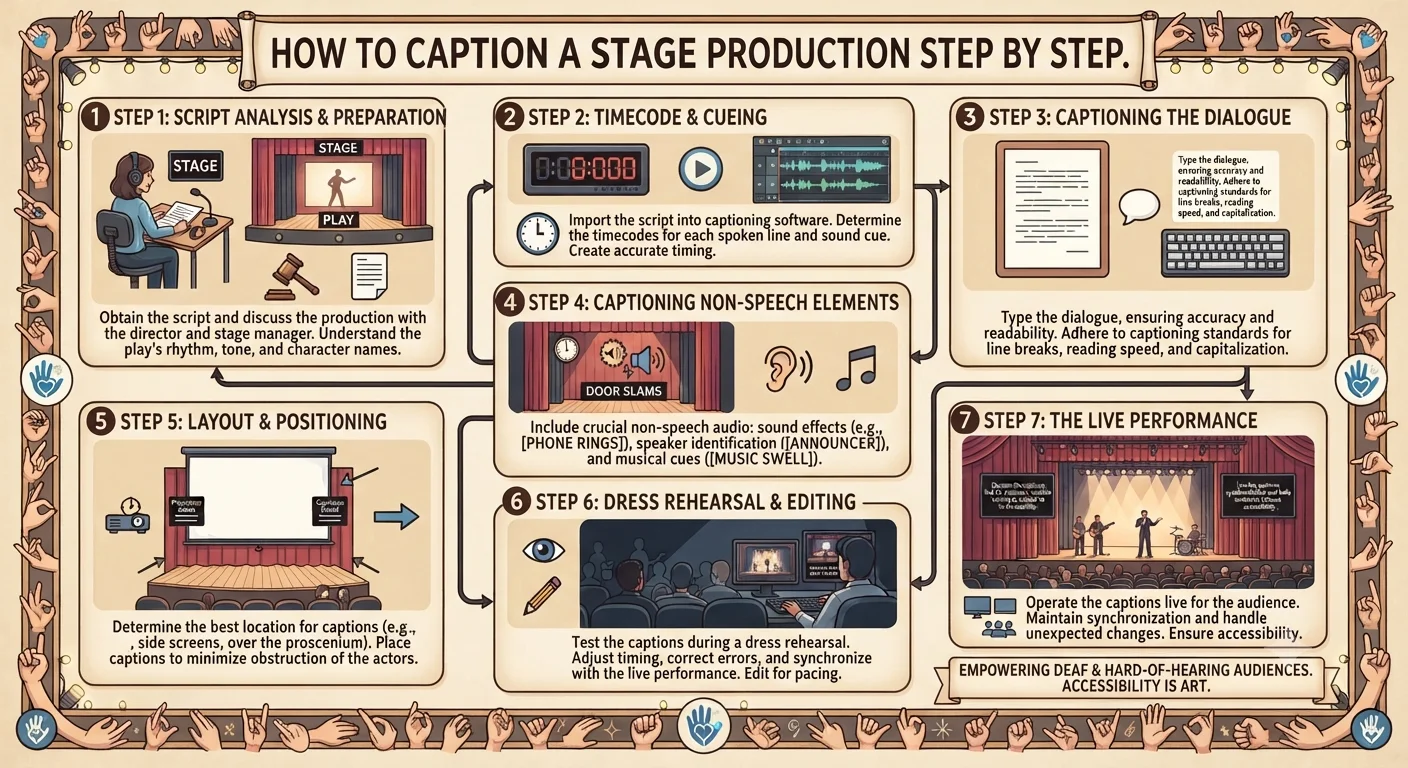
Learn how to caption a stage production step by step covering equipment script preparation operator training and creating truly accessible theatre for deaf audiences.
Captioning a stage production is a multi step process that requires careful planning specialized equipment skilled operation and genuine commitment to making live theatre accessible to deaf and hard of hearing audience members. This step by step guide walks through everything involved in creating effective live theatre captioning from initial planning through the captioned performance itself.
Step One Assess Your Captioning Needs and Options
Before beginning the captioning process theatre companies need to assess which captioning approach best suits their specific production venue budget and audience needs. The main options include open captioning which displays text on a screen visible to all audience members closed captioning through individual handheld devices that only caption users see and integrated caption displays built into the set design or seatback systems in venues equipped with this technology.
Each approach has different cost implications technical requirements and audience impact that need careful consideration before committing to a specific captioning method. Consulting with deaf community members and accessibility specialists during this initial assessment helps ensure the chosen approach genuinely serves the intended audience rather than simply satisfying a minimum compliance requirement in a way that does not provide truly useful access.
Step Two Obtain and Prepare the Production Script
- Step One Assess Your Captioning Needs and Options
- Step Two Obtain and Prepare the Production Script
- Step Three Select and Train Your Caption Operator
- Step Four Set Up Captioning Equipment and Software
- Step Five Attend Technical Rehearsals with the Caption System
- Step Six Conduct a Pre Performance Caption Check
- Step Seven Promote Your Captioned Performances Effectively
- Step Eight Gather Feedback and Improve
- Conclusion
- FAQ
- What is the difference between open captioning and closed captioning in theatre?
- How far in advance do caption operators need to receive the production script?
- How should theatres promote captioned performances to reach deaf audiences?
Effective live theatre captioning requires a complete and accurate script of all dialogue and relevant sound information that will be captioned during the performance. Obtaining this script as early as possible in the production process ideally during early rehearsals allows maximum preparation time before the first captioned performance.
The caption script must be formatted specifically for captioning use with clear cue points marked throughout indicating exactly when each line of dialogue should appear on the caption display. This formatting work requires careful attention to how natural speech patterns and line breaks translate into readable caption text since spoken dialogue does not always divide naturally into caption sized chunks that are easy to read during live performance.
Step Three Select and Train Your Caption Operator
A skilled caption operator is the most critical human element in effective live theatre captioning. The operator must be thoroughly familiar with the complete production script, capable of following the live performance accurately, and able to trigger caption displays at precisely the right moments to keep displayed text synchronized with the live dialogue happening on stage.
- How Storytelling Changes When Performed in Sign Language
- How Audio Description and Captioning Works in Live Theatre
- CODA Movie 2021 How It Represented Deaf Culture Accurately
Caption operator training typically involves multiple preparation sessions including script study to develop complete familiarity with the text, attendance at rehearsals to learn the production's specific timing patterns and pacing, and practice runs using the captioning equipment and software before the first live captioned performance.
Step Four Set Up Captioning Equipment and Software
Theatre captioning typically uses specialized software that displays pre-written caption text on connected screens or devices when the operator triggers each cue. Setting up this equipment requires technical planning regarding screen placement visibility from all seating areas cable management in the venue and testing of the display system under actual performance lighting conditions that may affect screen readability differently than ambient light conditions during setup.
Screen placement is particularly important since caption screens need to be positioned where audience members using the captions can read them without losing too much of their connection to the live performance happening on stage. Screens positioned too far from the stage or at awkward angles force caption users into uncomfortable viewing positions that significantly reduce the quality of their captioned performance experience.
Recommended Articles
 INCLUSIVE STORYTELLING
 INCLUSIVE STORYTELLING
 INCLUSIVE STORYTELLING
 INCLUSIVE STORYTELLING
Step Five Attend Technical Rehearsals with the Caption System
Caption operators should attend technical rehearsals with the full caption system set up and operational rather than first running the system during an actual performance. Technical rehearsals allow the operator to practice their cuing with the actual pacing of the production identify any script discrepancies between what was written and what is actually performed and troubleshoot any technical issues with the display system before deaf and hard of hearing audience members are depending on it during a real performance.
These technical rehearsals also allow the caption operator to develop the specific timing sense for this production that accurate live cuing requires since every production has its own unique pacing rhythms and actors' individual timing patterns that the operator must learn to follow precisely before confidently captioning a public performance.
Step Six Conduct a Pre Performance Caption Check
Before each captioned performance a brief pre performance check of all captioning equipment should confirm that screens or devices are functioning correctly that the caption software is loaded with the correct script version and that the operator position provides adequate visibility of both the stage and the caption triggering system. This pre performance verification prevents technical failures from disrupting the captioned performance experience for deaf audience members who have specifically attended this performance expecting reliable caption access.
Step Seven Promote Your Captioned Performances Effectively
Even perfectly executed captioning serves no audience if deaf and hard of hearing community members do not know captioned performances are available. Effective promotion of captioned performances through deaf community organizations social media channels accessible to deaf audiences and partnership with organizations serving deaf and hard of hearing populations in your community is essential for building the captioned audience that makes captioning investment worthwhile.
Step Eight Gather Feedback and Improve
After each captioned performance gathering feedback from deaf and hard of hearing audience members who used the captioning helps identify specific improvements for future captioned performances. This feedback might address caption timing accuracy screen visibility from different seating positions or aspects of the caption formatting that affected readability during the live performance. Treating this feedback as valuable professional input rather than simply compliance documentation demonstrates genuine commitment to continuous improvement in accessibility rather than minimum standard satisfaction.
Conclusion
Captioning a stage production effectively requires significant preparation skilled operation and genuine commitment to serving deaf and hard of hearing audience members with the highest possible quality of access. Theatre companies that invest properly in this process create genuinely inclusive performance experiences that expand their audiences while demonstrating that accessibility and artistic excellence are entirely compatible goals that strengthen rather than compromise each other.
FAQ
What is the difference between open captioning and closed captioning in theatre?
Open captioning displays text on a screen visible to the entire audience while closed captioning provides text through individual handheld devices or personal screens that only audience members who choose to use the captioning service can see.
How far in advance do caption operators need to receive the production script?
Caption operators should receive the complete script as early in the production process as possible ideally during early rehearsals to allow maximum preparation time for script formatting cue point marking and operator familiarization before the first captioned performance.
How should theatres promote captioned performances to reach deaf audiences?
Effective promotion should target deaf community organizations social media channels accessible to deaf audiences and partner organizations serving deaf and hard of hearing populations since these channels reach the specific community members most likely to attend and benefit from captioned performances.