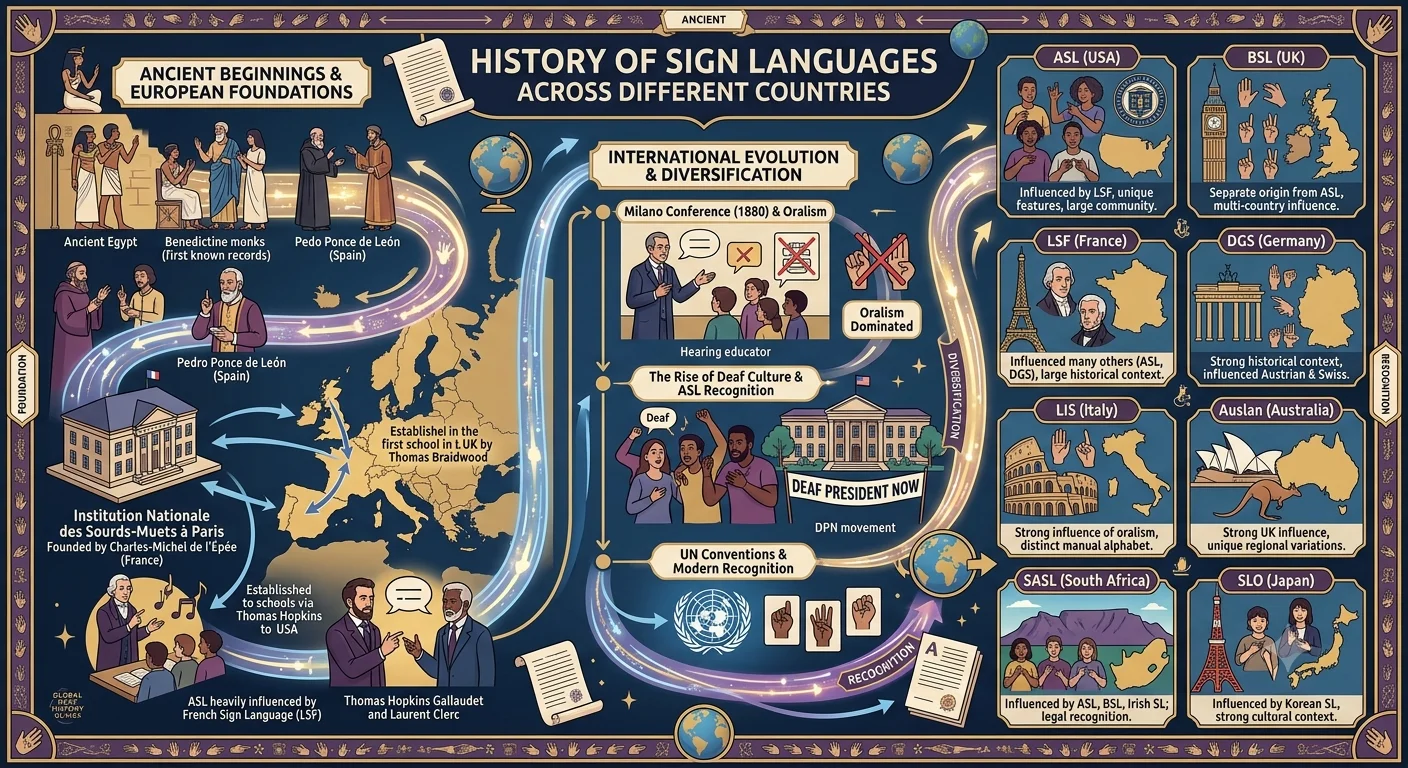
Sign languages have developed independently across countries and cultures throughout human history wherever deaf communities have formed and communicated visually with one another. Understanding the history of sign languages across different regions reveals how diverse and linguistically rich the world of signed communication truly is.
Why sign languages developed independently around the world
A common misconception is that sign language is universal across the globe. In reality sign languages emerged independently in different countries and regions much like spoken languages did. Wherever deaf people formed communities they naturally developed shared visual communication systems that eventually grew into complete and complex languages with their own grammar and vocabulary.
This independent development explains why someone fluent in American Sign Language cannot automatically understand British Sign Language despite both countries sharing English as a dominant spoken language. The sign languages evolved from entirely separate community origins rather than from the spoken languages around them.
French Sign Language and its influence on ASL
French Sign Language has one of the most well documented early histories among the world's sign languages. In the late 1700s Abbe Charles Michel de l'Epee established a school for deaf students in Paris and began systematically documenting and teaching sign language. His work represented one of the earliest formal educational approaches centered on sign language anywhere in the world.
- ASL Alphabet Chart with Pictures Complete Visual Guide
- Sign Language vs Spoken Language Key Differences Explained
When Laurent Clerc a deaf graduate of this Paris school traveled to America in 1816 with Thomas Hopkins Gallaudet he brought French Sign Language with him. This language blended with various home sign systems already used by deaf students across America eventually evolving into American Sign Language. This is why ASL shares more vocabulary and structural similarities with French Sign Language than with British Sign Language despite the shared spoken language with Britain.
British Sign Language and its distinct development
British Sign Language developed along an entirely separate path from ASL despite the shared English speaking context of both countries. BSL has its own grammar vocabulary and regional dialects that developed within deaf communities across the United Kingdom over centuries.
One notable difference between BSL and ASL is that BSL uses a two handed fingerspelling alphabet while ASL uses a one handed alphabet. This is one of many examples showing how sign languages develop unique features based on their own community history rather than mirroring the spoken language of the surrounding hearing population.
Japanese Sign Language
Japanese Sign Language developed within Japan's deaf community and has its own distinct grammar and vocabulary shaped by Japanese cultural context. Japanese Sign Language includes unique features related to how it handles concepts that differ structurally from spoken Japanese similar to how ASL differs structurally from spoken English.
- How to Learn ASL at Home for Beginners Step by Step Guide
- What is ASL and How Many People Use It Worldwide
Japan has a long history of deaf education and deaf community organizing and Japanese Sign Language continues to be an important part of deaf identity and culture within the country today.
Recommended Articles
 SIGN LANGUAGE EDUCATION
 SIGN LANGUAGE EDUCATION
 SIGN LANGUAGE EDUCATION
 SIGN LANGUAGE EDUCATION
Sign languages in developing nations
In many developing nations sign languages have historically developed more informally within local deaf communities without the same level of institutional documentation and standardization seen in countries with established deaf schools and universities. In some regions multiple village level or regional sign languages have developed independently within a single country before any national standardization occurred.
International deaf organizations and linguists have increasingly worked to document and support these emerging and lesser studied sign languages in recent decades recognizing their importance to local deaf communities and their value for linguistic research more broadly.
International Sign as a bridging tool
Because sign languages differ so significantly from country to country an informal communication system known as International Sign has developed particularly at international deaf events and gatherings. International Sign is not a complete language in the way ASL or BSL are. It functions more as a practical bridging tool that draws on widely understood gestures and gestures common across multiple sign languages to allow basic communication between deaf people from different countries.
Why understanding this history matters
Recognizing that sign languages have rich independent histories across different countries helps dismantle the misconception that sign language is a single universal system. It also highlights the linguistic achievement represented by each sign language's development as deaf communities created complete languages often without the same institutional support that spoken languages historically received.
This history also explains practical realities for deaf travelers and the deaf community internationally. A deaf ASL user traveling to the United Kingdom or Japan would need to learn the local sign language to communicate fluently just as a hearing English speaker would need to learn a new spoken language in those countries.
Conclusion
The history of sign languages across different countries reveals an extraordinary pattern of independent linguistic development as deaf communities around the world created complete languages suited to their own communities and cultural contexts. From the French roots of American Sign Language to the entirely separate development of British Sign Language and beyond this history shows the remarkable linguistic creativity of deaf communities throughout human history.
FAQ
Is there one universal sign language used by deaf people everywhere? No each country or region typically has developed its own distinct sign language with unique grammar and vocabulary. International Sign exists as an informal bridging tool but is not a complete universal language.
Why is ASL more similar to French Sign Language than British Sign Language? ASL developed partly from French Sign Language brought to America by Laurent Clerc in 1816 while British Sign Language developed entirely separately within the United Kingdom.
How many sign languages exist in the world today? Researchers estimate there are well over 100 distinct sign languages used around the world though exact numbers are difficult to determine due to limited documentation in some regions.