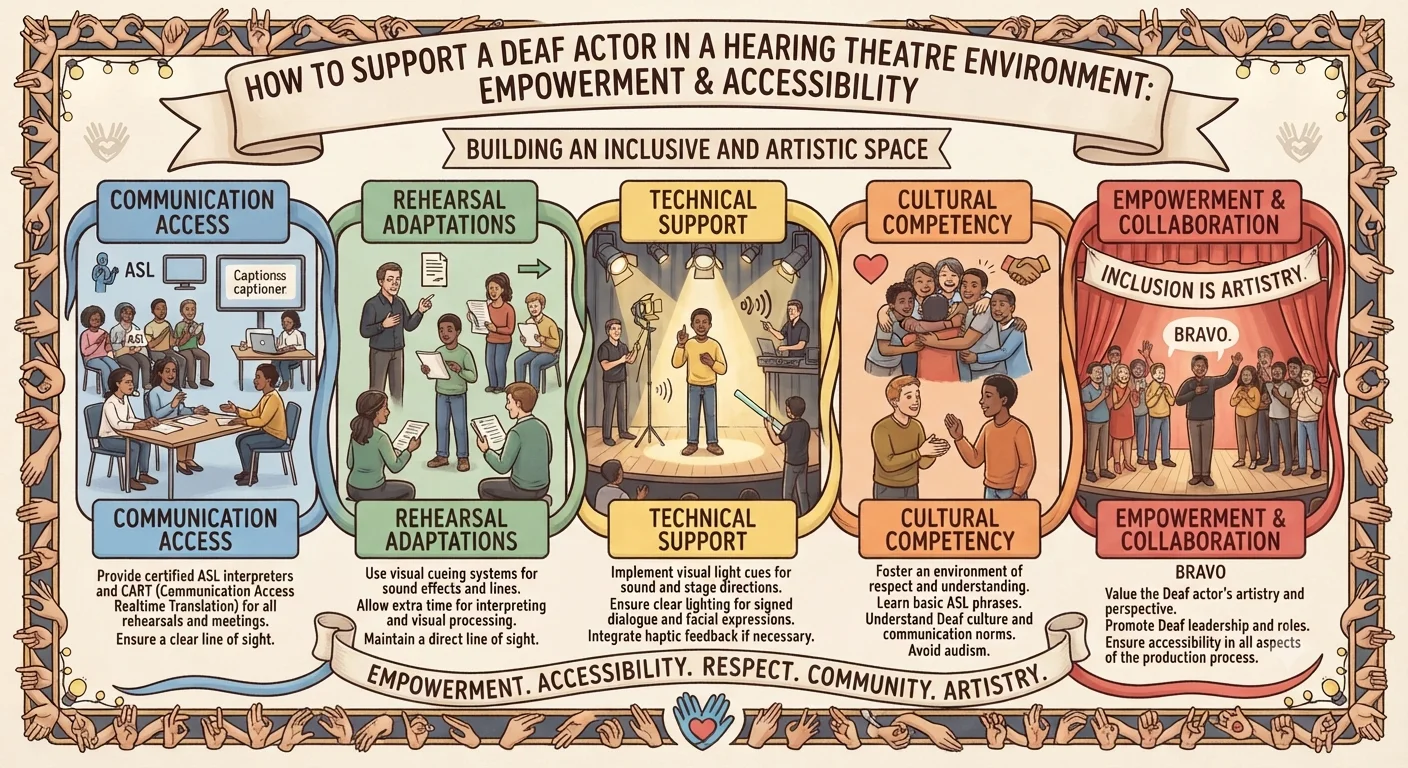
Learn how to support a deaf actor in a hearing theatre environment covering communication rehearsal accessibility and creating genuinely inclusive production cultures.
Supporting a deaf actor in a hearing theatre environment requires more than good intentions and basic accommodation awareness. It requires genuine commitment to creating communication access throughout every dimension of the production process from audition through closing night combined with real cultural humility and willingness to learn from the deaf artist themselves about what genuine support actually looks like in practice. When hearing theatre companies get this right the result is not only more inclusive productions but often more visually inventive and theatrically powerful work that benefits from the distinctive artistic perspective a deaf performer brings.
Understanding That Support Begins Before Rehearsals Start
Supporting a deaf actor effectively begins long before the first rehearsal with thoughtful planning and communication that ensures the actor knows what to expect and that the company has taken concrete steps to provide genuine access rather than improvising accommodation responses after problems emerge during the production process. Reaching out to the deaf actor before rehearsals begin to discuss their specific communication preferences access needs and any concerns about the production environment demonstrates respect and allows the company to address potential barriers proactively rather than reactively.
Many deaf actors have well developed understanding of what they need to participate fully in hearing theatre contexts having navigated these environments before and their input about what has worked and not worked in previous productions is invaluable practical guidance that companies should actively seek and genuinely incorporate into their planning rather than treating as an optional consultation that can be set aside if accommodation seems inconvenient or expensive.
Providing Qualified Interpretation Throughout the Process
- Understanding That Support Begins Before Rehearsals Start
- Providing Qualified Interpretation Throughout the Process
- Creating Communication Norms That Include the Deaf Actor
- Adapting Rehearsal Processes Thoughtfully
- Staging Decisions That Serve Both Art and Access
- Building Genuine Company Culture Inclusion
- Learning from the Deaf Actor's Artistic Perspective
- Conclusion
- FAQ
- Should interpretation be provided only during formal rehearsals or throughout the entire production process?
- How should directors adapt their rehearsal approach when working with a deaf actor?
- What is the most important thing hearing company members can do to support a deaf colleague?
Qualified ASL interpretation for a deaf actor in a hearing theatre environment should cover every aspect of the production process not just formal rehearsal periods. Production meetings design discussions script readings notes sessions and social gatherings that are part of company culture all require interpretation access if the deaf actor is to participate as a full member of the creative community rather than as a performer whose access is limited to the specific rehearsal activities for which formal interpretation has been arranged.
The quality of interpreters provided matters as much as their presence since an inadequately skilled interpreter provides nominal rather than genuine access particularly in the fast paced contextually complex environment of theatre rehearsals where creative discussion moves quickly between abstract concepts concrete staging problems and interpersonal dynamics that all require accurate nuanced interpretation. Companies should work with interpreter agencies specializing in theatrical interpreting and whenever possible should allow the deaf actor to have input in selecting interpreters they will work with throughout the production since existing working relationships with specific interpreters can significantly improve communication quality and comfort.
Creating Communication Norms That Include the Deaf Actor
Hearing theatre companies working with deaf actors need to examine and often change communication norms that feel natural within a hearing ensemble but that systematically exclude a deaf team member without the hearing company members even noticing. Calling out information across a room assuming everyone has heard an announcement made while facing away from a deaf actor or having side conversations that an interpreter cannot simultaneously cover while also interpreting primary rehearsal content all create exclusion that can leave a deaf actor feeling isolated from the company culture even when formal accommodation is in place.
Directors and stage managers can establish simple but meaningful communication norms at the beginning of a production process that significantly improve inclusion for a deaf company member. These might include always facing toward the deaf actor and their interpreter when giving direction ensuring all written production materials are distributed rather than only announced verbally and creating a culture where hearing company members naturally check that the deaf actor has received information that was shared in passing rather than assuming equal access has occurred automatically.
Adapting Rehearsal Processes Thoughtfully
Some standard hearing theatre rehearsal processes need thoughtful adaptation to serve a deaf actor's full participation without creating an experience of being perpetually behind or dependent on secondhand information about what is happening. Music learning periods for musical theatre productions present particular challenges since hearing actors can absorb music through repeated listening while deaf actors need alternative approaches for learning rhythms and cues that may require creative problem solving between the actor the music director and the interpreter.
Recommended Articles
 THEATRE AND PERFORMING ARTS
 THEATRE AND PERFORMING ARTS
 THEATRE AND PERFORMING ARTS
 THEATRE AND PERFORMING ARTS
Directors who are accustomed to giving direction through vocal tone and spoken nuance should consider how to make their directorial intentions fully accessible through language and demonstration that does not depend on hearing the specific quality of how something is said to understand what is being asked. This directorial adaptation often leads to clearer and more specific direction that benefits all performers in the rehearsal room even while being specifically designed to ensure full access for the deaf actor.
Staging Decisions That Serve Both Art and Access
When a deaf actor is in the cast staging decisions need to ensure their physical positioning on stage provides clear sightlines to their interpreter when they need visual cues during performance without creating obviously awkward staging that draws attention to the access arrangement rather than serving the dramatic scene. Experienced deaf theatre directors and advisors can provide valuable guidance on how to integrate interpreter positioning and deaf actor sightline needs into staging solutions that feel organic to the production rather than imposed by accommodation requirements.
Productions that take this staging work seriously often discover that the visual attentiveness to sightlines and physical clarity that serving a deaf actor requires produces staging that is more visually dynamic and intentionally composed than what would have emerged from a rehearsal process that never needed to consider these spatial and visual dimensions of theatrical communication so carefully.
Building Genuine Company Culture Inclusion
Beyond formal communication accommodation genuine inclusion of a deaf actor in the company culture of a hearing theatre production requires hearing company members to invest personal effort in building communication relationships with their deaf colleague rather than leaving all cross cultural communication to the interpreter as an ongoing intermediary. Learning even basic signs relevant to the production context asking the deaf actor directly about their preferences and experiences and treating sign language as a fascinating communication mode to engage with rather than a barrier to work around all contribute to building genuine ensemble culture that includes rather than tolerates the deaf company member.
Hearing actors who make genuine effort to communicate directly with deaf colleagues even imperfectly often develop the most meaningful and artistically productive working relationships that ultimately enrich the production work in ways that purely interpreter mediated professional relationships rarely achieve with the same depth and creative chemistry.
Learning from the Deaf Actor's Artistic Perspective
Perhaps the most valuable aspect of supporting a deaf actor in a hearing theatre environment is the opportunity to learn from their distinctive artistic perspective shaped by visual communication language and a fundamentally different relationship to how performance conveys meaning. Deaf actors often bring acute visual awareness spatial sensitivity and physical expressive range that can challenge and expand how hearing directors and fellow actors think about theatrical communication and presence.
Companies that approach working with a deaf actor as a genuine artistic enrichment opportunity rather than only an accommodation challenge to be managed often discover that the production and the company's broader artistic practice are expanded in lasting ways by what the deaf artist brings to the collaborative work when genuinely supported and invited to contribute their full artistic perspective.
Conclusion
Supporting a deaf actor in a hearing theatre environment effectively requires planning communication commitment and genuine cultural learning that goes well beyond basic accommodation awareness. Companies that invest this effort create genuinely inclusive production cultures that honor the deaf actor's full humanity and artistic contribution while often discovering in the process that the visual and communicative clarity this commitment requires enriches their entire artistic practice in ways that benefit every member of the creative community involved.
FAQ
Should interpretation be provided only during formal rehearsals or throughout the entire production process?
Interpretation should cover every aspect of the production process including production meetings design discussions notes sessions and company social gatherings since limiting interpretation to formal rehearsal periods excludes the deaf actor from significant dimensions of production community life and creative collaboration.
How should directors adapt their rehearsal approach when working with a deaf actor?
Directors should ensure their direction is fully accessible through clear language and demonstration rather than depending on vocal tone for nuanced communication should address the deaf actor and interpreter together during direction giving and should adapt music learning and cue processes to serve the deaf actor's different relationship to auditory information.
What is the most important thing hearing company members can do to support a deaf colleague?
Making genuine personal effort to communicate directly with the deaf actor even imperfectly rather than leaving all communication to the interpreter builds the most meaningful working relationships and creates the genuine ensemble inclusion that purely formally mediated professional relationships rarely achieve with the same depth and creative richness.