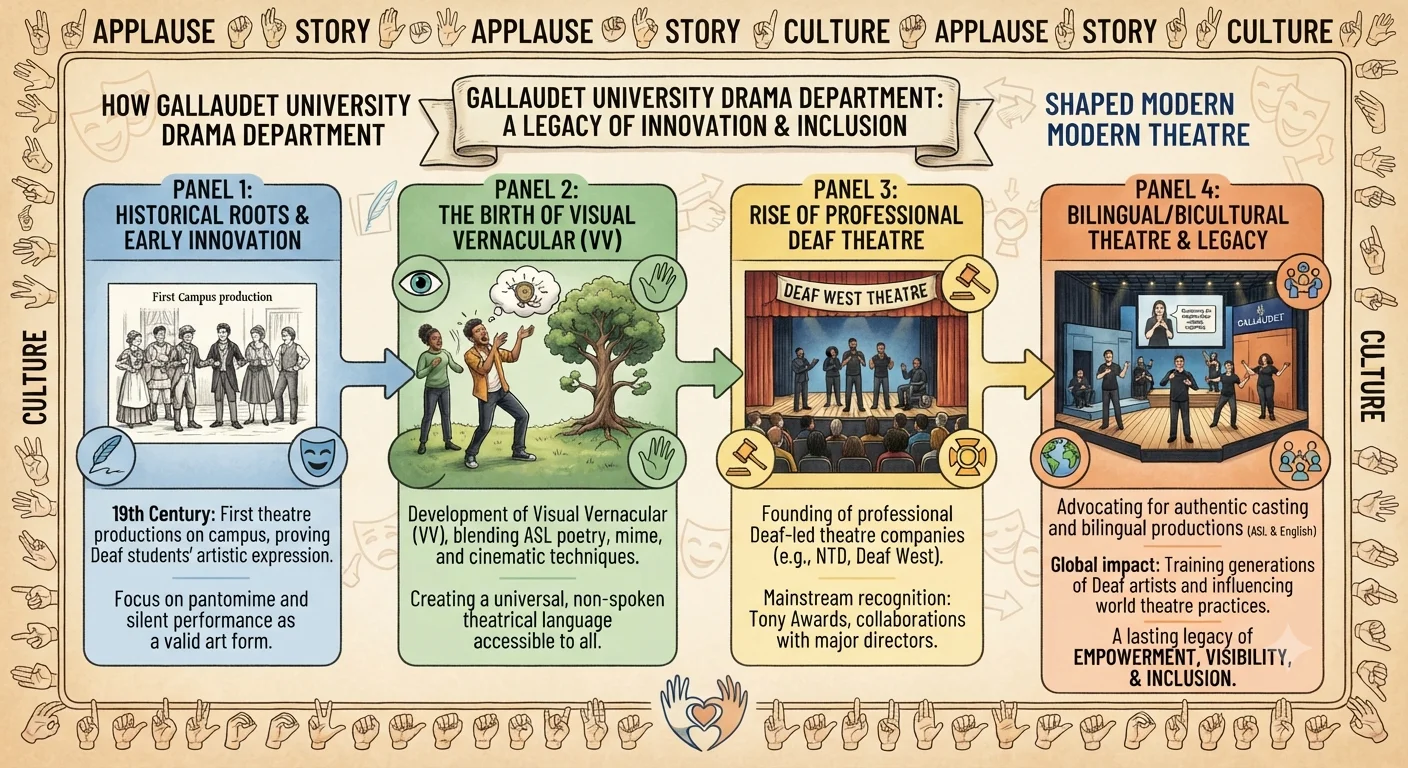
Discover how Gallaudet University drama department shaped modern deaf theatre producing legendary performers directors and playwrights who changed the industry forever.
Gallaudet University's drama department stands as one of the most consequential theatrical training programs in American history not because of its size but because of the extraordinary influence its graduates have had on deaf theatre mainstream theatre and the broader performing arts world. Understanding how this program developed and what makes it distinctive helps explain why Gallaudet remains the beating heart of deaf theatrical training more than a century after the university first opened its doors.
The Origins of Theatre at Gallaudet University
Theatre at Gallaudet University has roots stretching back to the earliest decades of the institution when student performance and dramatic presentation became important parts of campus cultural life. As the only university specifically designed for deaf students Gallaudet provided a unique environment where deaf performers could develop their craft in a fully accessible setting surrounded by peers faculty and a broader campus community that shared their language and cultural context.
This environment proved extraordinarily fertile for theatrical development since deaf performers at Gallaudet were not working around communication barriers or adapting to hearing centered theatrical conventions but were instead developing performance approaches that drew naturally and fully on the visual linguistic and spatial properties of their own language and culture. This freedom to develop from within rather than adapt from without gave Gallaudet theatre its distinctive character and helped produce performers with artistic approaches that differed meaningfully from anything being developed in hearing theatre programs of the same era.
The Department's Approach to ASL as Performance Language
- The Origins of Theatre at Gallaudet University
- The Department's Approach to ASL as Performance Language
- Famous Alumni Who Shaped American Theatre
- The Department's Role in Training Deaf Theatre Educators
- Collaboration with Professional Deaf Theatre Organizations
- The Intersection of Deaf Studies and Theatre Training
- Current Programs and Future Directions
- Conclusion
- FAQ
- What makes Gallaudet University's drama training distinctive from hearing theatre programs?
- Which famous deaf theatre artists trained at Gallaudet University?
- How has Gallaudet's drama program influenced deaf theatre education nationally?
What distinguishes Gallaudet's drama training most fundamentally from hearing theatre programs is the centrality of ASL as a complete performance language rather than an accommodation or translation tool. Students in Gallaudet's drama program learn to use ASL's spatial grammar visual storytelling techniques classifiers and facial expression as genuine dramatic resources rather than learning primarily within English language theatrical conventions and then considering how to adapt those conventions for deaf performance contexts.
This ASL centered approach produces performers who think visually and spatially about dramatic storytelling in ways that hearing trained performers typically do not develop even in highly physical or movement oriented hearing theatre training programs. The result is a distinctive performance aesthetic that has influenced how directors and choreographers across the broader theatre world think about visual storytelling and the use of physical and spatial elements in staging.
Famous Alumni Who Shaped American Theatre
The list of Gallaudet drama alumni who have gone on to make significant contributions to American theatre is remarkable for a program of its size. Phyllis Frelich who won the Tony Award for Best Actress in a Play for Children of a Lesser God on Broadway studied at Gallaudet bringing to her landmark performance the deep ASL fluency and visual performance sophistication she developed within the university's theatrical training environment.
- Playwrights Who Changed Deaf Theatre History Forever
- Best Deaf Theatre Companies Operating in the World Today
- How Deaf Theatre Directors Stage Productions Differently
Bernard Bragg whose contributions to the National Theatre of the Deaf and to deaf performance more broadly helped establish the artistic standards for professional deaf theatre in America also maintained close connections to Gallaudet throughout his career. Numerous other Gallaudet alumni have gone on to work with Deaf West Theatre the National Theatre of the Deaf and other significant deaf theatre organizations building professional careers rooted in the training foundation Gallaudet provided.
The Department's Role in Training Deaf Theatre Educators
Beyond producing professional performers Gallaudet's drama program has trained generations of deaf theatre educators who have gone on to establish and lead theatre programs at schools for the deaf and other educational institutions across the country. This educational multiplier effect means Gallaudet's theatrical influence extends far beyond the direct professional careers of its performance graduates to shape how theatre is taught and experienced by deaf students at every educational level nationwide.
Recommended Articles
 THEATRE AND PERFORMING ARTS
 THEATRE AND PERFORMING ARTS
 THEATRE AND PERFORMING ARTS
 THEATRE AND PERFORMING ARTS
This educator training function is arguably one of the most consequential aspects of Gallaudet's theatrical legacy since it has helped ensure that quality theatre education remains available to deaf students across the country rather than being concentrated only in areas with direct access to major professional deaf theatre companies and their training programs.
Collaboration with Professional Deaf Theatre Organizations
Gallaudet's drama department has maintained important collaborative relationships with professional deaf theatre organizations throughout its history creating pathways for students to transition from academic training into professional work and bringing professional artists onto campus to enrich the training environment beyond what full time faculty alone can provide. These relationships between the academic training environment and the professional performance world help ensure Gallaudet graduates are prepared for the realities of professional deaf theatre careers rather than only for the more protected environment of academic performance.
Guest artists residencies from deaf theatre professionals visiting Gallaudet have exposed students to a range of artistic approaches and professional perspectives that complement the consistent training provided by permanent faculty producing graduates with broader artistic awareness than any single pedagogical approach could develop on its own.
The Intersection of Deaf Studies and Theatre Training
One of the distinctive advantages of training in Gallaudet's drama program compared to theatre programs at hearing universities is the deep integration of deaf cultural studies and deaf history with theatrical training. Students at Gallaudet develop their performance skills within a comprehensive understanding of deaf cultural context deaf history and the specific artistic traditions of deaf theatre rather than learning performance technique in a cultural vacuum disconnected from the community whose stories they will ultimately be most equipped and called upon to tell.
This integration of cultural education with performance training produces graduates who understand not just how to perform but why deaf theatre matters what it is doing culturally and artistically and how their own work fits within a larger tradition of deaf artistic expression and community advocacy that gives individual artistic practice its broader significance and purpose.
Current Programs and Future Directions
Gallaudet's drama program continues evolving to address the changing landscape of deaf theatre and performance in the 21st century incorporating new technologies emerging performance forms and evolving conversations about representation and inclusion that shape contemporary theatre more broadly. The program's core commitment to ASL as a complete performance language and to training artists deeply grounded in deaf cultural knowledge and community connection remains constant even as specific curricular offerings and artistic approaches continue developing.
As mainstream theatre continues moving toward greater inclusion of deaf and disabled artists Gallaudet trained performers and directors are increasingly well positioned to contribute their distinctive artistic perspectives to productions and organizations across the full spectrum of American theatre rather than only within specifically deaf theatre contexts.
Conclusion
Gallaudet University's drama department has shaped modern theatre through the extraordinary artists educators and advocates it has trained over more than a century of theatrical education rooted in ASL as a complete performance language and deep integration with deaf cultural knowledge and community. Its influence on American theatre extends far beyond the relatively small number of students it has trained directly reaching across the entire landscape of deaf theatre and increasingly into mainstream theatrical practice through the work of its remarkable alumni.
FAQ
What makes Gallaudet University's drama training distinctive from hearing theatre programs?
Gallaudet's program centers ASL as a complete performance language rather than an accommodation produces performers who think visually and spatially about dramatic storytelling and integrates deep deaf cultural education with technical performance training in ways hearing programs cannot replicate.
Which famous deaf theatre artists trained at Gallaudet University?
Notable alumni include Tony Award winner Phyllis Frelich and Bernard Bragg among many others who have shaped American deaf theatre through performance directing and education across multiple generations of deaf theatrical work.
How has Gallaudet's drama program influenced deaf theatre education nationally?
By training generations of deaf theatre educators who have established and led programs at schools for the deaf across the country Gallaudet's theatrical influence extends through an educational multiplier effect that shapes how theatre is taught to deaf students at every level nationwide.