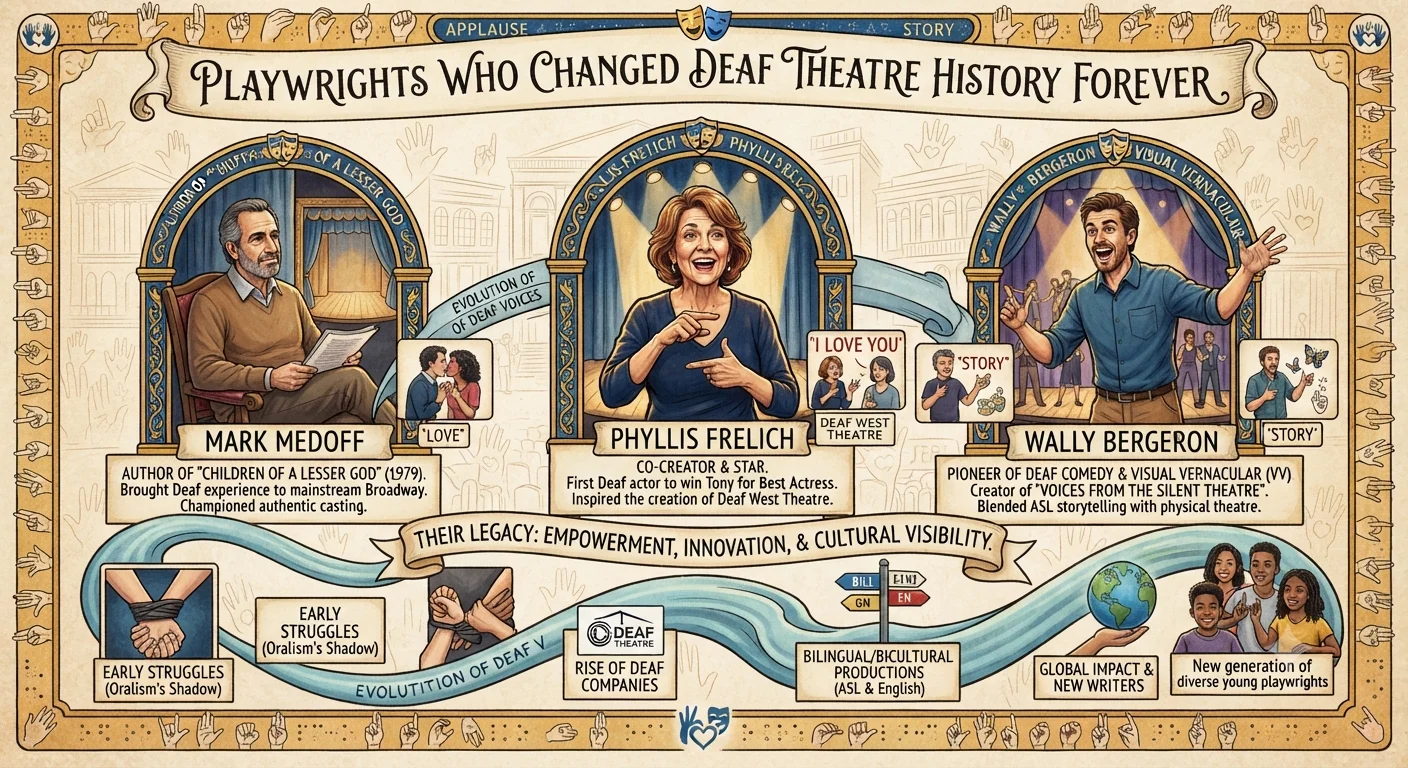
Discover the playwrights who changed deaf theatre history forever through groundbreaking scripts that centered deaf experience identity and sign language performance.
Deaf theatre history has been shaped by a relatively small number of extraordinarily influential playwrights whose work created the dramatic foundation on which subsequent generations of deaf theatre artists have built their careers and artistic visions. Understanding who these writers were and what made their work so significant helps explain how deaf theatre developed from a community performance tradition into a recognized and respected professional art form.
Mark Medoff and Children of a Lesser God
Mark Medoff holds a unique place in deaf theatre history as a hearing playwright who created one of the most celebrated and enduring deaf theatre scripts ever written. Children of a Lesser God which premiered on Broadway in 1980 was written specifically for deaf actress Phyllis Frelich after Medoff met her and recognized her extraordinary talent and the dramatic potential of a story exploring the relationship between deaf and hearing worlds through deeply human characters rather than through a medical or inspirational framework.
What distinguished Medoff's writing was his willingness to genuinely center Sarah Norman's deaf perspective and fierce resistance to hearing assumptions rather than ultimately privileging his hearing protagonist's point of view as so many other stories about deaf experience had done before. The play's dramatic power comes precisely from this tension and the way Medoff allowed Sarah's perspective genuine weight and validity rather than resolving the story by having her accommodate to the hearing world's expectations.
Eugene Bergman and Bernard Bragg
- Mark Medoff and Children of a Lesser God
- Eugene Bergman and Bernard Bragg
- Willy Conley and Deaf Centered Dramatic Writing
- Stephen Sachs and Expanding the Canon
- The Role of Gallaudet University in Nurturing Deaf Playwrights
- What Makes Deaf Theatre Writing Distinctive
- The Continuing Need for Deaf Authored Scripts
- Conclusion
- FAQ
- Why is Mark Medoff significant in deaf theatre history despite being a hearing playwright?
- What role has Gallaudet University played in nurturing deaf playwrights?
- What distinguishes the most effective scripts written for deaf theatre?
Eugene Bergman and Bernard Bragg collaborated as playwrights associated with the early National Theatre of the Deaf creating works that drew directly on deaf community experience and ASL as performance language during the company's formative years. Their collaboration represented an important early model of deaf centered playwriting that drew on insider cultural knowledge rather than hearing perspectives on deaf experience.
- Best Deaf Theatre Companies Operating in the World Today
- How Deaf Theatre Directors Stage Productions Differently
- Children of a Lesser God Play and Movie Complete Review
Bernard Bragg in particular was a significant figure not only as a playwright but as a performer director and advocate whose multifaceted contributions helped establish the artistic standards and cultural authenticity that became hallmarks of the National Theatre of the Deaf during its most influential period.
Willy Conley and Deaf Centered Dramatic Writing
Willy Conley is a deaf playwright director and writer whose work has explored deaf experience and identity through a range of dramatic forms including plays essays and criticism. His writing has contributed to developing a body of deaf authored dramatic literature that centers deaf perspectives from the inside rather than interpreting deaf experience through hearing authored frameworks regardless of how sympathetically those frameworks may be constructed.
Deaf playwrights like Conley represent an important ongoing development in deaf theatre history since authentic representation in playwriting ultimately requires insider cultural knowledge and lived experience that no amount of research and good intention by outside authors can fully replicate in the way that insider perspective naturally provides.
Recommended Articles
 THEATRE AND PERFORMING ARTS
 THEATRE AND PERFORMING ARTS
 THEATRE AND PERFORMING ARTS
 THEATRE AND PERFORMING ARTS
Stephen Sachs and Expanding the Canon
Several contemporary playwrights both deaf and hearing have continued expanding the deaf theatre canon with new works that address aspects of deaf experience not previously explored in dramatic literature. These contemporary works reflect both the broadening of deaf representation in theatre more generally and the growing recognition that deaf experience encompasses far more dramatic territory than the specific themes and situations that dominated earlier deaf theatre scripts.
The Role of Gallaudet University in Nurturing Deaf Playwrights
Gallaudet University's theatre program has played a vital role in training and nurturing deaf playwrights by providing an educational environment where deaf students can develop both their theatrical craft and their understanding of deaf cultural and artistic traditions that should inform authentic deaf playwriting. Many of the most significant deaf playwrights working today have connections to Gallaudet either as students or faculty demonstrating the university's central role in developing the creative talent that continues shaping deaf theatre.
What Makes Deaf Theatre Writing Distinctive
The most effective scripts for deaf theatre share certain qualities that distinguish them from plays that simply feature deaf characters without genuine cultural grounding. They treat ASL as a legitimate and expressive dramatic language rather than as a limitation to work around. They give deaf characters full interior lives and genuine dramatic agency rather than using deafness primarily as a plot device or source of inspirational narrative arc. They engage authentically with the specific textures of deaf cultural life community and identity rather than depicting deafness in generic or culturally inaccurate ways that ring false to deaf audience members with lived experience of the community being portrayed.
The Continuing Need for Deaf Authored Scripts
Despite the significant contributions of hearing playwrights like Mark Medoff to deaf theatre history the ongoing development of the art form ultimately depends on cultivating deaf playwrights who can bring genuine insider perspective to dramatic writing about deaf experience. This requires educational pipelines theatrical opportunities and financial support for deaf playwrights at all career stages from student work through professional production of new scripts by established deaf writers.
Conclusion
The playwrights who have changed deaf theatre history represent a mix of hearing allies who brought genuine respect and dramatic skill to deaf centered stories and deaf writers who brought irreplaceable insider cultural knowledge and lived experience to their dramatic writing. Together their contributions have created a body of dramatic literature that continues to grow in richness and diversity as new generations of deaf and allied playwrights build on the foundation these pioneering writers established.
FAQ
Why is Mark Medoff significant in deaf theatre history despite being a hearing playwright?
Medoff wrote Children of a Lesser God specifically for deaf actress Phyllis Frelich and gave her character Sarah Norman genuine dramatic weight and cultural authenticity that set a new standard for how deaf experience could be centered in mainstream theatrical writing.
What role has Gallaudet University played in nurturing deaf playwrights?
Gallaudet's theatre program provides deaf students an educational environment combining theatrical craft training with deep grounding in deaf cultural and artistic traditions producing many of the most significant deaf playwrights working in the field today.
What distinguishes the most effective scripts written for deaf theatre?
The strongest deaf theatre scripts treat ASL as a legitimate expressive dramatic language give deaf characters full dramatic agency beyond their hearing status and engage authentically with specific deaf cultural life and community in ways that ring true to audience members with lived deaf experience.