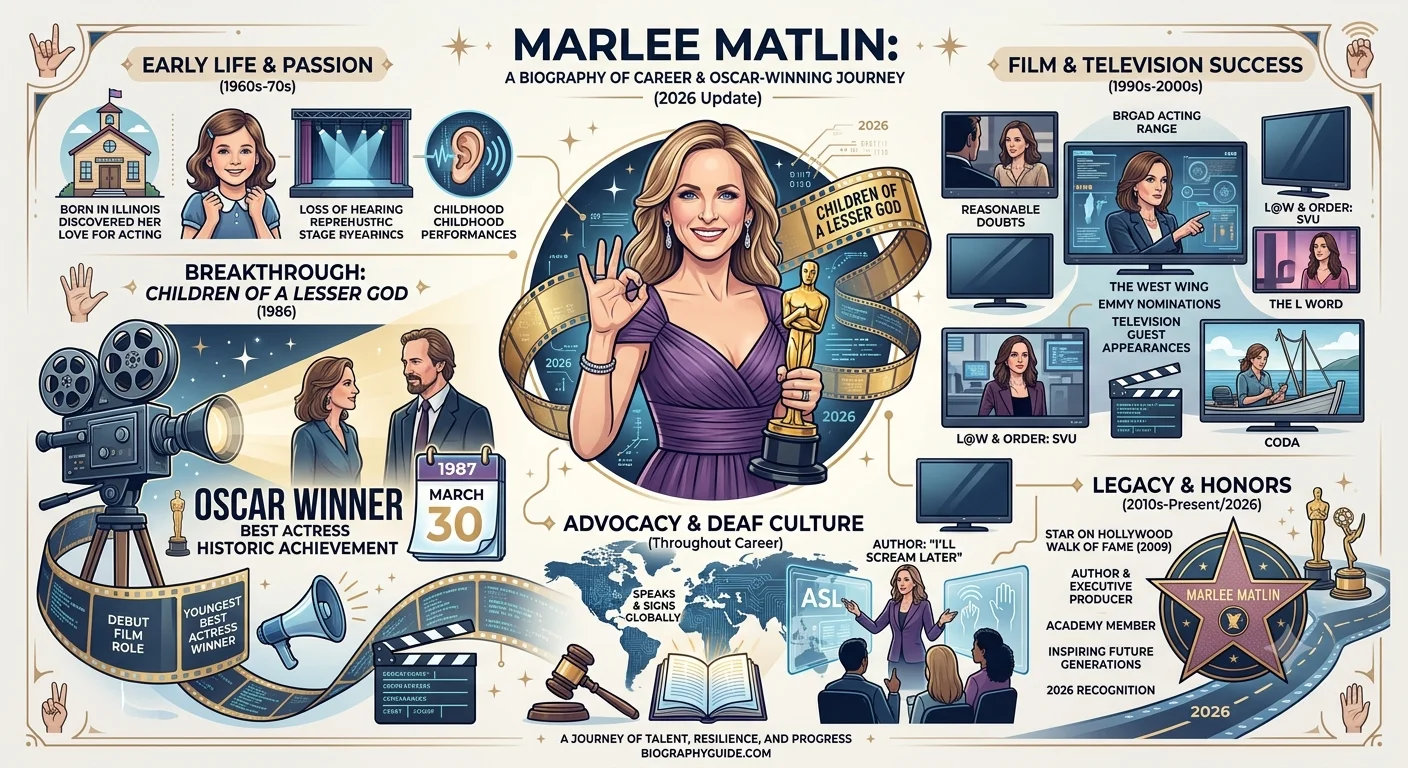
Marlee Matlin is the most celebrated deaf actor in Hollywood history and her career has spanned nearly four decades of groundbreaking work. From her Oscar winning film debut to her ongoing advocacy for deaf representation Matlin's biography is a story of talent persistence and cultural impact that reshaped how Hollywood views deaf performers.
Early life and becoming deaf
Marlee Matlin was born on August 24 1965 in Morton Grove Illinois. She lost most of her hearing at 18 months old due to illness. She grew up using both ASL and spoken English having attended a school program that emphasized oral communication skills alongside sign language.
As a child Matlin developed an early interest in performance. She began acting at age seven with the Center on Deafness in Chicago a children's theatre group for deaf youth. This early theatre experience would prove formative in shaping the career she would eventually build.
Breaking into film with Children of a Lesser God
Matlin's professional breakthrough came when she was cast in the 1986 film Children of a Lesser God based on the acclaimed stage play. She played Sarah Norman a deaf woman working as a janitor at a school for the deaf who becomes involved with a hearing speech therapist played by William Hurt.
Matlin had no prior film experience when she was cast and her performance stunned critics and audiences alike with its emotional depth and authenticity. At the 1987 Academy Awards ceremony Matlin won the Oscar for Best Actress becoming both the youngest winner in the category's history at the time and the only deaf performer ever to win an Academy Award for acting up to that point.
Building a career across film and television
Following her Oscar win Matlin worked steadily to build a career that spanned both film and television over the following decades. She has appeared in dozens of television series including recurring and guest roles on Seinfeld The Practice The West Wing Law and Order Special Victims Unit Picket Fences and Switched at Birth where she played a series regular role for several seasons.
Matlin's willingness to take on a wide range of roles across drama and comedy helped demonstrate that deaf actors deserved opportunities across every genre rather than being limited only to roles explicitly written as deaf characters.
Advocacy for deaf representation and accessibility
Throughout her career Matlin has been a consistent and vocal advocate for deaf representation in media and for accessibility more broadly. She has pushed for greater use of closed captioning has spoken publicly about the challenges deaf actors face in auditioning and casting and has worked to mentor younger deaf performers entering the industry.
Recommended Articles
 DEAF ARTISTS AND STORIES
 DEAF ARTISTS AND STORIES
 DEAF ARTISTS AND STORIES
 DEAF ARTISTS AND STORIES
Matlin has also written books including a memoir and children's books that explore deaf identity and experience for young readers. Her public visibility has made her one of the most recognized advocates for the deaf community in mainstream American culture.
Personal challenges and openness
Matlin has spoken openly about personal struggles including past substance abuse issues that she dealt with as a young actress navigating sudden fame after her Oscar win. Her willingness to discuss these challenges publicly has added depth to her public persona beyond her professional accomplishments and has resonated with audiences who have faced similar struggles.
Legacy and continuing influence
Decades after her Oscar win Matlin remains an active and influential figure in entertainment. Her early breakthrough opened doors that had simply not existed for deaf performers before her and her sustained career has shown that initial recognition can translate into a long lasting body of work rather than a single notable moment.
When Troy Kotsur won his Academy Award in 2022 for CODA becoming the first deaf man to win an acting Oscar he specifically acknowledged Matlin's pioneering role in paving the way for his own opportunity. This moment captured how directly Matlin's legacy continues to shape opportunities for deaf actors today.
Conclusion
Marlee Matlin's career represents one of the most significant individual contributions to deaf representation in entertainment history. From her stunning debut performance in Children of a Lesser God through decades of consistent television and film work and her ongoing advocacy Matlin has built a legacy that extends far beyond a single award. She remains a foundational figure whose influence continues to open doors for deaf performers working today.
FAQ
How did Marlee Matlin become deaf? Matlin lost most of her hearing at 18 months old due to illness as an infant.
What was Marlee Matlin's first major film role? Her first major film role was Sarah Norman in Children of a Lesser God in 1986 for which she won the Academy Award for Best Actress.
Is Marlee Matlin still acting today? Yes Matlin continues to work in film and television and remains active as an advocate for deaf representation and accessibility in entertainment.