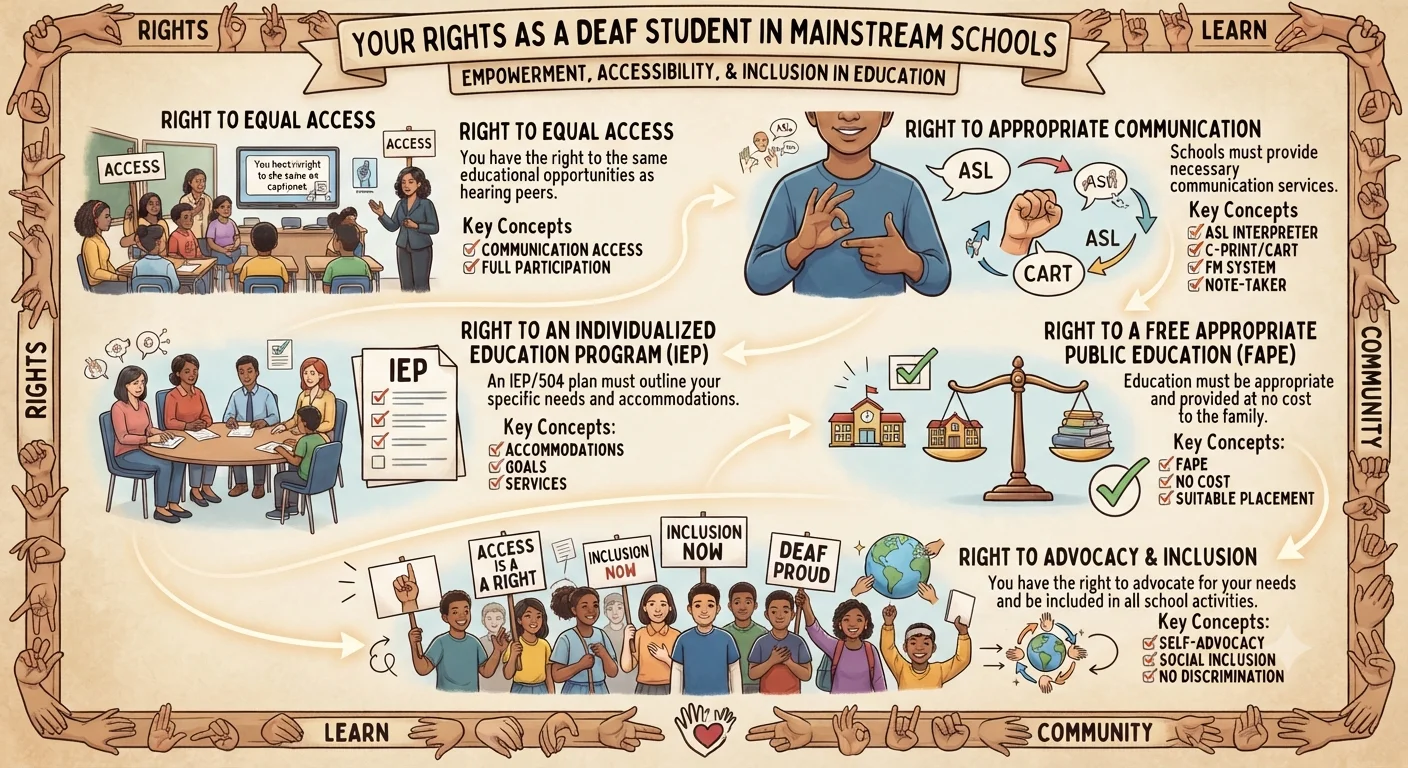
Learn about the legal rights of deaf students in mainstream schools covering IDEA Section 504 IEP requirements and what schools must provide for equal access.
Deaf students in mainstream schools have specific and substantial legal rights that entitle them to appropriate educational accommodations specialized services and genuine access to educational opportunity equal to that provided to hearing peers. Understanding these rights helps families advocate effectively for deaf children and helps educators understand their legal and ethical obligations toward deaf students in their programs.
The Foundation of Deaf Student Rights in American Law
The legal framework protecting deaf students' educational rights in the United States rests primarily on two federal laws that together create a comprehensive framework for educational accessibility and appropriate services. The Individuals with Disabilities Education Act commonly known as IDEA provides the most detailed and specific framework for special education services including those for deaf and hard of hearing students. Section 504 of the Rehabilitation Act of 1973 provides broader civil rights protections against discrimination for students with disabilities in schools receiving federal funding.
Together these laws require schools to identify deaf and hard of hearing students assess their specific educational needs develop individualized education plans and provide the services and accommodations needed for each student to access educational opportunity meaningfully rather than only nominally. Understanding how these laws apply specifically to deaf students helps families know what they are legally entitled to request and expect from their child's school.
The Individualized Education Program for Deaf Students
- The Foundation of Deaf Student Rights in American Law
- The Individualized Education Program for Deaf Students
- The Right to Communication Access
- Least Restrictive Environment Requirements and Deaf Students
- The Right to Appropriate Assistive Technology
- Extracurricular and Non-Academic Rights
- Parent Rights in the Special Education Process
- Conclusion
- FAQ
- What is an IEP and why is it important for deaf students in mainstream schools?
- Do schools have to provide qualified sign language interpreters for deaf students who use ASL?
- Does least restrictive environment always mean mainstream classroom placement for deaf students?
The Individualized Education Program or IEP is the central document through which IDEA protections are implemented for eligible deaf and hard of hearing students. An IEP is a legally binding document developed collaboratively by a team that includes the child's parents or guardians relevant school staff and often specialists in deaf education that specifies the unique educational needs of the individual child and the specific services and accommodations the school will provide to address those needs.
For deaf students IEP documents should address communication needs specifically including what language or communication mode will be used for instruction whether ASL English or another approach what communication accommodations will be provided across all school settings not just specialized classes and what related services such as speech language pathology or audiology services will be provided. Parents have the right to participate meaningfully in IEP development and to challenge IEP provisions they believe do not adequately address their child's needs through established dispute resolution processes.
The Right to Communication Access
One of the most fundamental rights of deaf students in mainstream schools is the right to communication access in a language and mode they can fully understand. This means schools must provide qualified sign language interpreters for deaf students who use ASL as their primary language in all educational settings including classrooms extracurricular activities school events and disciplinary proceedings rather than only in formal academic instruction contexts.
- How Drama Therapy Helps Deaf Children Develop Communication
- How Hearing Parents of Deaf Children Can Support Arts Education
- How Deaf Education Works in Developing Countries
The qualification of sign language interpreters provided by schools is a critical issue since an unqualified or insufficiently skilled interpreter provides inadequate communication access regardless of their presence in the classroom. Families have the right to ask about interpreter qualifications and to raise concerns when interpreter quality appears inadequate for providing genuine educational access rather than only nominal compliance with interpreter provision requirements.
Least Restrictive Environment Requirements and Deaf Students
IDEA requires that deaf students be educated in the least restrictive environment appropriate for their individual needs meaning that schools should include deaf students in general education settings alongside hearing peers to the maximum extent appropriate for each individual student. However the least restrictive environment requirement does not automatically mean that mainstream placement is always the most appropriate or least restrictive option for every deaf student.
Recommended Articles
 DEAF EDUCATION AND SCHOOLS
 DEAF EDUCATION AND SCHOOLS
 DEAF EDUCATION AND SCHOOLS
 DEAF EDUCATION AND SCHOOLS
For some deaf students a specialized school for the deaf or a dedicated deaf education program within a mainstream school may actually represent a less restrictive educational environment in the educationally meaningful sense since it provides full language access peer interaction in the student's primary language and deaf cultural community connection that a mainstream placement without adequate support may not provide despite being nominally more integrated with hearing peers.
The Right to Appropriate Assistive Technology
Deaf and hard of hearing students have the right to appropriate assistive technology under IDEA when such technology is necessary for them to access educational opportunities meaningfully. Assistive technology for deaf students might include FM systems that transmit a teacher's voice directly to a hearing aid or cochlear implant captioning technology for classroom use or other tools that improve communication access within the educational setting.
Schools are required to provide necessary assistive technology at no cost to families when the IEP team determines that specific technology is necessary for the student to receive an appropriate education rather than being merely beneficial or convenient. Families should raise assistive technology needs specifically during IEP meetings and ensure any agreed technology provisions are documented in the IEP document itself.
Extracurricular and Non-Academic Rights
Deaf students' rights to accessibility and appropriate accommodations extend beyond academic instruction to include extracurricular activities school sports theater programs school events and other non-academic dimensions of school life. Schools cannot legally exclude deaf students from extracurricular participation due to their hearing status or fail to provide necessary communication accommodations that would enable meaningful extracurricular participation.
This inclusive extracurricular right is important because participation in extracurricular activities contributes significantly to social development community belonging and overall educational experience in ways that affect long term outcomes well beyond academic achievement alone.
Parent Rights in the Special Education Process
Parents of deaf students have specific and substantial rights within the special education process that are as important as the student's own rights. These include the right to be notified of and to participate in all IEP meetings the right to access all school records related to their child's education the right to request independent educational evaluations at school expense under certain circumstances and the right to pursue formal dispute resolution processes including mediation and due process hearings when they believe the school is not providing their child with an appropriate education.
Conclusion
Deaf students in mainstream schools have robust legal rights to communication access appropriate services and meaningful educational opportunity that schools are legally obligated to fulfill. Families who understand these rights and advocate effectively using the frameworks provided by IDEA and Section 504 give their deaf children the strongest possible foundation for accessing the education they deserve within mainstream school settings.
FAQ
What is an IEP and why is it important for deaf students in mainstream schools?
An IEP or Individualized Education Program is a legally binding document that specifies the unique educational needs of an individual deaf student and the specific services accommodations and communication support the school must provide to address those needs appropriately.
Do schools have to provide qualified sign language interpreters for deaf students who use ASL?
Yes schools must provide qualified sign language interpreters for deaf students who use ASL as their primary language across all educational settings not just formal academic instruction including extracurricular activities and school events.
Does least restrictive environment always mean mainstream classroom placement for deaf students?
Not necessarily since for some deaf students a specialized school for the deaf or dedicated deaf education program may actually provide a less restrictive educational environment in the meaningful sense by offering full language access and deaf peer community that inadequately supported mainstream placement cannot provide.