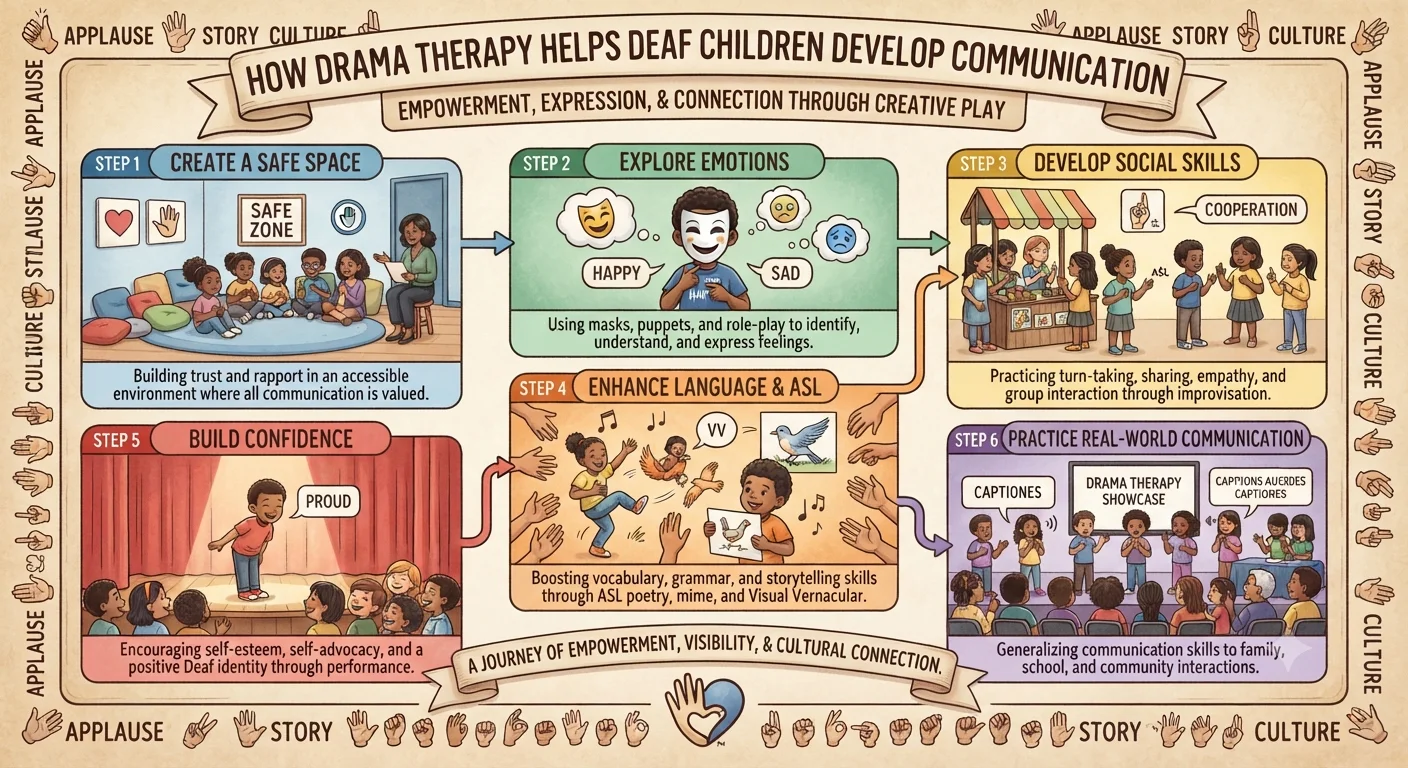
Discover how drama therapy helps deaf children develop communication confidence and emotional expression through structured creative play and theatrical techniques.
Drama therapy offers deaf children a uniquely powerful pathway to communication development emotional expression and social confidence that traditional therapeutic and educational approaches often cannot replicate as effectively. By using creative play storytelling role play and theatrical techniques within a fully accessible visual communication environment drama therapy creates conditions where deaf children can flourish in ways that reveal their full potential rather than highlighting their communication differences as deficits requiring correction.
What Drama Therapy Is and How It Differs from Theatre Education
Drama therapy is a recognized form of psychotherapy that uses theatrical techniques dramatic play and creative expression as primary therapeutic tools for achieving specific psychological developmental and communicative goals. It is distinct from theatre education in that the primary goal is therapeutic rather than artistic with the creation of a polished performance being secondary or irrelevant compared to the therapeutic process experienced by participants during dramatic activities.
A registered drama therapist holds specific clinical training in both theatrical techniques and therapeutic practice allowing them to use dramatic activities intentionally to address specific developmental emotional or communicative goals identified for individual children or groups. This clinical training distinguishes drama therapy from enriching but non-therapeutic drama enrichment programs even when both may use similar theatrical activities on the surface.
Why Drama Therapy Is Particularly Suited to Deaf Children
- What Drama Therapy Is and How It Differs from Theatre Education
- Why Drama Therapy Is Particularly Suited to Deaf Children
- Communication Development Through Dramatic Play
- Emotional Expression and Regulation Through Drama Therapy
- Building Social Confidence and Peer Communication Skills
- Storytelling as a Core Drama Therapy Tool with Deaf Children
- Practical Considerations for Drama Therapists Working with Deaf Children
- Conclusion
- FAQ
- What is the difference between drama therapy and theatre education for deaf children?
- Why is drama therapy particularly well suited to deaf children specifically?
- Do drama therapists working with deaf children need to know ASL?
Drama therapy is particularly well suited to deaf children for several interconnected reasons rooted in how dramatic activities naturally align with deaf children's existing visual communication strengths. Drama is fundamentally a visual and physical art form that uses body movement facial expression gesture and spatial relationships to convey meaning in ways that directly parallel the visual grammar of ASL and other sign languages that deaf children use as their primary communication mode.
- How Hearing Parents of Deaf Children Can Support Arts Education
- How Deaf Education Works in Developing Countries
- What Is Bilingual Deaf Education and Why It Matters
This natural alignment means deaf children entering drama therapy environments are not starting from zero or adapting to an inherently hearing centered therapeutic modality. They are instead bringing existing visual communication skills that translate directly into dramatic expression creating immediate opportunities for success and engagement that build therapeutic momentum from the earliest sessions.
Communication Development Through Dramatic Play
Dramatic play and role play activities within drama therapy provide deaf children with low stakes opportunities to experiment with different communication approaches express complex ideas and emotions and practice the kind of perspective taking that sophisticated communication requires. When a child plays a character in a dramatic scenario they are simultaneously practicing how to express that character's thoughts feelings and intentions clearly through all available physical and linguistic channels.
For deaf children with limited language exposure particularly those from hearing families where ASL may not have been introduced early dramatic play can provide valuable language practice in a highly motivating context where communication serves immediately meaningful dramatic purposes rather than being practiced in isolation as an abstract skill. The meaningful context of dramatic play often motivates communication attempts that more structured language practice activities cannot generate with the same degree of natural engagement.
Emotional Expression and Regulation Through Drama Therapy
Drama therapy provides deaf children with structured opportunities to explore and express emotions safely through fictional dramatic contexts that create helpful distance from real personal emotional experiences. A child who struggles to discuss their own feelings directly may find it much easier to explore similar emotional territory through a character in a story or dramatic scenario providing therapeutic access to emotional content that more direct therapeutic approaches might struggle to reach.
This fictional distance is one of drama therapy's most powerful therapeutic tools and it works particularly well with children regardless of hearing status since children naturally use play and dramatic scenarios as ways of processing and understanding emotional experiences that exceed their current capacity for direct verbal or signed expression and discussion.
Recommended Articles
 DEAF EDUCATION AND SCHOOLS
 DEAF EDUCATION AND SCHOOLS
 DEAF EDUCATION AND SCHOOLS
 DEAF EDUCATION AND SCHOOLS
Building Social Confidence and Peer Communication Skills
Group drama therapy with deaf peers provides invaluable opportunities for developing social communication skills confidence in peer interaction and the ability to collaborate creatively with others that are essential components of healthy childhood social development. For deaf children who attend mainstream schools where they may be the only deaf student group drama therapy with deaf peers creates rare and precious opportunities for natural fluent communication and social connection without the communication barriers that characterize many of their other daily social environments.
The collaborative nature of dramatic activities naturally requires children to communicate negotiate and respond to each other building exactly the reciprocal communication and social coordination skills that drama therapy targets alongside its other developmental goals. These social communication skills developed in the supportive drama therapy context often generalize to other social settings benefiting children's broader social development beyond the therapy room itself.
Storytelling as a Core Drama Therapy Tool with Deaf Children
Storytelling plays a central role in drama therapy with deaf children since narrative is one of the most fundamental human ways of making meaning from experience and ASL storytelling traditions provide deaf children with a rich indigenous narrative art form that connects therapeutic storytelling directly to deaf cultural heritage and identity. Drama therapists working with deaf children can draw on ASL storytelling techniques including perspective shifting visual vernacular and narrative pacing to create culturally grounded therapeutic storytelling experiences that honor deaf children's linguistic and cultural identity alongside therapeutic goals.
Creating enacting and reflecting on original stories allows deaf children to explore identity questions process experiences and develop narrative communication skills that serve both therapeutic and educational goals simultaneously within a culturally affirming framework that celebrates rather than minimizes their deaf identity and sign language abilities.
Practical Considerations for Drama Therapists Working with Deaf Children
Drama therapists working with deaf children need genuine ASL fluency or access to qualified interpreters to conduct ethical and effective therapy since conducting therapeutic work through an interpreter creates significant limitations and complications that can undermine therapeutic goals especially with young children. Drama therapists who learn ASL specifically to work with deaf children build the most effective therapeutic relationships since direct communication without interpretation allows the kind of spontaneous responsive interaction that drama therapy depends upon.
Training in deaf culture and deaf child development alongside technical drama therapy skills is equally important since effective therapeutic work with deaf children requires understanding their specific cultural context language history and developmental experiences rather than simply applying standard child drama therapy approaches without cultural adaptation.
Conclusion
Drama therapy offers deaf children an extraordinarily well suited pathway to communication development emotional expression and social confidence by drawing on theatrical techniques that naturally align with visual communication strengths and provide culturally affirming contexts for language and creative development. As awareness of drama therapy's potential for deaf children grows and more drama therapists develop the ASL fluency and cultural competency needed to work effectively with this population this powerful therapeutic modality will increasingly fulfill its potential for supporting deaf children's holistic development.
FAQ
What is the difference between drama therapy and theatre education for deaf children?
Drama therapy uses theatrical techniques as primary tools for achieving specific psychological developmental and communicative therapeutic goals while theatre education focuses primarily on artistic skill development and performance with therapeutic benefits being secondary rather than the primary purpose of the activity.
Why is drama therapy particularly well suited to deaf children specifically?
Drama therapy naturally aligns with deaf children's existing visual communication strengths since dramatic expression uses body movement facial expression and spatial relationships to convey meaning in ways that directly parallel the visual grammar of sign language creating immediate opportunities for engagement and success.
Do drama therapists working with deaf children need to know ASL?
Yes genuine ASL fluency is strongly preferred for drama therapists working with deaf children since conducting therapeutic work through an interpreter creates significant limitations that can undermine therapeutic goals especially with young children who benefit most from direct spontaneous communication with their therapist.