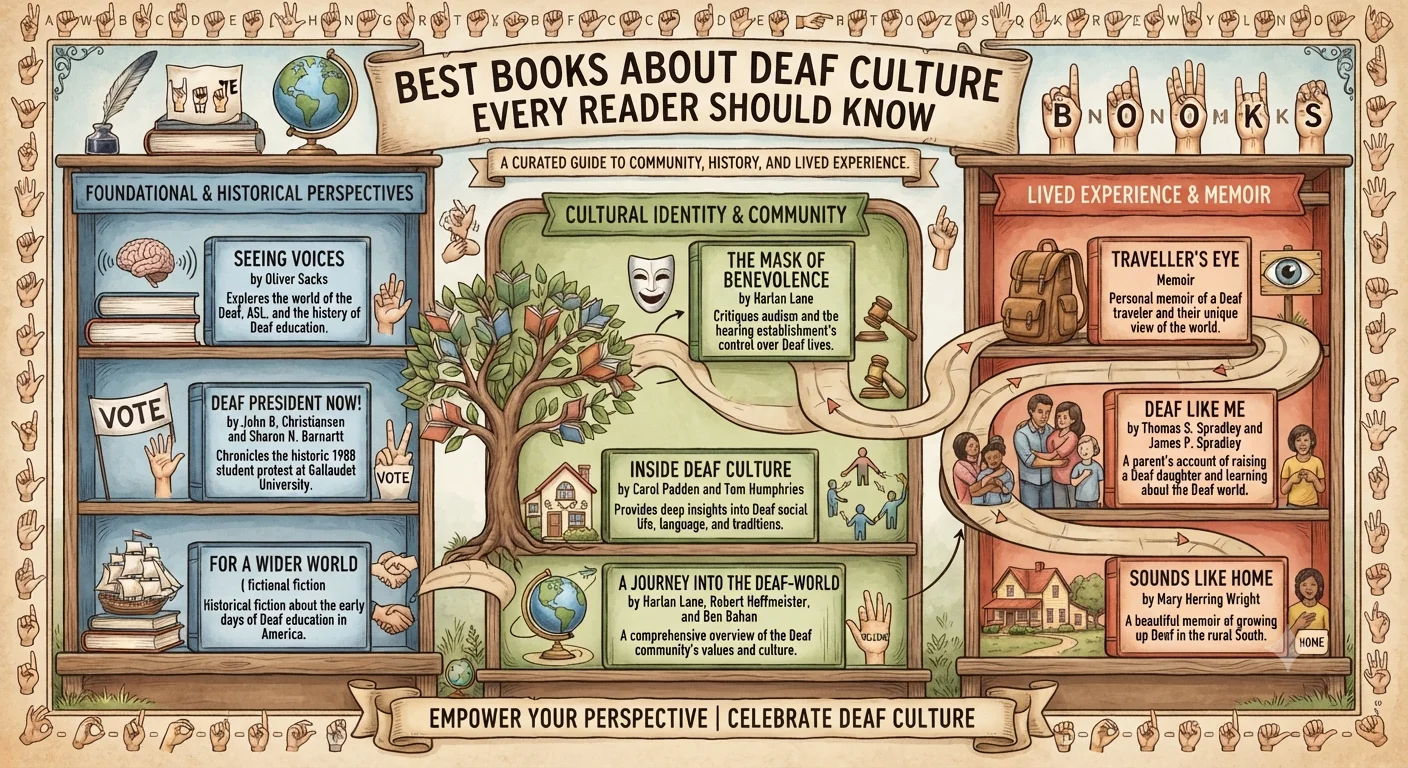
Discover the best books about deaf culture covering history sign language identity memoir and fiction that every reader interested in deaf community should know
Books about deaf culture offer hearing and deaf readers alike deep insight into the history language and community that make deaf culture one of the world's most distinctive and resilient minority cultures. This guide covers essential reading across memoir history linguistics fiction and advocacy that provides a comprehensive introduction to deaf culture through some of its most important and accessible written works.
Seeing Voices by Oliver Sacks
Seeing Voices by neurologist and writer Oliver Sacks published in 1989 remains one of the most widely read introductions to deaf culture and sign language for hearing audiences. Sacks explores the history of deaf education the linguistic nature of sign language and the Deaf President Now movement at Gallaudet University with characteristic clarity and genuine curiosity that makes complex linguistic and cultural material accessible to general readers without simplifying it to the point of inaccuracy.
While some deaf scholars have offered critiques of Sacks as an outsider interpreter of deaf experience the book's accessibility and genuine enthusiasm for its subject have introduced countless hearing readers to aspects of deaf culture and sign language they might never have encountered otherwise making it a genuinely influential work in terms of broader public awareness.
Deaf in America Voices from a Culture by Carol Padden and Tom Humphries
- Seeing Voices by Oliver Sacks
- Deaf in America Voices from a Culture by Carol Padden and Tom Humphries
- Train Go Sorry by Leah Hager Cohen
- Shouting Wont Help by Katherine Bouton
- Nyle DiMarco and Deaf Representation in Contemporary Publishing
- The Mask of Benevolence by Harlan Lane
- Fiction and Creative Writing About Deaf Experience
- Why Reading Widely About Deaf Culture Matters
- Conclusion
- FAQ
- What is considered the most important insider account of deaf culture in book form?
- Are there good books about deaf culture written for general rather than academic audiences?
- Why is reading books by deaf authors specifically important for understanding deaf culture?
Deaf in America Voices from a Culture by Carol Padden and Tom Humphries both of whom are members of the deaf community is widely considered one of the most important academic introductions to deaf culture written from an insider perspective. The book examines deaf cultural values traditions and community life through the framework of cultural anthropology rather than through a medical or deficit based lens offering hearing readers genuine insight into how deaf people understand their own community from the inside.
- Cochlear Implant Debate in the Deaf Community Explained
- Laurent Clerc Father of Deaf Education in America Biography
- History of Oralism and Why It Hurt the Deaf Community
This insider perspective makes Deaf in America particularly valuable as a complement to works written by hearing authors about deaf culture since it centers deaf community members own understanding of their cultural life and values rather than interpreting deaf experience from outside the community itself.
Train Go Sorry by Leah Hager Cohen
Train Go Sorry by Leah Hager Cohen published in 1994 offers a compelling narrative account of life at the Lexington School for the Deaf in New York through the eyes of Cohen whose family has a multi generational connection to the school. The book weaves together personal family history with broader exploration of deaf education debates and community life creating a richly human portrait of a specific deaf educational institution during a period of significant change and controversy.
Cohen's outsider but deeply connected perspective gives the book a particular quality of genuine engagement with deaf community life without claiming a deaf insider identity she does not hold making it a model of thoughtful and respectful outside engagement with deaf cultural material.
Shouting Wont Help by Katherine Bouton
Shouting Wont Help by Katherine Bouton offers a personal memoir perspective on acquired hearing loss and the experience of navigating the hearing world with progressive deafness later in life. While Bouton's experience differs from those born deaf or who became deaf in early childhood her account provides valuable perspective on how hearing loss at different life stages creates different relationships to both deaf culture and hearing identity.
Recommended Articles
 DEAF CULTURE AND HISTORY
 DEAF CULTURE AND HISTORY
 DEAF CULTURE AND HISTORY
 DEAF CULTURE AND HISTORY
This book is particularly valuable for readers interested in the experience of people navigating identity questions around acquired hearing loss and for understanding how the cochlear implant debate plays out from the perspective of someone who has lived through progressive hearing loss as an adult.
Nyle DiMarco and Deaf Representation in Contemporary Publishing
The growing visibility of deaf public figures like Nyle DiMarco has contributed to increased mainstream interest in books by and about deaf people in recent years. This increased visibility has helped create greater market space for both deaf authored memoirs and fiction and for books about deaf culture history and sign language from both insider and carefully researched outsider perspectives.
The Mask of Benevolence by Harlan Lane
The Mask of Benevolence by Harlan Lane is a more polemical and academically rigorous work that examines the history of hearing control over deaf education and communities from a critical perspective rooted in deaf community advocacy. Lane argues that many well intentioned hearing interventions in deaf life including oralist education and certain uses of cochlear implants reflect paternalistic assumptions that undermine deaf community autonomy and self determination.
While some readers find Lane's perspective challenging or one sided his book represents an important voice in the academic and advocacy literature on deaf community rights and deserves attention from serious readers seeking to understand the most critical perspectives on the history of hearing society's relationship with deaf communities.
Fiction and Creative Writing About Deaf Experience
Beyond nonfiction a growing body of fiction explores deaf experience and characters with increasing authenticity and cultural specificity. Readers interested in experiencing deaf cultural perspectives through narrative fiction will find an expanding library of novels short stories and other creative works that center deaf characters and communities with genuine cultural understanding rather than treating deafness as a simple dramatic device.
Why Reading Widely About Deaf Culture Matters
Reading broadly across deaf cultural history linguistics memoir and fiction from both insider and thoughtfully engaged outside perspectives provides the kind of multidimensional understanding of deaf community and culture that no single book can fully deliver. Each of the works discussed here contributes different dimensions of insight that together build a substantially richer and more accurate understanding of deaf experience than any single genre or perspective can provide alone.
Conclusion
The best books about deaf culture offer hearing and deaf readers alike genuine insight into one of the world's most distinctive communities through a range of voices perspectives and genres that together provide a comprehensive and nuanced portrait of deaf cultural life history and advocacy. Beginning with any of the works discussed here provides a strong foundation for continued reading and learning about a community whose richness and complexity rewards sustained engagement and curiosity.
FAQ
What is considered the most important insider account of deaf culture in book form?
Deaf in America Voices from a Culture by Carol Padden and Tom Humphries is widely considered one of the most important academic introductions to deaf culture written from a genuine insider perspective centered on how deaf community members understand their own cultural life.
Are there good books about deaf culture written for general rather than academic audiences?
Yes Seeing Voices by Oliver Sacks and Train Go Sorry by Leah Hager Cohen are both widely praised for making deaf cultural history and community life accessible and engaging for general readers without significant prior knowledge of deaf culture or sign language.
Why is reading books by deaf authors specifically important for understanding deaf culture?
Books by deaf authors provide insider perspectives that center deaf community members own understanding of their cultural life values and experiences rather than interpreting deaf experience from outside the community offering a different and complementary kind of insight compared to works by hearing authors however sympathetically engaged those authors may be.