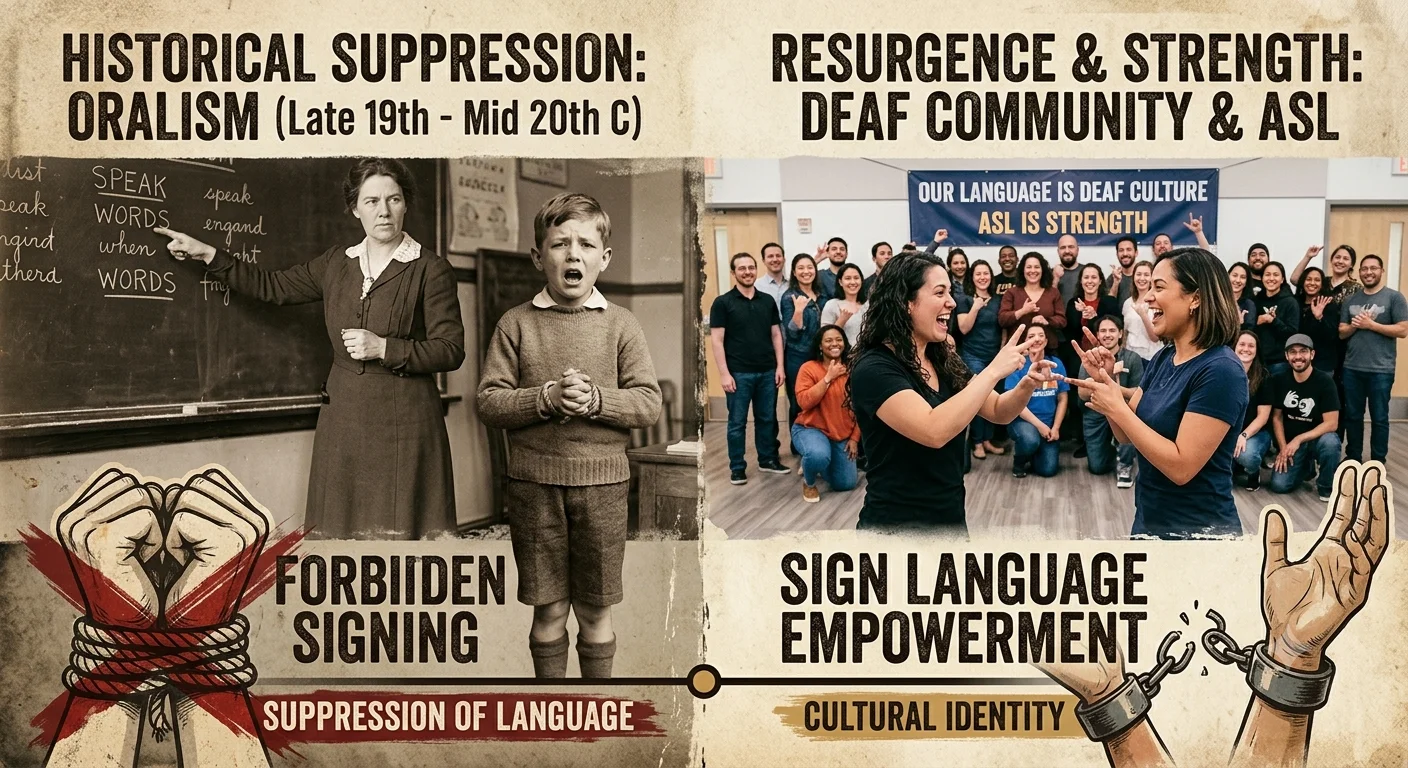
Oralism is an educational philosophy that dominated deaf education for over a century insisting deaf children learn to speak and lip read while discouraging or banning sign language entirely. Understanding the history of oralism and its lasting harm helps explain why bilingual ASL based education has become the preferred approach among most deaf educators and community advocates today.
What oralism actually meant in practice
Oralism as an educational philosophy held that deaf children should be taught exclusively through spoken language using techniques like lip reading and speech training rather than being taught through or even exposed to sign language in the classroom. Proponents believed this approach would better prepare deaf students to function within a hearing dominated society by developing spoken communication skills.
In its most extreme forms oralism involved actively punishing students caught using sign language including measures like tying children's hands behind their backs to physically prevent signing. These harsh enforcement methods reflected how deeply committed oralist educators were to eliminating sign language from deaf education entirely regardless of the cost to individual students.
The Milan Conference of 1880
- What oralism actually meant in practice
- The Milan Conference of 1880
- How oralism affected academic outcomes
- The psychological and social harm of oralism
- How oralism intersected with broader attitudes toward deafness
- The pushback against oralism
- Lasting effects of oralism on deaf community and education
- Conclusion
- FAQ
- What was the Milan Conference of 1880 and why does it matter?
- Did oralism succeed in helping deaf students develop strong spoken language skills?
- Is oralism still practiced in deaf education today?
The history of oralism's dominance in deaf education is closely tied to the International Congress on Education of the Deaf held in Milan Italy in 1880. At this conference educators primarily hearing voted to declare oral education superior to sign language based instruction leading to a resolution that significantly influenced deaf education policy across many countries for the following century.
- Deaf Comedy and Humor Understanding the Unique Tradition
- Deaf Culture Values Community Language and Pride Explained
- Complete History of Gallaudet University from 1864 to Today
This resolution proved enormously consequential since it provided institutional and ideological backing for oralist educators to suppress sign language in schools across Europe and the United States often overriding the preferences of deaf communities and deaf educators themselves who had limited voice in the conference proceedings.
How oralism affected academic outcomes
Research conducted in subsequent decades has consistently shown that oralism often failed to achieve its stated goals while simultaneously causing significant harm. Many deaf students under oralist education systems struggled to develop either strong spoken language skills or strong academic knowledge since they lacked full and immediate access to instruction through a language they could perceive completely.
This created a troubling pattern where many deaf students under oralist systems ended up with limited proficiency in any language during critical childhood language development years since spoken language access was often incomplete due to hearing loss while sign language access was actively denied or discouraged by their educational environment.
The psychological and social harm of oralism
Beyond academic struggles oralism caused significant psychological and social harm to generations of deaf students. Many former oralist education students have described feelings of isolation shame and frustration from being denied access to sign language and from constant pressure to perform spoken communication skills that did not come naturally given their hearing loss.
Recommended Articles
 DEAF CULTURE AND HISTORY
 DEAF CULTURE AND HISTORY
 DEAF CULTURE AND HISTORY
 DEAF CULTURE AND HISTORY
The suppression of sign language also delayed many deaf children's access to deaf community and culture since sign language naturally serves as a gateway to community connection and shared cultural identity that oralist students were often denied during critical developmental years.
How oralism intersected with broader attitudes toward deafness
Oralism reflected and reinforced a broader medical model view of deafness that framed deaf identity as something requiring correction and assimilation toward hearing norms rather than respecting deaf community and sign language as valuable in their own right. This ideological foundation helps explain why oralist policies persisted despite mounting evidence of their educational shortcomings since the underlying goal was assimilation rather than purely educational effectiveness.
The pushback against oralism
Deaf community advocates and increasingly supportive linguists and researchers began pushing back against oralist dominance more forcefully throughout the latter half of the 20th century. Linguistic research demonstrating that ASL was a complete and complex natural language provided important scientific backing for arguments against oralist suppression of sign language in education.
This research combined with growing deaf community advocacy eventually contributed to significant shifts toward bilingual deaf education approaches that value both ASL and English rather than suppressing sign language in favor of exclusively oral methods.
Lasting effects of oralism on deaf community and education
While bilingual education approaches have gained significant ground in recent decades the legacy of oralism continues to influence deaf education debates and policy in various ways. Some educational settings and family preferences still favor oral focused approaches particularly in conjunction with technologies like cochlear implants reflecting ongoing complexity in how oralist philosophy and its legacy continue to shape contemporary deaf education choices.
Many deaf community advocates remain particularly vigilant about protecting language access rights for deaf children given the historical harm caused by oralist suppression of sign language, viewing early and complete language access through ASL as a fundamental right regardless of what other educational approaches a family may also choose to incorporate.
Conclusion
The history of oralism reveals a painful chapter in deaf education where well intentioned but ultimately harmful educational philosophy suppressed natural language access for generations of deaf students. Understanding this history helps explain why bilingual ASL based education has become increasingly favored today and why deaf community advocates remain committed to protecting language access rights for deaf children moving forward.
FAQ
What was the Milan Conference of 1880 and why does it matter?
The Milan Conference was an international gathering of deaf education professionals that voted to declare oral education superior to sign language instruction significantly influencing deaf education policy toward suppressing sign language for the following century.
Did oralism succeed in helping deaf students develop strong spoken language skills?
Research has generally shown oralism often failed to achieve strong spoken language outcomes while simultaneously denying students full language access through sign language resulting in many students developing limited proficiency in any language during critical developmental years.
Is oralism still practiced in deaf education today?
While bilingual ASL based approaches have gained significant favor some educational settings and families still choose oral focused approaches particularly alongside technologies like cochlear implants though pure oralist suppression of sign language is far less common than in previous eras.