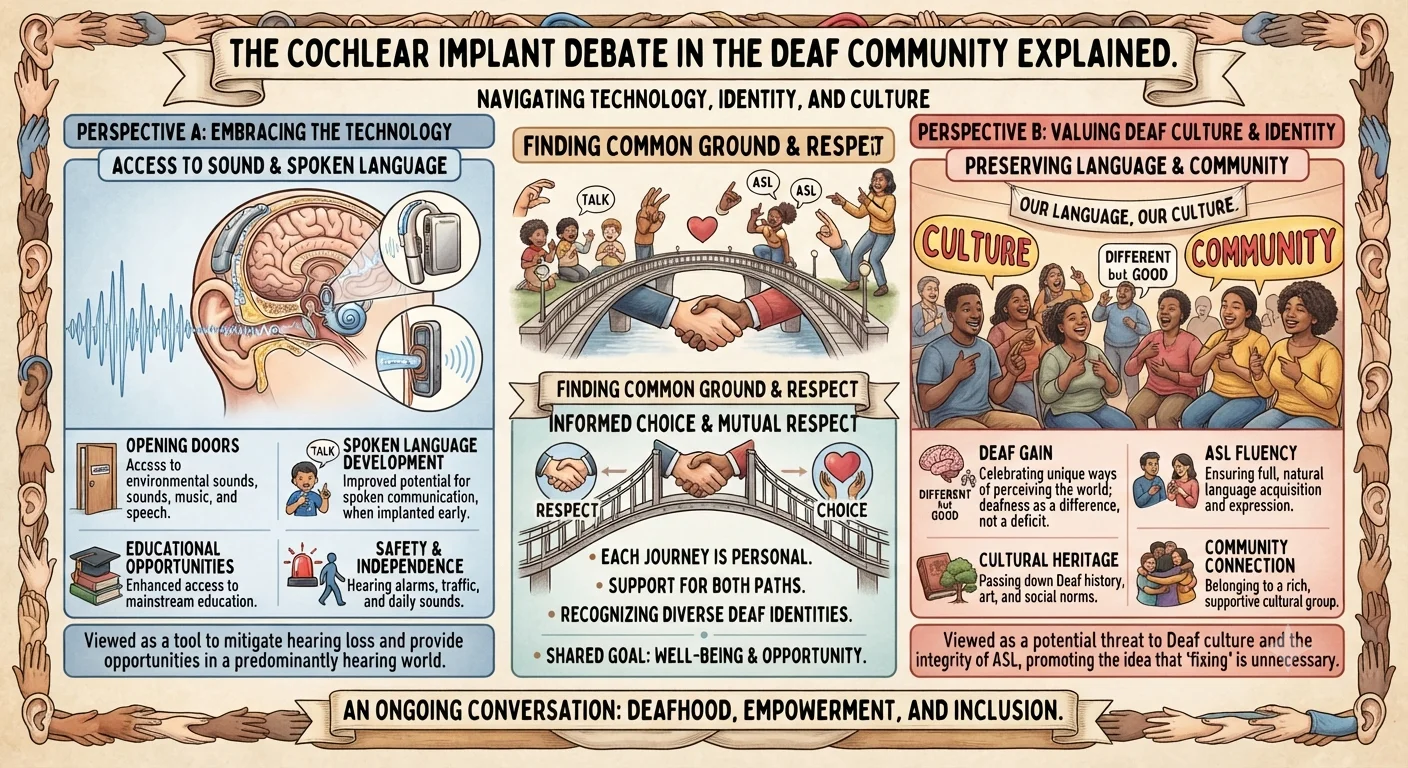
Understand the cochlear implant debate within the deaf community exploring cultural identity language access medical perspectives and parental choices.
The cochlear implant debate is one of the most complex and emotionally significant ongoing conversations within the deaf community. It touches on fundamental questions about identity language medical ethics and parental rights that do not have simple answers and that continue generating passionate discussion among deaf community members medical professionals educators and families navigating these decisions for their children.
What a Cochlear Implant Is
A cochlear implant is a surgically implanted electronic device designed to provide a sense of sound to people who are profoundly deaf or severely hard of hearing. Unlike hearing aids which amplify sound cochlear implants bypass damaged portions of the inner ear and directly stimulate the auditory nerve sending signals to the brain that the recipient learns to interpret as sound over time through extensive rehabilitation and therapy.
Cochlear implants do not restore normal hearing and the sound experience they provide differs significantly from natural hearing requiring substantial adjustment and ongoing therapy particularly when implanted in young children who must learn to interpret these new sound signals during critical language development years. Results vary considerably across individual recipients depending on numerous factors including age at implantation degree of prior hearing experience and access to quality rehabilitation support.
The Medical Community Perspective on Cochlear Implants
- What a Cochlear Implant Is
- The Medical Community Perspective on Cochlear Implants
- The Deaf Community Perspective on Cochlear Implants
- The Language Access Concern
- Parental Rights and Decision Making
- The Identity Question
- Finding Common Ground
- Conclusion
- FAQ
- Why does the deaf community have concerns about cochlear implants for children?
- Can a child have both a cochlear implant and learn ASL?
- Why are hearing parents making cochlear implant decisions sometimes criticized?
The mainstream medical community has generally viewed cochlear implants positively as a technology that can provide meaningful sound access for deaf individuals particularly when implanted early in childhood during critical language development windows. Medical guidelines from audiology and otolaryngology professional organizations typically recommend early implantation for eligible candidates to maximize potential benefits during the most plastic period of auditory and language development.
From a purely audiological perspective cochlear implants have enabled many recipients to develop spoken language skills and access auditory information that would not be available without the technology. Medical advocates argue that providing this access early gives deaf children more options across their lifetimes rather than limiting their choices by waiting until they are old enough to make the decision themselves.
The Deaf Community Perspective on Cochlear Implants
Many within the deaf community have raised significant concerns about cochlear implants particularly when implanted in young deaf children who cannot consent to the procedure themselves. These concerns center on several interconnected issues including the implication that deafness requires fixing the potential disruption of natural sign language acquisition during critical developmental years and the risk that implanted children may end up without strong fluency in either spoken language or ASL if rehabilitation does not achieve hoped for spoken language outcomes.
From a deaf cultural perspective the pressure many hearing parents feel to implant deaf children early reflects broader societal assumptions that hearing is inherently superior to deafness and that deaf children must be made as hearing like as possible rather than being supported in developing complete language access through ASL and connection to deaf cultural community and identity.
The Language Access Concern
One of the most substantive concerns raised by deaf community advocates and bilingual education researchers relates to language access during critical developmental years. When hearing parents of newly identified deaf infants focus primarily on cochlear implant preparation and post implant spoken language rehabilitation some advocates argue this can delay or prevent robust sign language acquisition during the period when language learning happens most naturally and completely.
Researchers and advocates supporting bilingual approaches argue that establishing strong ASL fluency in deaf children regardless of whether cochlear implants are also pursued provides a guaranteed complete language foundation during the most critical developmental window rather than gambling this period entirely on spoken language outcomes that may be uncertain depending on individual implant success and rehabilitation access.
Recommended Articles
 DEAF CULTURE AND HISTORY
 DEAF CULTURE AND HISTORY
 DEAF CULTURE AND HISTORY
 DEAF CULTURE AND HISTORY
Parental Rights and Decision Making
A particularly complex dimension of the cochlear implant debate involves the rights and responsibilities of hearing parents making irreversible medical decisions for young deaf children who cannot yet participate in those decisions themselves. Most deaf children are born to hearing parents who often have little prior knowledge of deaf culture sign language or the perspectives of deaf adults who have navigated similar decisions about their own identities.
- Laurent Clerc Father of Deaf Education in America Biography
- History of Oralism and Why It Hurt the Deaf Community
- Deaf Comedy and Humor Understanding the Unique Tradition
Deaf community advocates argue that hearing parents making cochlear implant decisions without meaningful exposure to deaf adult perspectives and deaf cultural community are making these consequential choices without the full range of information they need to make truly informed decisions. Early and meaningful connection between families of newly identified deaf children and deaf adult mentors is increasingly recommended by organizations seeking to ensure families have complete information before making these significant decisions.
The Identity Question
Beyond medical and educational considerations the cochlear implant debate also raises profound questions about identity and belonging that affect implanted individuals throughout their lives. Some cochlear implant recipients describe feeling caught between deaf and hearing worlds without full belonging in either particularly if their spoken language development did not meet hoped for outcomes or if they later connect with deaf cultural community and wish they had developed stronger ASL fluency during childhood.
Others describe their cochlear implants positively as tools that expanded their access to auditory information while maintaining strong deaf identity and ASL fluency demonstrating that cochlear implants and robust deaf cultural identity are not inherently incompatible when families pursue both sign language development and implant technology simultaneously rather than treating them as mutually exclusive options.
Finding Common Ground
Many contemporary advocates from both medical and deaf community perspectives increasingly emphasize that the false choice between cochlear implants and sign language represents a harmful framing that disadvantages deaf children regardless of which option families prioritize exclusively. Supporting robust sign language development alongside whatever hearing technology families choose to pursue provides the strongest possible language foundation while maximizing rather than limiting deaf children's future options and identities.
Conclusion
The cochlear implant debate within the deaf community reflects genuinely complex tensions between medical perspectives cultural identity language access and parental decision making that resist simple resolution. Understanding the full range of perspectives involved helps families medical professionals and educators navigate these decisions with greater awareness of the cultural and linguistic dimensions that purely medical frameworks sometimes overlook in ways that matter profoundly for deaf children's long term wellbeing and identity.
FAQ
Why does the deaf community have concerns about cochlear implants for children?
Key concerns include the implication that deafness requires medical fixing the potential disruption of natural sign language acquisition during critical developmental years and the risk of children developing insufficient fluency in either spoken language or ASL if rehabilitation outcomes fall short of hoped for results.
Can a child have both a cochlear implant and learn ASL?
Yes many advocates and researchers recommend pursuing both sign language development and cochlear implant technology simultaneously rather than treating them as mutually exclusive providing the strongest possible language foundation while maximizing future options for deaf children.
Why are hearing parents making cochlear implant decisions sometimes criticized?
Critics argue that hearing parents often make these consequential irreversible decisions without meaningful exposure to deaf adult perspectives and cultural community resulting in choices made without the full range of information needed to understand the complete implications for their child's identity language and community belonging.