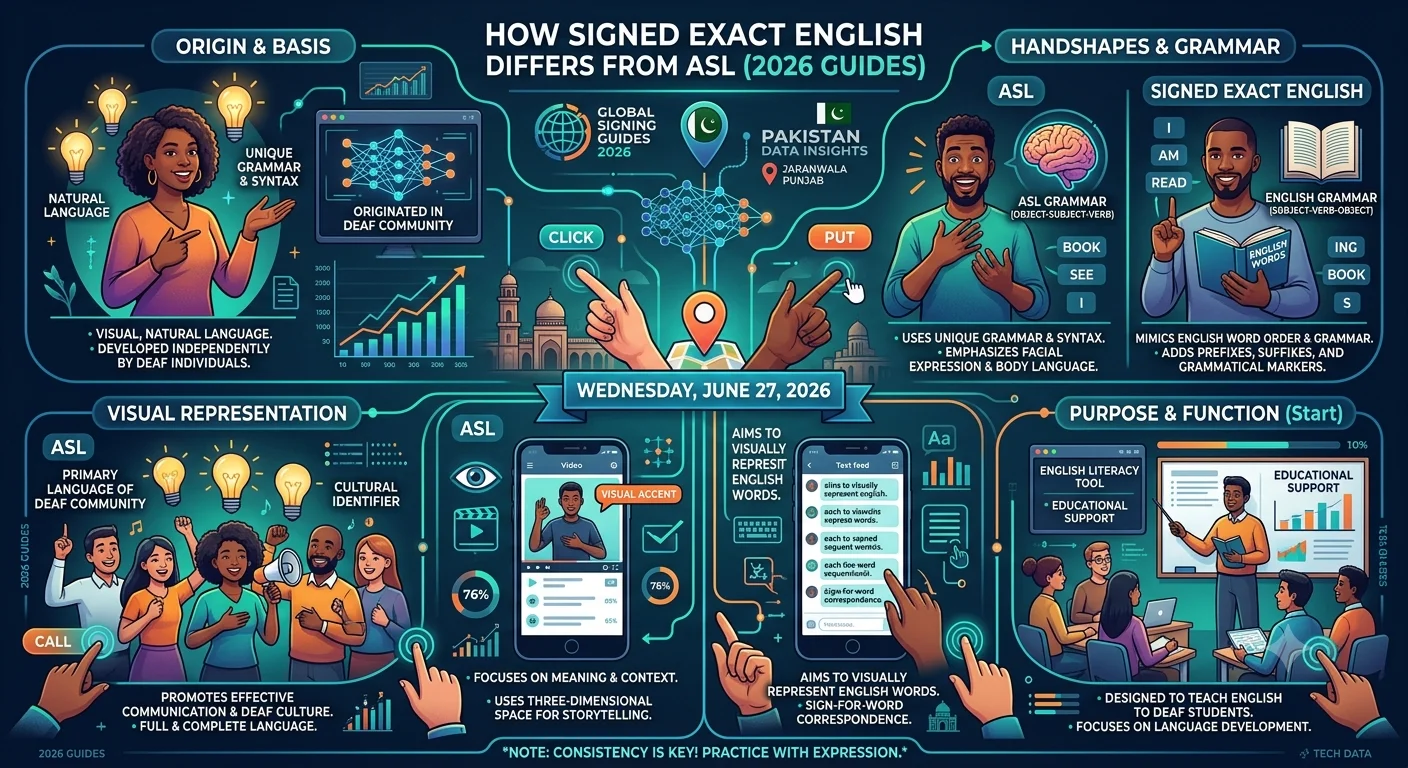
Signed Exact English and American Sign Language are both visual communication systems used within deaf and hard of hearing communities but they differ fundamentally in their structure and purpose. Understanding these differences matters for anyone exploring sign language education or communication options for deaf children and adults.
What Signed Exact English is
Signed Exact English commonly abbreviated as SEE is a manual communication system designed to represent English grammar directly using signs and fingerspelling. Unlike ASL which has its own independent grammar SEE was specifically created to mirror English word order and grammatical structure as closely as possible using signs that correspond to English words and grammatical markers.
SEE was developed in the late 1960s as an educational tool with the goal of helping deaf students develop stronger English literacy skills by exposing them to a visual system that directly parallels written and spoken English grammar rather than the distinct grammatical structure found in natural ASL.
What ASL is by contrast
American Sign Language as covered extensively elsewhere on this site is a complete natural language with its own independent grammar vocabulary and sentence structure that developed organically within the deaf community over generations. ASL does not follow English word order and uses grammatical features like spatial referencing and facial expression markers that have no direct equivalent in English at all.
This fundamental difference in origin and structure is the key distinction between the two systems. ASL evolved naturally as a complete language within a community while SEE was deliberately constructed as an educational tool to mirror an already existing spoken language.
Key grammatical differences between SEE and ASL
SEE attempts to represent English grammatical markers directly including word endings like ing or ed using specific signs or markers that have no equivalent in natural ASL since ASL conveys tense and other grammatical information through entirely different mechanisms such as time indicators placed at the beginning of a sentence rather than verb conjugation.
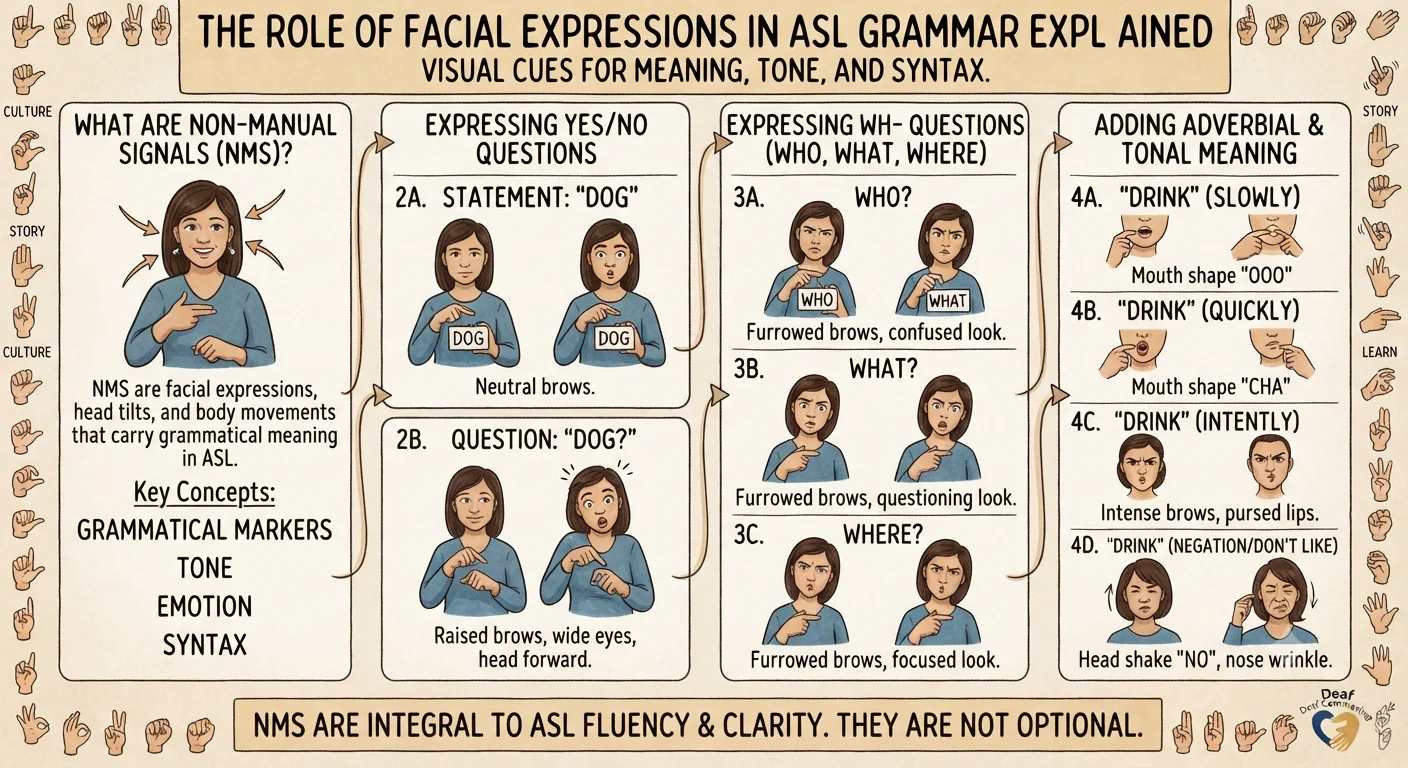
ASL also relies heavily on facial expression and spatial grammar that SEE generally does not incorporate to the same degree since SEE's primary goal is representing English structure rather than developing the independent visual grammatical system found in natural sign languages.
Why SEE was developed for educational purposes
The creators of Signed Exact English in the late 1960s were primarily concerned with improving English literacy outcomes for deaf students. At the time there was significant concern within deaf education about literacy gaps and SEE was proposed as a tool that could help bridge spoken and written English more directly for deaf students through a visual modality.
The underlying theory was that if deaf students could see English grammar represented visually and consistently through signs this exposure might support stronger English literacy development compared to either oral only methods or natural ASL which does not directly mirror English structure.
Criticisms of Signed Exact English from the deaf community
Many deaf community members and linguists have raised significant concerns about SEE over the decades since its introduction. Critics argue that SEE is not a natural language and lacks the full expressive richness and efficiency of ASL since it was constructed to mirror English rather than developing organically to serve communication needs as ASL did.
Recommended Articles
 SIGN LANGUAGE EDUCATION
 SIGN LANGUAGE EDUCATION
 SIGN LANGUAGE EDUCATION
 SIGN LANGUAGE EDUCATION
- ASL Numbers and Counting Complete Beginner Guide
- History of Sign Languages Across Different Countries
- ASL Alphabet Chart with Pictures Complete Visual Guide
Some deaf community members view SEE as reflecting underlying assumptions that English grammar should take priority over ASL's natural grammatical structure which can feel dismissive of ASL's status as a complete and valuable language deserving of use and instruction on its own terms rather than as a vehicle for teaching English.
Research on educational outcomes
Research comparing educational outcomes between SEE based instruction and natural ASL based bilingual education has generally favored bilingual approaches that treat ASL as a complete first language alongside dedicated English literacy instruction rather than systems like SEE that attempt to merge sign and English grammar directly into a single hybrid system.
Many contemporary deaf education researchers and bilingual education advocates argue that strong ASL fluency as a complete first language better supports later English literacy development compared to SEE which lacks the natural grammatical completeness that makes ASL such an effective foundation for cognitive and linguistic development in deaf children.
Where SEE is still used today
While bilingual ASL and English approaches have become increasingly favored in many deaf education settings SEE and other systems that closely mirror English grammar are still used in certain educational programs and by some families and individuals who prefer this approach for various personal or educational reasons.
The choice between these systems often reflects broader educational philosophy debates within deaf education about the best path toward strong language and literacy outcomes for individual deaf children which can vary based on specific circumstances and family preferences.
Conclusion
Signed Exact English and ASL represent fundamentally different approaches to visual communication with SEE designed specifically to mirror English grammar for educational purposes while ASL exists as a complete independent natural language with its own grammatical system. Understanding this distinction helps clarify ongoing conversations within deaf education about language instruction approaches and why many in the deaf community strongly favor ASL based bilingual education over systems like SEE.
FAQ
Is Signed Exact English the same as American Sign Language? No SEE was specifically created to mirror English grammar using signs while ASL is a completely independent natural language with its own distinct grammatical structure unrelated to English word order.
Why do some deaf community members prefer ASL over Signed Exact English? Many deaf community members and linguists view ASL as a complete and naturally developed language while SEE is seen as an artificially constructed system that lacks the same expressive richness and grammatical completeness.
Is Signed Exact English still used in deaf education today? Yes though bilingual ASL and English approaches have become increasingly favored by many researchers and educators SEE and similar systems are still used in certain educational programs depending on individual school and family preferences.