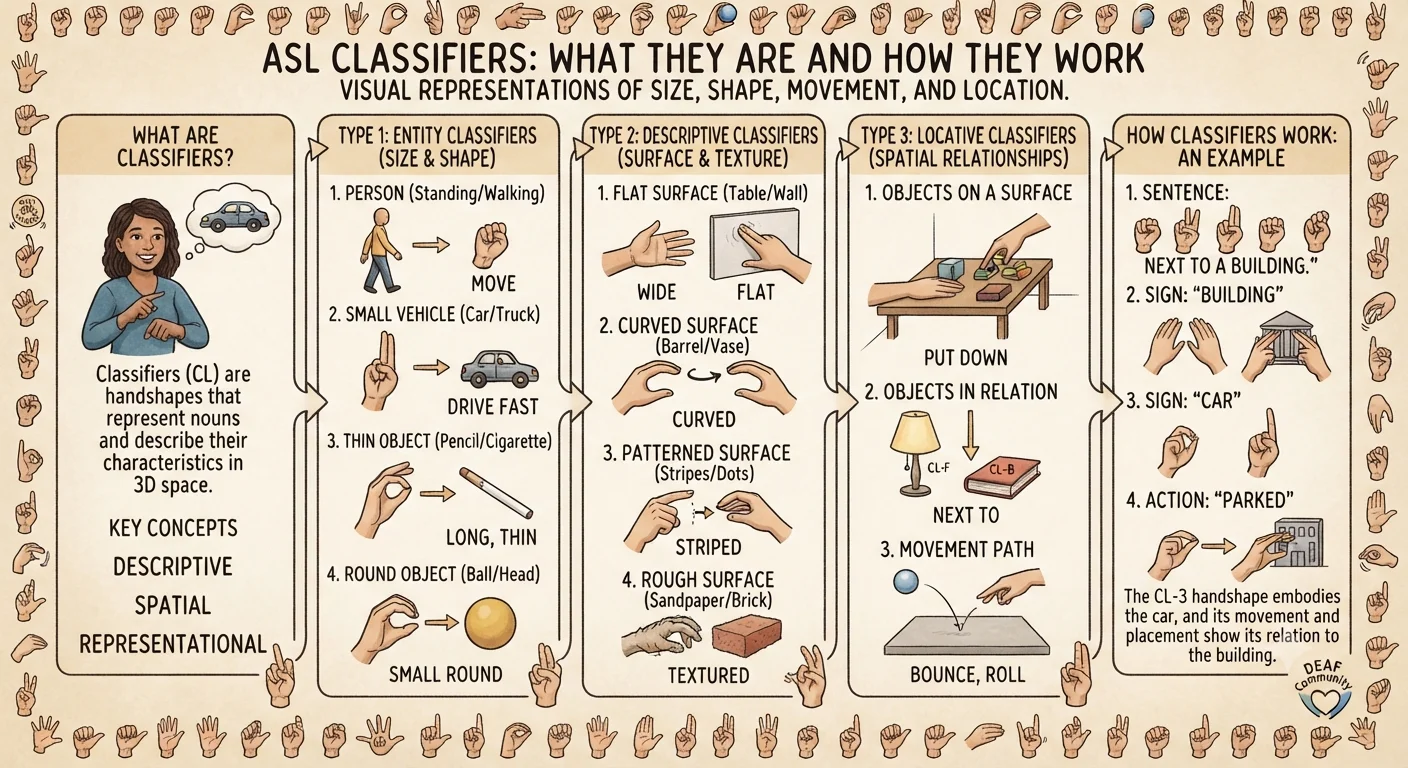
Learn what ASL classifiers are and how they work with this complete guide covering types of classifiers examples and why they make ASL uniquely expressive.
ASL classifiers are one of the most fascinating and distinctive grammatical features of American Sign Language allowing signers to convey complex visual spatial information about people objects and their relationships with remarkable precision and expressiveness. Understanding classifiers helps explain why ASL is so much more than a simple word for word signed translation of English and why fluent signers can describe complex visual scenes with extraordinary efficiency and detail.
What ASL Classifiers Are
A classifier in ASL is a handshape that represents a category or class of noun and can be moved through signing space to show how things are positioned how they move and how they relate to each other spatially. Rather than signing a specific noun repeatedly throughout a description a signer can use the appropriate classifier handshape to represent that category of object and then manipulate it in space to convey detailed information about location movement and spatial relationships.
Think of classifiers as visual pronouns that carry shape and spatial information along with their referential function. Once a noun has been established in a conversation or description its classifier can replace it throughout subsequent description much as a pronoun replaces a noun in spoken language but with the additional capacity to simultaneously convey visual and spatial information that spoken pronouns cannot carry.
Why Classifiers Make ASL Exceptionally Expressive
- What ASL Classifiers Are
- Why Classifiers Make ASL Exceptionally Expressive
- Major Categories of ASL Classifiers
- How Classifiers Function in Real Signing
- How Beginners Should Approach Learning Classifiers
- Common Mistakes Learners Make with Classifiers
- Why Understanding Classifiers Matters for Theatre and Performance
- Conclusion
- FAQ
- Are classifiers unique to ASL or do other sign languages also use them?
- When do ASL students typically begin formally learning classifiers?
- What is the most effective way to practice using classifiers?
Classifiers give ASL a capacity for precise visual spatial description that spoken languages can only approximate through extensive verbal elaboration. A skilled signer can describe a complex traffic accident a detailed landscape or a choreographed dance sequence using classifiers to show exactly how each element is positioned and how it moves relative to other elements in a way that would require many more words and take significantly more time to convey in spoken language description.
This expressive efficiency is one of the features that makes ASL particularly well suited to certain types of visual narrative and description and that contributes to the remarkably cinematic quality that skilled ASL storytellers and performers achieve when using classifiers to paint visual scenes in signing space.
Major Categories of ASL Classifiers
Linguists have identified several major categories of classifiers in ASL each serving different descriptive functions within the language. Semantic classifiers represent broad categories of nouns such as vehicles people or animals using handshapes that iconically suggest something about the shape or category of the referent being represented.
- Differences Between ASL BSL Auslan and Other Sign Languages
- Top ASL YouTube Channels for Learners in 2026
- ASL Emotions and Feelings Signs Complete Visual Dictionary
Size and shape specifiers are classifiers that convey specific information about the shape and size of objects allowing signers to describe the dimensions contours and physical characteristics of objects with precision that general category classifiers alone cannot provide. Instrumental classifiers represent the hand or tool being used to perform an action showing how something is held grasped or manipulated. Body classifiers use parts of the signer's own body to represent corresponding parts of another person or creature's body within a description.
How Classifiers Function in Real Signing
In natural signing classifiers are used fluidly and often rapidly in combination with each other and with lexical signs to create detailed and expressive descriptions. A signer describing someone walking down a street and entering a building might use a person classifier to show the walking figure approaching use a flat surface classifier to establish the ground plane use a vertical flat classifier to represent the building wall and then show the person classifier moving through a doorway indicated by two vertical classifiers positioned appropriately in signing space.
Recommended Articles
 SIGN LANGUAGE EDUCATION
 SIGN LANGUAGE EDUCATION
 SIGN LANGUAGE EDUCATION
 SIGN LANGUAGE EDUCATION
This sequence conveys detailed visual spatial information about the scene in a way that flows naturally in skilled signing but that beginners and students of ASL often find challenging to produce fluently since it requires simultaneously managing multiple elements of spatial grammar while also attending to facial expression and other grammatical features of the language.
How Beginners Should Approach Learning Classifiers
Classifiers are typically introduced in intermediate ASL instruction after beginners have established foundational vocabulary and basic grammatical understanding since they require a degree of spatial grammatical awareness that is difficult to develop without prior foundation in ASL's overall grammatical system. Beginning to notice classifiers in native signing even before formally studying them helps beginners start building intuitive understanding of how these handshapes function within natural signing.
When formally studying classifiers students benefit from extensive practice using classifiers to describe real visual scenes and objects rather than only studying them as abstract grammatical categories. The practical goal of classifiers is precise visual description so practicing actual description tasks using appropriate classifiers develops the functional skill much more effectively than grammatical memorization alone.
Common Mistakes Learners Make with Classifiers
One of the most common mistakes learners make with classifiers is choosing the wrong handshape for the category of noun being represented which can significantly change or confuse the meaning of a description. Learning which classifiers are appropriate for which categories of nouns requires exposure to many examples of native signing rather than simply memorizing lists of classifier handshapes without seeing them in authentic descriptive context.
Another common issue is inconsistent spatial placement where a learner establishes a classifier at one location in signing space and then inadvertently moves it or fails to return to the correct location when referencing the same object later in a description breaking the spatial consistency that makes classifier descriptions coherent and easy to follow.
Why Understanding Classifiers Matters for Theatre and Performance
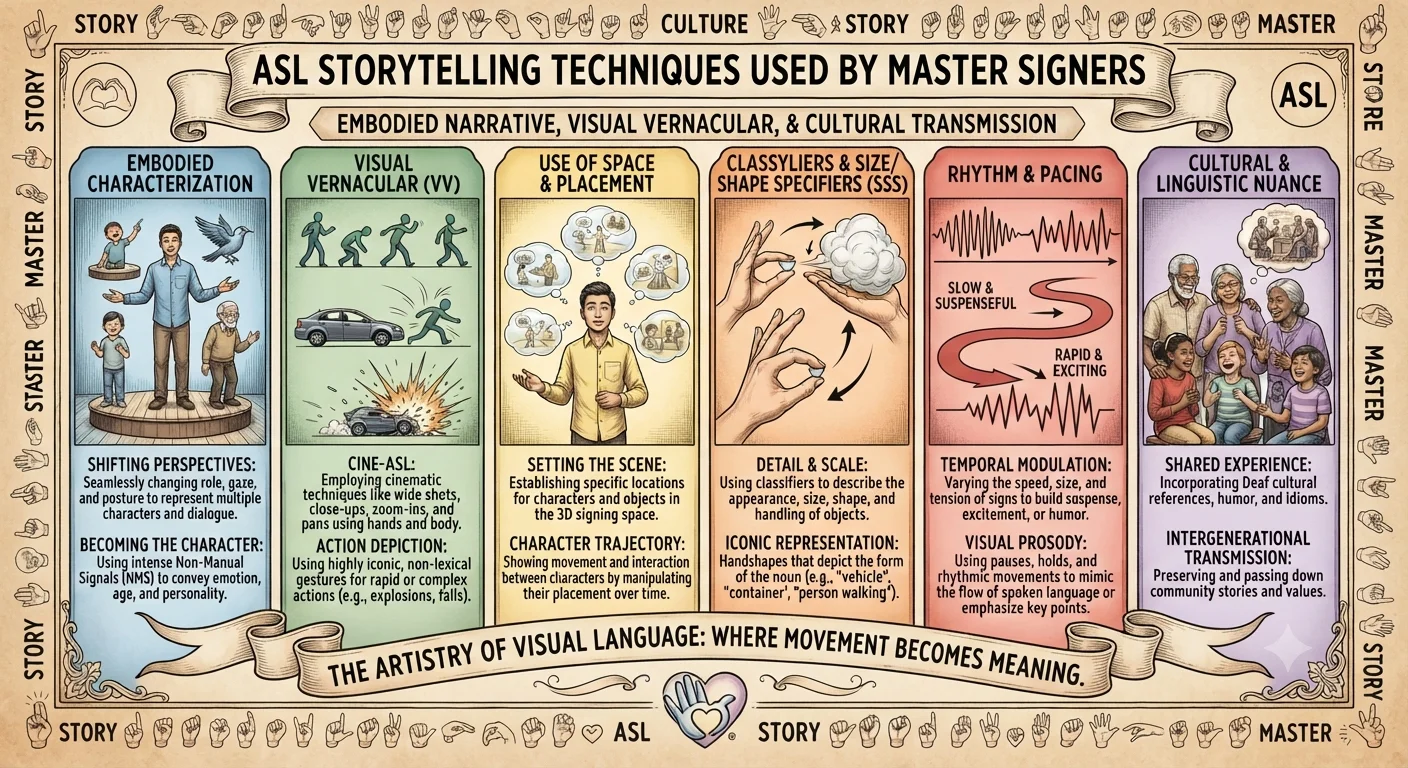
For anyone working in deaf theatre or ASL performance contexts understanding classifiers is particularly important since skilled ASL performers use classifiers extensively in visual storytelling visual vernacular performance and descriptive narrative to create the vivid visual imagery that makes ASL based performance so distinctive and powerful. Directors working with deaf performers and writers creating scripts for ASL performance need enough classifier knowledge to understand and work with this fundamental feature of the language as it functions in performance contexts.
Conclusion
ASL classifiers represent one of the most sophisticated and expressive features of American Sign Language giving skilled signers a capacity for precise visual spatial description that has no direct equivalent in spoken language. Understanding classifiers is essential for anyone pursuing genuine ASL fluency and provides important insight into what makes ASL such a remarkable and distinctive language capable of describing the visual world with extraordinary efficiency and expressive power.
FAQ
Are classifiers unique to ASL or do other sign languages also use them?
Classifiers are a feature of all natural sign languages not just ASL though the specific handshapes used as classifiers and the specific categories they represent can vary across different sign languages reflecting the independent grammatical development of each language.
When do ASL students typically begin formally learning classifiers?
Classifiers are typically introduced at the intermediate level after students have established foundational vocabulary and basic grammatical understanding since they require spatial grammatical awareness that is difficult to develop without this prior foundation in ASL's overall grammatical system.
What is the most effective way to practice using classifiers?
Practicing actual visual description tasks using appropriate classifiers to describe real objects scenes and spatial relationships develops functional classifier skill much more effectively than studying them as abstract grammatical categories without practical descriptive application.