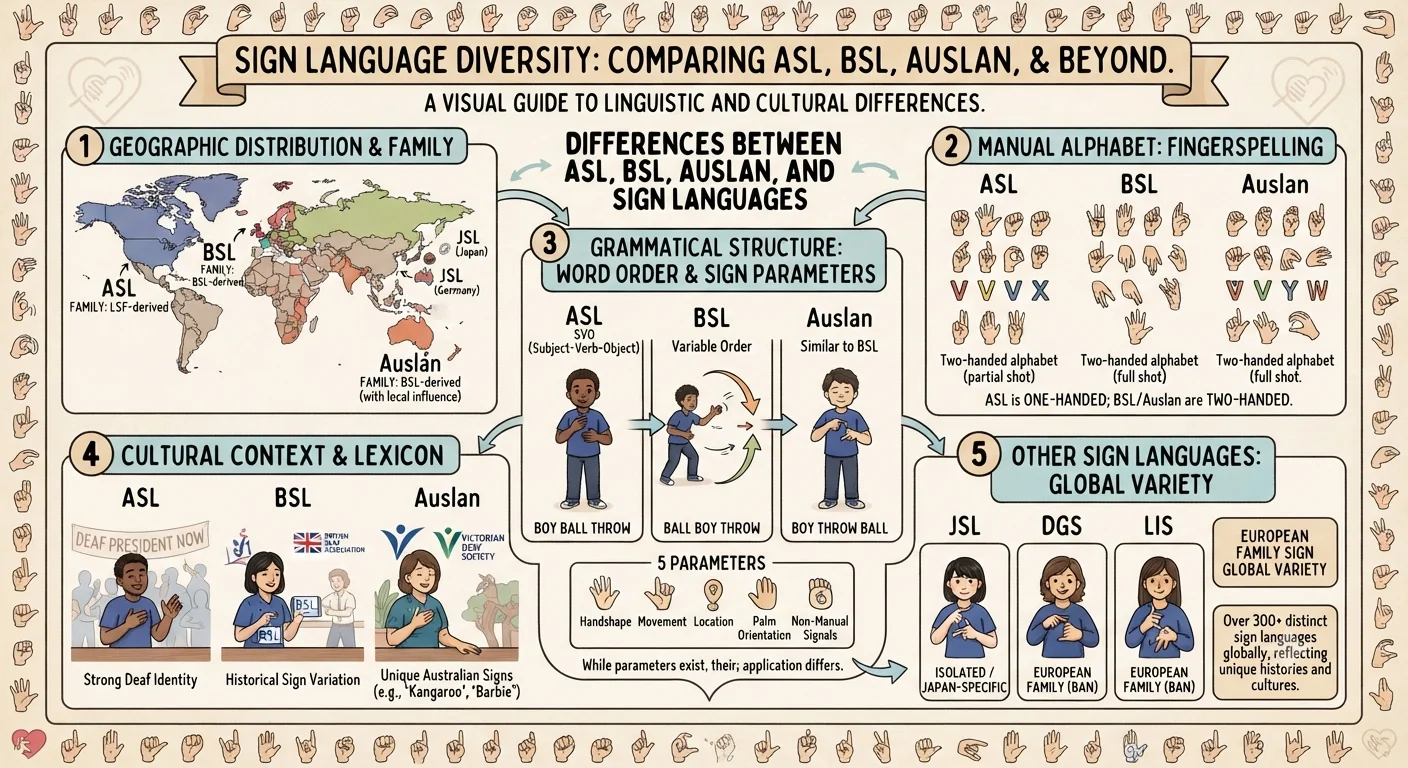
Explore the key differences between ASL BSL Auslan and other major sign languages covering grammar vocabulary fingerspelling and cultural context
American Sign Language British Sign Language and Auslan are three of the most widely studied sign languages in the English speaking world yet they are entirely distinct languages with different grammar vocabulary and cultural histories. Understanding the differences between these and other major sign languages helps explain why sign language is not universal and why each represents a complete and independent linguistic system.
Why Sign Languages Differ Between Countries
The fundamental reason ASL BSL Auslan and other sign languages differ so significantly is that each developed independently within its own deaf community rather than being derived from or based on the spoken language of the surrounding hearing population. Deaf communities in different countries created their own visual communication systems organically over generations producing languages with distinct grammatical structures vocabularies and cultural associations even when the surrounding hearing population shares the same spoken language.
This independent development explains one of the most commonly surprising facts about sign language for people new to the subject which is that ASL and BSL are mutually incomprehensible despite both being used primarily in English speaking countries while ASL actually shares more vocabulary and structural similarity with French Sign Language due to the historical influence of Laurent Clerc who brought French Sign Language to America in 1817.
American Sign Language Overview
- Why Sign Languages Differ Between Countries
- American Sign Language Overview
- British Sign Language Overview
- Auslan Overview
- Other Major Sign Languages Around the World
- Grammatical Differences Across Sign Languages
- International Sign as a Bridging Communication Tool
- Conclusion
- FAQ
- Can an ASL user and a BSL user understand each other?
- Why does ASL share more similarity with French Sign Language than British Sign Language?
- What is the difference between BSL and Auslan fingerspelling?
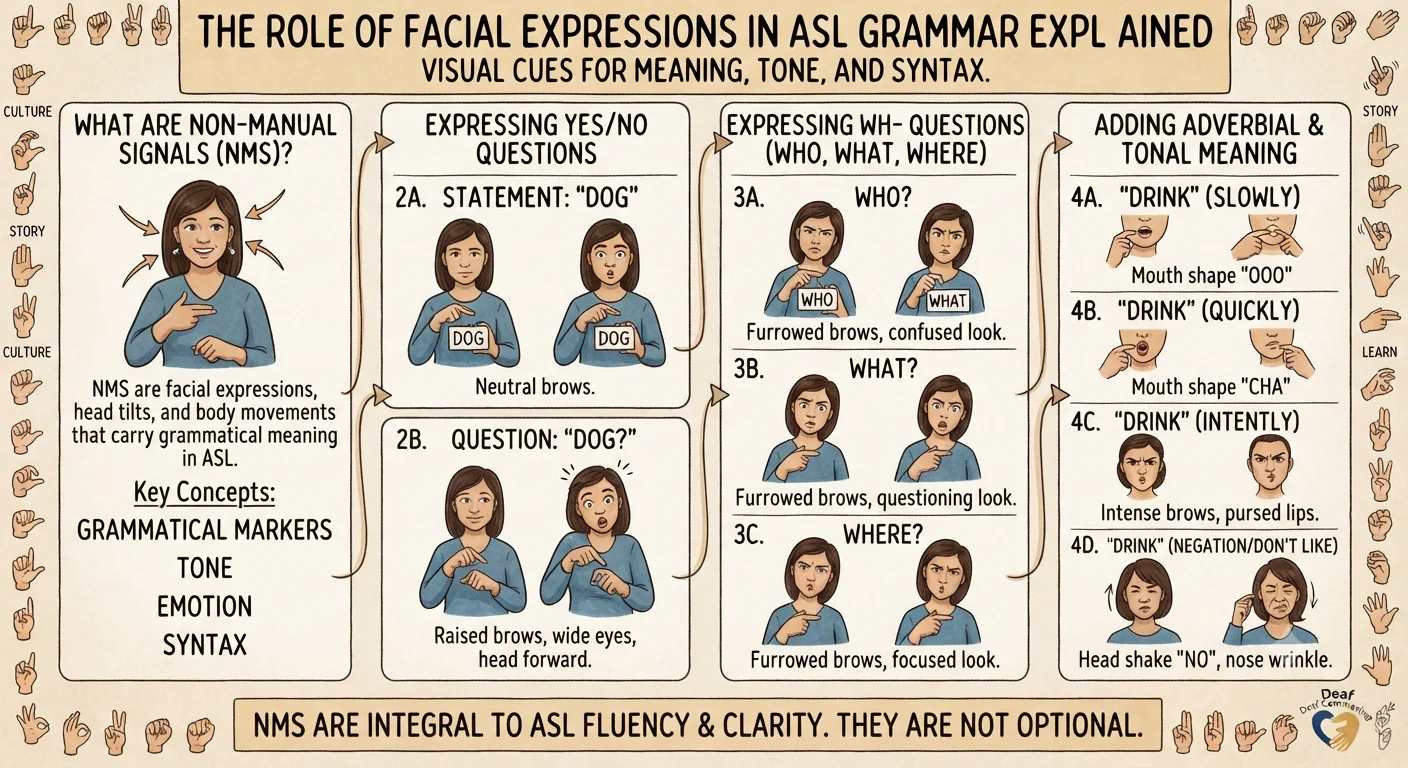
American Sign Language is used primarily in the United States and English speaking Canada and serves a deaf community of several hundred thousand people. ASL uses a one handed fingerspelling alphabet and has a grammatical structure that differs significantly from English including extensive use of spatial grammar facial expression markers and classifiers that have no direct English equivalents.
ASL developed from a blend of French Sign Language and various home sign systems used by early students at the American School for the Deaf in Hartford Connecticut giving it a distinct genealogical relationship to French Sign Language that sets it apart from British and Australian sign languages which developed along entirely separate historical pathways.
British Sign Language Overview
British Sign Language is used primarily in the United Kingdom and has its own completely distinct grammar vocabulary and cultural history that developed independently from ASL. One of the most immediately noticeable differences for those familiar with ASL is that BSL uses a two handed fingerspelling alphabet in which both hands work together to form letters while ASL uses only one hand for fingerspelling.
- Top ASL YouTube Channels for Learners in 2026
- ASL Emotions and Feelings Signs Complete Visual Dictionary
- How to Become a Sign Language Interpreter Career Guide
BSL has its own regional dialects with some variation in vocabulary and signing style across different parts of the United Kingdom similar to how regional accents and vocabulary variations exist in spoken British English. BSL was formally recognized as an official language of the United Kingdom in 2003 representing an important milestone for sign language recognition within British law and policy.
Auslan Overview
Auslan which stands for Australian Sign Language is used by the deaf community in Australia and shares significant historical connections with BSL since Australia's deaf education history was heavily influenced by British deaf education methods and educators during the colonial period. This historical connection means Auslan and BSL share more vocabulary and structural similarity with each other than either shares with ASL.
Recommended Articles
 SIGN LANGUAGE EDUCATION
 SIGN LANGUAGE EDUCATION
 SIGN LANGUAGE EDUCATION
 SIGN LANGUAGE EDUCATION
Like BSL Auslan uses a two handed fingerspelling alphabet reflecting its historical connections to British sign language tradition. Auslan has its own distinct vocabulary that has developed within the Australian deaf community over time including signs that reflect specifically Australian cultural references and experiences that differ from both British and American cultural contexts.
Other Major Sign Languages Around the World
Beyond ASL BSL and Auslan numerous other significant sign languages are used by deaf communities worldwide each with their own complete grammatical systems and cultural histories. French Sign Language which significantly influenced ASL's development is used in France and parts of Switzerland and Belgium. Japanese Sign Language serves Japan's significant deaf community with grammatical features shaped by Japanese cultural context.
Sign languages in many other countries including Germany Brazil South Africa and across Asia and the Middle East each represent complete and distinct linguistic systems that developed within their own national deaf communities rather than being derived from or closely related to the sign languages used in other countries.
Grammatical Differences Across Sign Languages
While all natural sign languages share certain features related to their visual spatial modality including use of signing space and facial expression the specific ways these features are employed grammatically differ significantly across different sign languages. Spatial grammar classifiers and nonmanual grammatical markers all function somewhat differently across ASL BSL Auslan and other sign languages creating genuine grammatical barriers to mutual comprehension even between sign languages that may appear superficially similar to outside observers.
International Sign as a Bridging Communication Tool
Because individual national sign languages are mutually incomprehensible an informal communication system called International Sign has developed particularly at international deaf events and gatherings. International Sign draws on vocabulary and gestures that tend to be more widely understood across different national sign language communities though it functions more as a practical bridging tool than as a complete language with the full grammatical complexity found in individual national sign languages.
Conclusion
ASL BSL Auslan and other sign languages around the world are entirely distinct languages each with their own grammar vocabulary and cultural history that developed independently within their respective deaf communities. Understanding these differences helps dismantle the common misconception that sign language is universal while also highlighting the remarkable linguistic diversity that deaf communities around the world have independently created through their own community language development over generations.
FAQ
Can an ASL user and a BSL user understand each other?
No ASL and BSL are mutually incomprehensible despite both being used in English speaking countries because they developed entirely independently and have different grammar vocabulary and fingerspelling systems.
Why does ASL share more similarity with French Sign Language than British Sign Language?
ASL developed partly from French Sign Language brought to America by Laurent Clerc in 1817 giving it historical linguistic connections to French Sign Language that are stronger than any connection to BSL which developed entirely separately.
What is the difference between BSL and Auslan fingerspelling?
Both BSL and Auslan use a two handed fingerspelling alphabet in which both hands work together to form letters while ASL uses a one handed fingerspelling alphabet reflecting their different historical origins and development.